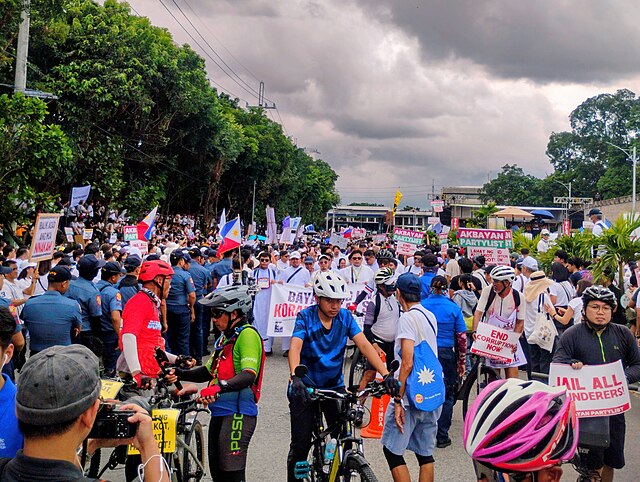
Thousands of protesters took to the streets of the Philippine capital on Sunday, November 30, 2025, demanding immediate accountability and jail time for scores of officials and contractors implicated in a sweeping multi-billion-peso corruption scandal involving fraudulent “ghost” flood-control projects.
Dubbed as the “Trillion Peso March,” the protest drew various groups and sectors to Manila’s Rizal Park and to EDSA.
While official estimates placed the crowd at fewer than 10,000, the protesters’ anger was palpable, fueled by months of mounting rage after recent powerful typhoons left entire towns submerged in floodwaters due to substandard or non-existent infrastructure.
Protesters who attempted to march toward Malacañan Palace were met with barbed wire, concrete barricades, and a heavy deployment of riot police.
Earlier in the day, demonstrators at Rizal Park carried a large effigy that merged the figures of President Ferdinand Marcos Jr. and Vice President Sara Duterte into a two-headed crocodile, a symbol of systemic corruption, which was later destroyed by some groups.
Leaders of the Catholic Church and civil society groups meanwhile intensified pressure on the Marcos administration to deliver on its promise of a thorough investigation.
“Prove that you will do this fully… and genuinely go after the corrupt whoever they may be,” said Cardinal Pablo Virgilio David, the outgoing president of the Catholic Bishops’ Conference of the Philippines (CBCP), challenging the President to be resolute in jailing those accountable, including relatives or senators.
The flood-control scandal, which President Marcos made a centerpiece of his national address in July, has implicated friend and foe alike, including a congressman cousin.
However, protesters voiced dissatisfaction with the pace of the investigation.
“It’s impossible that that corruption happened without the knowledge of the higher officials. (They) must be accountable too,” said Mervin Toquero of the National Council of Churches in the Philippines.
Other groups, like the Bagong Alyansang Makabayan (Bayan), openly called for the resignation of President Marcos and Vice President Duterte.
In response, the Palace stood firm against calls for resignation.
Communications Secretary Dave Gomez asserted that President Marcos Jr. would not be “distracted” by the protests.
“He will finish the job—the job that he began,” Gomez told reporters, reminding the public that it was the President who first “blew the whistle” on the anomalies.
He assured the public that the government respects the right to assemble and that more arrests are imminent.
“Before Christmas, more individuals, including the so-called ‘big fish,’ will be jailed,” Gomez promised, stressing the administration’s focus on solidifying evidence to ensure that “no one who stole from the nation will get away this time.”
The demonstration marks the second major anti-corruption protest in recent months, highlighting the public’s persistent frustration with the Philippines’ history of corruption scandals, where high-ranking politicians have frequently escaped serious jail time.
In addition to demanding accountability for the infrastructure fraud, protesters and faith leaders also called for crucial legislative reforms, including the passage of an anti-political dynasty bill and stronger budget transparency measures.