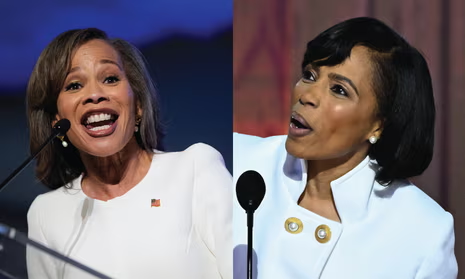

COLLEGE PARK, Maryland — Angela Alsobrooks won her Senate race here on Tuesday. With that victory, she achieved something never before seen in the 235-year history of the Senate: serving alongside another Black woman in the upper chamber.
“Now, it’s remarkable to think that in two years, America will celebrate its 250th birthday, and in all those years, there have been more than 2,000 people who have served in the United States Senate, and only three have looked like me,” Alsobrooks said on stage with several dozen supporters behind her with “Angela is my Senator” signs.
Maryland Gov. Wes Moore told a full crowd wearing the campaign’s signature yellow-green color that the state “understood the assignment” by sending Alsobrooks to the Senate.
“When I look at Angela, I don’t just see a great leader,” Moore said. “I see my daughter, I see my wife, I see my sisters. I see my mom. I see all of those who came before us.”
“I know right now they are smiling from ear to ear, and they are watching us from up high,” he continued.
The vibes were high in the ballroom at The Hotel in College Park with upbeat ’90s R&B playing in the background throughout the night but voters knew the night wasn’t over. Supporters said to each other they “weren’t done yet” and they needed to “elect the other woman,” Kamala Harris.
“[Alsobrooks’] win represents America beginning to see Black women as the strength that we are but I’m nervous,” said Symone Redwine, an attorney. “But I’m feeling nervous for [Harris]. I’m hanging in there but I also want to throw up in my mouth.”
Alsobrooks and Lisa Blunt Rochester followed what is now a familiar playbook that Kamala Harris established in her own presidential run: Don’t talk too much about history-making.
“It is good to make history, in some ways, because hopefully you knock down the door and somebody can see themselves in you,” Blunt Rochester told POLITICO in late September. “It can’t be the sole motivation.”
California Sen. Laphonza Butler, a longtime ally of Harris who decided to forgo a run herself for a full Senate term, said both newly minted senators’ decision not to lean too much into race and gender would be “sort of Captain Obvious.”
“The one thing that a Black woman does not have to do … is remind people that she’s Black,” Butler said.
“These are women who have been working their tails off for their states and their communities for decades,” she added. “That’s what is paramount in this election, and I’m not just talking about Angela or Lisa, the same is true, of course, for the vice president.”
The relationship between Harris, Butler and the two Senate-elects is one that is evolving. They all lean on each other for support.
Alsobrooks and Blunt Rochester’s relationship is the newest.
Despite being from neighboring states, their paths never crossed until they both ran for Senate this year. But they grew close quickly.
During Alsobrooks’ primary, Rep. David Trone, a wine and spirits magnate, attacked her credentials by saying she would need “training wheels” if elected to the Senate — a comment that drew fierce criticism from Black women, who hinted it smacked of a racialized attack.
“After Angela won her primary, I texted her, to remind her what an incredible campaigning [she] ran, you know, and I’m looking forward to hopefully being your sister senator-to-be,” Blunt Rochester said in an interview.
Blunt Rochester and Harris were both elected to Congress in the same year and got to know each other then, despite being in different chambers. Blunt Rochester hails from a well-connected family in Delaware and has been close to the Bidens for decades. It’s part of the reason President Joe Biden named her to his vice presidential search committee, which of course would eventually become Harris.
Alsobrooks refers to Harris as “a friend, mentor and role model,” including during her remarks at the Democratic National Convention this summer, revealing she was enamored by Harris’ career as a district attorney in San Francisco years ago. At the time, Harris was spearheading an innovative program known as “Back on Track,” which helped prisoners serving sentences for low-level crimes to receive skills training and access to apprenticeship programs to help them get jobs upon their release.
Two days after Alsobrooks won her contest to become State’s Attorney for Prince George’s County 14 years ago, she got a surprise cold call from Harris, who asked how she could help.
The two have remained close. About six weeks before the vice president ascended to the top of the Democratic presidential ticket, she appeared at a rally at a community center in Landover, Maryland marking National Gun Violence Awareness Day. “She will be an experienced leader on that issue when she is in the United States Senate, and that matters,” Harris told the crowd as she officially endorsed Alsobrooks’ campaign.
Other connections between the group are more subtle. A top staffer who worked with Butler when she headed Emily’s List, the powerful fundraising PAC that backs abortion-rights candidates, left the organization to work on Blunt Rochester’s Senate campaign.
And during the Congressional Black Caucus Foundation’s Annual Legislative Conference in September, the Delaware congresswoman sat in between Butler and Alsobrooks for a panel about how Black women belong in the Senate.
Alsobrooks vowed that together, she and Blunt Rochester “would be quite bold” as senators — “there’s no reason for us to hold back.” She suggested they may work on a bill focusing on improving maternal mortality rates, which disproportionately impacts Black women.
During that same discussion, Butler, who was sworn into office last October to take the late Sen. Dianne Feinstein’s seat and became the only Black woman in the Senate, found it jarring at times to suddenly be“the only one in the room.”
“When you’re in the room, as the only, you go in there as the voice of millions,” Butler said. “I’m so excited that we are about to move beyond the acceptance of having just one, we’re going to be bold enough to send two.”