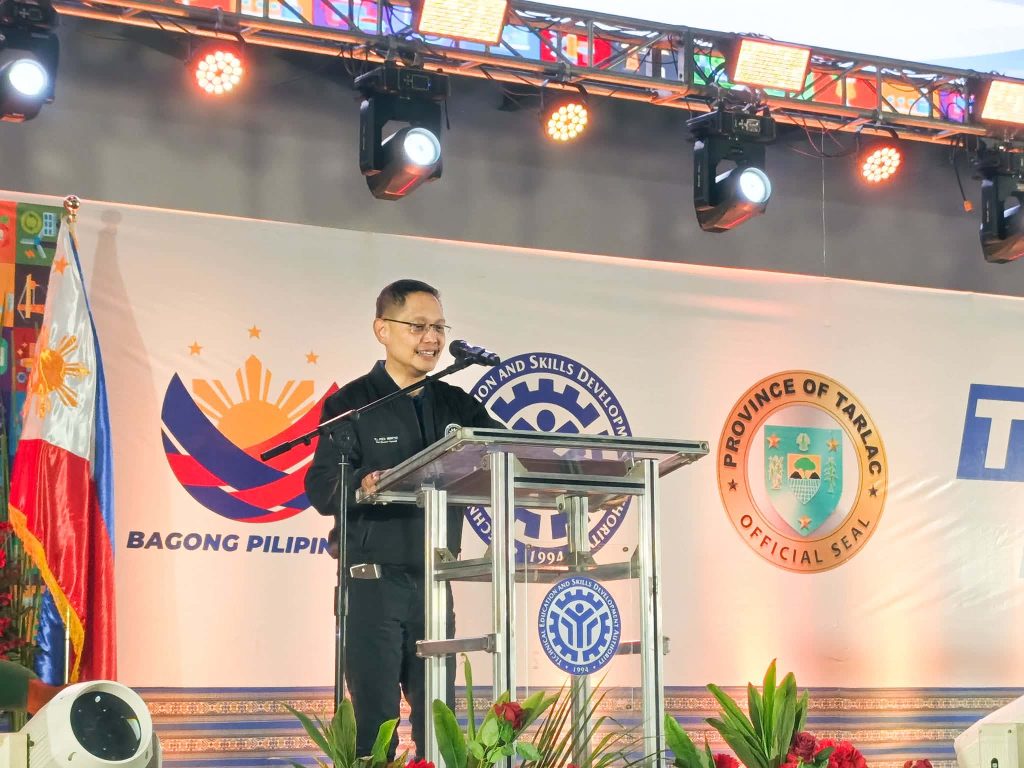

(Photo courtesy of PIA)
TARLAC CITY, Philippines — The Technical Education and Skills Development Authority (TESDA) has launched the Train Localized Opportunities for Knowledge Access and Lifelong Learning (LOKAL) program to help local government units (LGUs) develop skills training initiatives aligned with local industry demands and employment opportunities.
During the national launch in Tarlac on November 19, TESDA Secretary and Director General Kiko Benitez emphasized the importance of empowering local governments to identify workforce requirements and implement training programs suited to their communities.
“Train LOKAL is about making skills training more responsive to the needs of every community. When local governments take the lead in identifying the skills their people need, we can create better pathways to employment, livelihood, and local growth,” Benitez said.
He said the initiative supports President Ferdinand Marcos Jr.’s administration in expanding access to quality technical-vocational education and training (TVET) while promoting inclusive economic growth.
“Sa pamamagitan po ng pagpapalawak sa aming mga partnership, hopefully mas marami pa kaming matutulungan at ang atin pong workforce development planning ay mainstitutionalize,” Benitez added.
The launch highlighted the Tarlac Center for Learning and Skills Success as an example of a successful LGU-led skills development initiative.
Tarlac Governor Christian Yap described the program as an important component of the province’s poverty reduction strategy, emphasizing the need to connect training opportunities with actual labor market demands.
“At the Provincial Government of Tarlac, we believe the best service the government can do for its people is to provide opportunities for economic productivity that ultimately uplift the quality of life of Tarlaqueños and their loved ones,” Yap said.
“The formula is simple: our government proactively assesses community and investment needs, trains the underprivileged, certifies them, and links such workforce to the labor market,” he added.
Benitez also outlined TESDA’s nationwide training targets, noting that the country’s TVET system, composed of public and private training institutions, aims to train approximately 1.6 million to 1.8 million individuals annually.
For 2026, TESDA is targeting 630,000 trainees through government-funded programs.
“Sa taon na ito, dahil din po sa budget na ibinigay sa atin ng pangulo, tayo po ay nagtatarget na makapagtrain ng 630,000 Filipinos budgeted by TESDA,” Benitez said.
The remaining training target is expected to be met through walk-in applicants seeking national certification and improved employment opportunities.
Under Train LOKAL, local governments are encouraged to take a more active role in planning, financing and implementing technical-vocational training programs.
TESDA, meanwhile, will provide technical assistance, capacity-building support, competency standards, assessment and certification services, and quality assurance to participating LGUs.
The launch, themed “A National Commitment to LGU-Led Skills Development,” featured a Challenge to Lead activity, where local chief executives, government representatives and private-sector partners pledged support for locally driven workforce development.
Seven LGU technical assistance desks were also established during the event to guide participating local governments on training program planning, implementation, registration, assessment center accreditation and other TESDA services.
Through the initiative, TESDA aims to strengthen cooperation with local governments and industry partners, ensuring that training programs respond to actual workforce needs while creating more employment and livelihood opportunities for Filipinos.
Courtesy: Philippine Information Agency (PIA) / Technical Education and Skills Development Authority (TESDA)