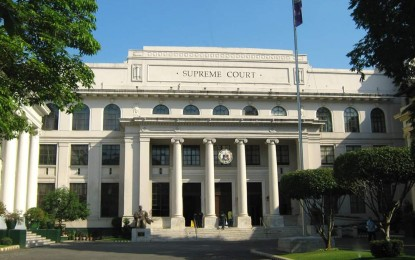

As of Sept. 30, 2024, the Supreme Court (SC) had disposed of 4,294 cases, with a clearance rate of 87 percent and a disposition rate of 22 percent.
The clearance rate shows how many cases are resolved compared to the number of new cases filed; while the disposition rate is the percentage of cases determined by the SC out of all existing cases.
Here’s a look at some of the high tribunal’s significance in 2024.
Right to life, liberty, and security
In Deduro v. Vinoya, the SC declared that red-tagging, vilification, labeling, and guilt by association threaten a person’s right to life, liberty, or security, which entitles one to protection under the writ of amparo.
The writ of amparo has also protected abducted environmental advocates, as in the case of Castro v. Dela Cruz, where the SC found elements of enforced disappearance.
However, in Roque v. House of Representatives Quad-Committee, the SC turned down former presidential spokesperson Harry Roque Jr.’s prayer for the writ of amparo, holding that it is not the proper remedy against congressional contempt and detention orders.
The SC clarified that the scope of Amparo is limited to extralegal killings and enforced disappearances or such threats, which were not present in his case.
In another case, Besmonte v. Napolcom-NCR (National Police Commission-National Capital Region), the SC found a police officer guilty of simple misconduct for using unnecessary force and violence during a buy-bust.
It issued a reminder that it does not condone the indiscriminate use of force by police officers against persons under arrest.
The SC also ruled in Ridon v. People that simply violating ordinances and regulations is not enough to justify a valid warrantless search and seizure, mainly when the penalty does not involve imprisonment.
In People v. Agustin and Antonio, the SC ruled that imprisonment beyond the maximum penalty is not only cruel and inhumane but also undermines the dignity of detainees.
The SC stressed that the court’s power to commit prisoners carries with it the duty to immediately release them in case of detention for a period equivalent to or longer than the maximum imposable penalty.
Due process
To ensure fair prosecution, the SC ensures strict observation of due process.
In People v. Valencia, the SC determined that even minor changes in the receipts documenting the transfer of seized drugs can undermine the integrity of the chain of custody in drug cases.
In Guinto v. DOJ (Department of Justice), the SC clarified that the 2019 Implementing Rules and Regulations of Republic Act No. (RA) 10592, or the New Good Conduct Time Allowance law, cannot exclude persons convicted of heinous crimes, repeat offenders, habitual delinquents, and escapees from the law’s benefits.
Meanwhile, the SC granted the DOJ’s request to move the venue of two criminal cases against religious leader Apollo Quiboloy from the Regional Trial Court (RTC) of Davao City to Quezon City.
Free speech
In ABS-CBN Corporation v. Ampatuan Jr., the SC established the limits of free speech for participants in legal proceedings and clarified the guidelines for imposing the subsequent punishment of indirect contempt.
It cautioned that while courts’ contempt powers can limit the speech of the media and the public, they should not be broadly used to prevent the press from reporting on important public matters.
The SC also recognized social media speech as a fourth type of regulated speech, acknowledging the influence of fake news online on public trust in the Judiciary and its application of justice.
Regarding the statements made by former Duterte administration official Lorraine Marie Badoy, the SC emphasized the importance of balancing free speech with the protection of judicial independence. It found that certain social media posts attacking a judge were contemptuous.
While the SC ruled that expressing criticism of a court’s decision in a pending case, when done in good faith, may be permitted, it made clear that accusing a judge of improper motives and trying to rally public support to pressure that judge is not acceptable.
In Labargan v. People, the SC ruled that statements against public officers do not amount to oral defamation or slander when these concern their discharge of official duties unless they are made maliciously.
The SC recognizes that the right to free speech empowers citizens to hold public officers accountable, as public office is considered a public trust.
Right to privacy
In IBP (Integrated Bar of the Philippines) v. Purisima and Jacinto-Henares, the SC upheld the right to privacy of professionals and their clients, invalidating a regulation from the Bureau of Internal Revenue that required self-employed professionals to submit their rates and register appointment books to monitor their tax compliance.
In People v. Rodriguez, the SC reiterated that using online chat logs and videos as evidence does not violate the right to privacy to assess if a crime has been committed.
RA No. 10173, or the Data Privacy Act, permits the processing of sensitive personal information to determine a person’s criminal liability and protect individuals’ rights and interests in court proceedings.
In Tria v. People, the SC upheld the conviction of an accused of robbery for demanding money from his ex-girlfriend in exchange for deleting her nude photos posted on Facebook.
Right to suffrage
The SC ruled in National Press Club v. Comelec that the Commission on Elections may be compelled, via writ of mandamus, to allow the witnessing of ballot printing and disclose the complete transmission diagram and data/communications network architecture of vote counting machines (VCMs).
The SC, however, clarified in Rio v. Comelec that the election body cannot be forced to either grant or deny requests for a ballot recount as this requires the exercise of Comelec’s discretion or judgment. This ministerial duty cannot be the subject of a writ of mandamus.
In Smartmatic v. Comelec, the SC reversed the poll body’s resolutions disqualifying Smartmatic TIM Corporation and Smartmatic Philippines, Inc. from participating in public election bidding.
However, the SC recognized that requiring Comelec to conduct another round of public bidding would seriously disrupt its preparations for the 2025 elections; thus, the ruling would apply prospectively or to future events or cases.
In Macalino v. COA (Commission on Audit), the SC ruled that the Constitutional prohibition on appointing individuals to government positions within one year after an election applies to all losing candidates regardless of the position they seek or the place or jurisdiction of the office to which they are appointed.
For the Sinsuat v. Ebrahim case, the SC emphasized that the creation of new municipalities must be approved or ratified in a plebiscite by a majority vote of qualified voters from both the newly created municipalities and the original parent municipalities.
Limiting the plebiscite to only those residing in the newly formed municipalities denies the voting rights of individuals from the original parent municipalities.
In Duterte Youth v. Comelec, the SC held that the deadlines for substituting party-list candidates remain in effect even after the elections.
The SC emphasized the importance of the timing for nominee substitutions, as it directly affects voters’ right to know the identities of the nominees from party lists. This knowledge allows voters to make informed and intelligent choices on election day.
Right to autonomy and self-determination
In Province of Sulu v. Executive Secretary, the SC upheld the validity of RA 11054 or the Organic Law for the BARMM (Bangsamoro Autonomous Region in Muslim Mindanao) but declared the province not part of the region after the province rejected the law’s ratification.
Access to justice
In De Guzman-Lara v. Comelec and Mamba, the SC pointed out that since technological advances now permit electronic filing, filings by email may be made even beyond office hours as long as they are completed within the same day.
Inclusivity
The SC also reminded a judge and a prosecutor in Yokogawa-Tan v. Tan to use gender-fair language in the courtroom, consistent with promoting gender equality in the Judiciary.
In People v. ZZZ (G.R. No. 266706), the SC ruled that in instances of rape committed through force, threat, or intimidation, there is no requirement to prove that the victim resisted.
The SC clarified that previous decisions stating that a woman cannot claim to be a rape victim unless she fought back are inconsistent with the current legal framework.
These earlier pronouncements often reinforce misguided stereotypes that contribute to gender bias and insensitivity. Recognizing and respecting women’s rights to autonomy and bodily integrity is essential.
In People v. Bragais and Tacuyo, the SC highlighted that a person’s ability to testify as a witness depends on their capacity to relay their knowledge, regardless of any intellectual disability. If their testimony is clear and understandable, it can be accepted.
Separation of powers
In An Waray v. Comelec, the SC upheld the Comelec resolutions, canceling An Waray’s registration as a party-list organization.
The SC held that under both the Constitution and the Party-List System Act, Comelec has exclusive jurisdiction to rule on the cancellation of party-list registrations.
In Magsasaka Party-List v. Comelec and Villamin, the SC ruled that party-list organizations must be allowed to interpret their own internal rules on how to remove their officials, declaring that Soliman Villamin Jr. was validly removed from his position as the group’s national chairperson.
The SC also affirmed in FEJODAP v. Manila City the Metropolitan Manila Development Authority’s exclusive power to enforce traffic laws, rules, and regulations against local governments in the NCR.
In MWSS v. Bulacan, the SC affirmed that the Metropolitan Waterworks and Sewerage System is not required to share its proceeds from using the Angat Dam with the Bulacan government.
Social welfare
In XXX v. People (G.R. No. 252739), the SC ruled that in determining whether marital infidelity caused psychological violence under RA 9262 or the Anti-Violence Against Women and Their Children Act, criminal intent is presumed in acts of marital infidelity.
Protecting children’s welfare, the SC in CICL XXX v. People set guidelines to streamline the process for determining discernment in crimes involving children in conflict with the law, recognizing there is a different standard in determining a minor’s culpability for crimes.
In Dela Cruz v. Lanuza, Jr. the SC ruled that decades-long unjustified absence from the marital home may be evidence of a spouse’s psychological incapacity to comply with matrimonial obligations.
Labor
The SC also ruled that it is illegal to dismiss an employee solely for testing positive for HIV (human immunodeficiency virus), declaring such termination discriminatory.
It is likewise illegal for a school to suspend its unmarried teacher for pregnancy, as in the Bohol Wisdom School et al. v. Mabao case.
The SC invalidated several quit claims after discovering that the employer tricked its workers into signing them.
Additionally, it emphasized that compromise agreements and settlements between employers and employees that provide excessively low amounts to employees are invalid.
In Bartolome v. Toyota, the SC ruled that demotion, verbal abuse, and indifferent behavior by an employer that forces an employee to resign constitute constructive illegal dismissal.
It held that the standard for constructive dismissal is whether a reasonable person in the employee’s position would have felt forced to give up their employment under the circumstances.
Habitual negligence, however, is a ground for dismissal, as held by the SC. The court emphasized that under Article 297(b) of the Labor Code, employers may terminate employees for gross and habitual neglect of duties, including carelessness and inefficiency in their tasks.
Cleansing the Bench and the Bar
The court also made several administrative rulings against court officials, employees and lawyers.
In one case, the SC dismissed three Court of Appeals employees for testing positive for shabu for the second time.
In another, the SC dismissed a judge for gross misconduct after finding messages on his laptop asking for bribes from lawyers and litigants in exchange for favorable rulings in cases before him.
The SC ordered the preventive suspension of a Pasay City judge and an acting branch Clerk of Court to ensure a thorough and uninterrupted formal investigation. In contrast, another judge was dismissed for falsification of official documents and serious dishonesty for making false certifications and misappropriating her staff’s salaries.
The SC dismissed a judge for manipulating the procurement of medical supplies for the City of Manila, emphasizing that judges must follow the highest standards of conduct and avoid any behavior that could seem improper.
The SC disbarred a lawyer for grossly immoral conduct for engaging in extramarital affairs with at least three women, entering into a bigamous marriage, and sexually harassing his staff.
It also found a private lawyer guilty of simple misconduct for committing impropriety when he sponsored the trips of IBP-Central Luzon officers. (PNA)