
(Photo: Anadolu)
A group of international researchers said climate change likely played a destabilizing role in last month’s deadly flash floods and mudslides along the Nepal-China border, though it was not the sole cause of the disaster.
In a report released Thursday, World Weather Attribution said the event resulted from a combination of geological conditions and climate-related factors.
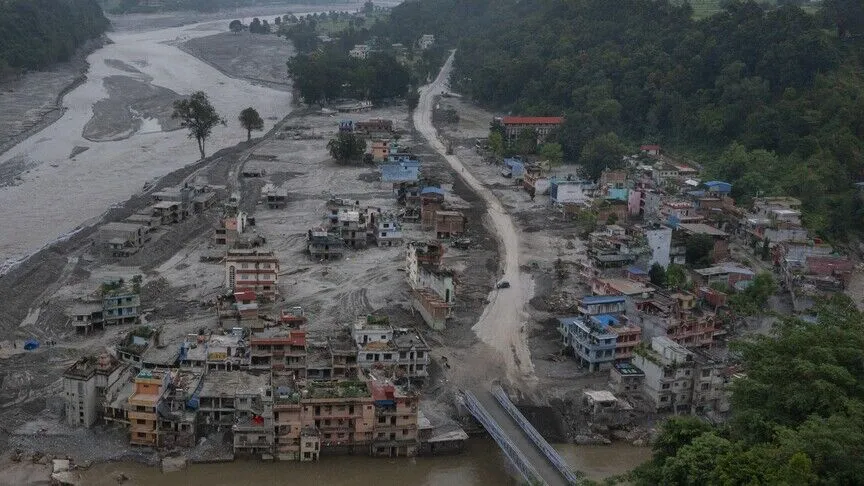
The researchers said the Aug. 26 disaster began when part of a glacier on Nepal’s Mount Langtang Lirung fractured at an altitude of about 5,200 meters, triggering an ice-and-rock avalanche that developed into a massive debris flow.
The floods and mudslides devastated parts of Rasuwa, Nuwakot, Dhading and Kavre districts, as well as the Kathmandu Valley, and also buried the Gyirong border crossing in Xizang.
According to the report, the glacier may already have been weakened by the magnitude 7.8 earthquake that struck Nepal in 2015.
Researchers said rising temperatures, permafrost degradation, glacier thinning and retreat, increased rainfall and unusually warm conditions likely contributed to the eventual collapse.
“Climate change is thus best understood as a destabilising factor acting on a pre-existing geological predisposition, rather than the fundamental cause of the failure,” the report said.
The study also found that existing early warning and adaptation systems were unlikely to have provided enough lead time to prevent the scale of the disaster, highlighting the limits of current risk-reduction measures in high-mountain environments.
The researchers called for stronger monitoring of Himalayan hazards, better earth observation, improved risk communication and greater cross-border data sharing.
They also urged faster reductions in fossil fuel emissions and stronger climate-finance support to reduce future risks in vulnerable mountain regions.