
(Photo courtesy of Bacolod City Communications Office)
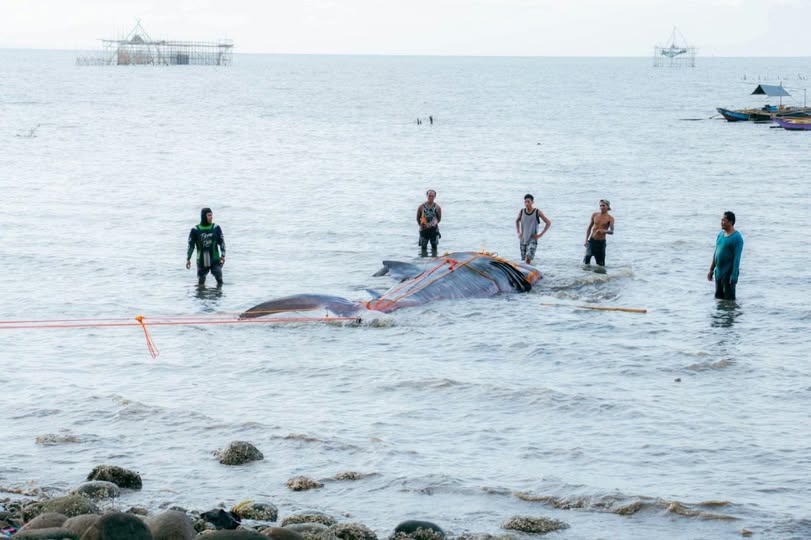
BACOLOD CITY — The Bacolod City government and the Department of Agriculture-Bureau of Fisheries and Aquatic Resources (DA-BFAR) have called for stronger marine conservation efforts following the death of a three-ton whale shark that became stranded in shallow waters on October 30.
Mayor Greg Gasataya said a multi-agency response team was immediately activated to handle the incident, with authorities recovering and burying the animal’s carcass at the city’s sanitary landfill in Barangay Felisa on the same day.
“Although this is part of nature, we hope this is the last time our city gets to witness such a sad incident,” Gasataya said in a social media post over the weekend.
The city government and DA-BFAR reminded residents that whale sharks, locally known as butanding, are protected marine animals that pose no danger to humans.
These gentle giants primarily feed on plankton and small fish and must not be harassed, injured, captured or harvested.
“Local communities are encouraged to immediately report any stranded marine wildlife to city authorities for prompt response,” the agencies said.
An on-site assessment conducted by the City Agriculture Office and DA-BFAR found no evidence of injuries caused by human activity or abuse.
However, the whale shark sustained minor scrapes on its head and body, which authorities attributed to its attempts to escape after becoming disoriented and trapped upside down in shallow waters as the tide receded.
“Only minor scrapes seen on the animal’s head and body which came from its desperate attempts to free itself after it became disoriented and trapped upside-down in shallow waters as the tide receded,” the assessment team said in its report.
City Agriculturist Maricar Quiro said the whale shark may have entered the shallow coastal area while feeding on plankton and small fish before becoming stranded.
“The cause of death is undetermined,” Quiro said.
According to the city government’s report, local fishermen discovered the whale shark at around 5 a.m. on October 30.
The animal was reportedly familiar to fishermen in the area, who had previously observed it swimming alongside their boats.
The incident has prompted renewed calls for public awareness and stronger protection of marine wildlife, particularly in coastal communities where endangered species are occasionally encountered.
The DA-BFAR said the Philippines is home to the world’s second-largest population of whale sharks, making the country an important area for the conservation of the species.
Whale sharks are recognized as the largest living fish species and are classified as endangered by the International Union for Conservation of Nature (IUCN).
Under Section 102 of Republic Act 10654, which amended the Philippine Fisheries Code, the capture and collection of protected aquatic species, including whale sharks, are prohibited.
Authorities emphasized the importance of enforcing fisheries laws, preserving marine habitats and strengthening cooperation among government agencies, fishing communities and conservation groups.
The city government and DA-BFAR urged the public to immediately report sightings of stranded or distressed marine animals so trained personnel can conduct proper assessments and respond without delay.

