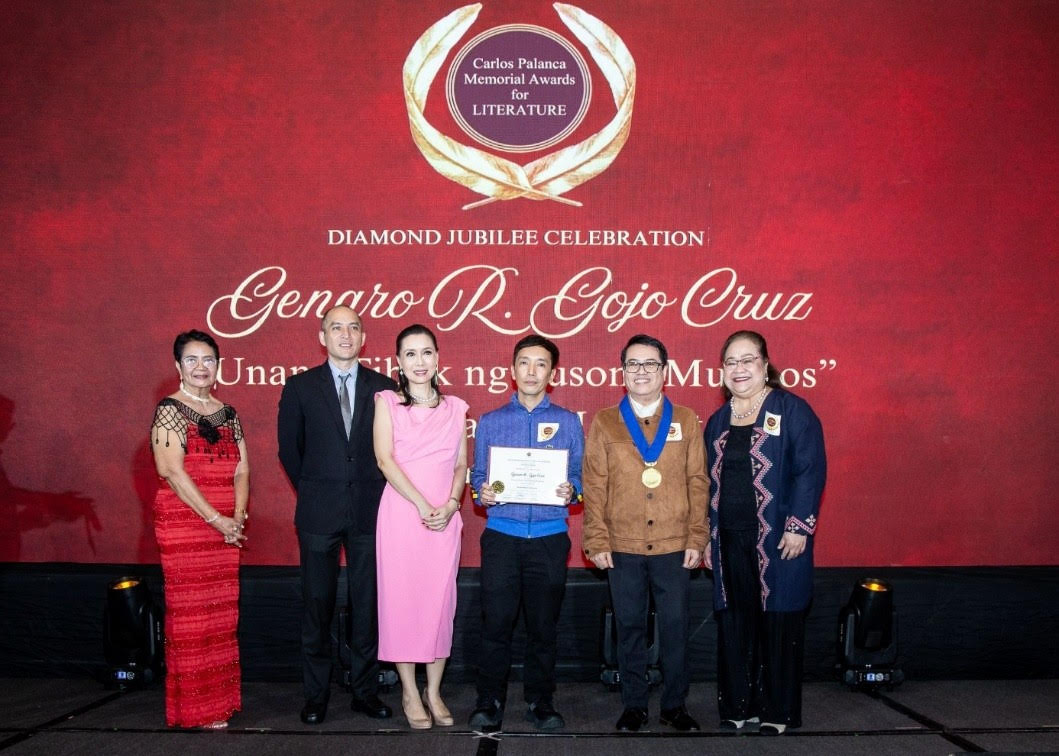

Genaro R. Gojo Cruz scores two wins, Second Prizes in Maikling Kuwentong Pambata and Tula Para sa mga Bata at this year’s Palanca Awards Diamond Jubilee.
The first time a child saw him in person, the reaction came out unfiltered and unforgettable. “Buhay ka pa pala, Sir.” Genaro R. Gojo Cruz—known to students and young readers as Sir Gene—bursts into laughter every time he retells it. For many children, writers exist only as names printed on book covers, distant and almost fictional, sometimes assumed to belong to another era altogether.
Sir Gene, however, is very much here, very much writing, and still deeply invested in the inner lives of Filipino children. Twenty-five years into a career dedicated to children’s literature, that devotion was affirmed anew when he earned two Palanca Awards in a single year, both Second Prize distinctions in Maikling Kuwentong Pambata and Tula Para sa mga Bata.
When the Palanca notifications arrived, his thoughts did not race toward trophies or validation. What crossed his mind first was relief. “Ang una pumasok sa isip ko, buti sinali ko.” Submitting an entry is never a simple act. It involves paperwork, notarizations, deadlines squeezed between teaching duties and meetings, and the daily exhaustion that makes postponement tempting.
Any one of those hurdles could have been reason enough to delay. Instead, he pressed on. The result was not a sudden peak but a quiet affirmation that years of writing for an often-underrated audience had mattered.

One of his winning works, Problema Ko Si Nanay, carries a title that feels light, almost playful. The story itself is anything but shallow. It follows a child whose mother is a teacher, a situation that outsiders might view as an advantage. For the child, it becomes a series of silent constraints. There is no anonymity in class, no allowance for noise or mistakes, no escaping expectations that follow him everywhere. When your mother is a teacher, your behavior is never just your own.
Sir Gene wanted to give voice to that unspoken reality, to the small losses children endure when parental love must be shared with lesson plans, classrooms, and other students. The story does not accuse or lecture. It simply listens, allowing young readers to recognize feelings they may have never articulated.
His other award-winning work, the poetry collection Unang Tibok ng Pusong Musmos, turns its attention to beginnings. Not romantic love, but the first attachments that shape a child’s emotional world. In these poems, first love might be a plant carefully watered, a loyal pet, a favorite toy, a trusted playmate, or a fleeting moment that lingers longer than expected.
Sir Gene treats these early affections with seriousness and care, recognizing them as formative experiences that teach children how to feel, remember, and value. Each poem captures that first quickening of the heart, when emotion is new, confusing, and deeply sincere.
Writing for children, Sir Gene insists, begins with respect. Young readers should never be underestimated. When writers assume children are incapable of nuance, stories become heavy-handed and overly explanatory. He believes in restraint, in leaving space for discovery, in trusting children to make connections on their own. A story should not feel like a lesson sheet. Meaning, he believes, is more powerful when it is found rather than handed down.
Finding the right voice was one of his earliest challenges. A children’s story, he says, should never sound like a lecture or a college classroom. It must sound like a child could have said it. To achieve this, he listens closely to how children speak and think, observes their rhythms, and reads widely within children’s literature. His preparation is meticulous.
If a story involves pigeons, he studies their habits, care, and quirks. Writing for children, to him, is not about simplifying the world. It is about understanding it well enough to present it honestly.
In an age dominated by screens and endless scrolling, Sir Gene rejects the idea that children’s books are losing relevance. A good book, he argues, offers something no gadget can replace. Stories rooted in Filipino life strengthen language, culture, and identity. They sharpen imagination and emotion while anchoring children in their own history and environment.
Only Filipino writers can truly capture Filipino childhood—the streets and games, the food, the fears, and the small, everyday joys. Foreign media may entertain, but local stories allow children to see themselves and believe that their lives are worth telling.
That belief has kept him steady. Having won the Palanca before, he describes his first award as acceptance, the next as proof, and every recognition after as a reminder to continue. The greatest challenge of being a writer, he says, is not winning but persisting. What is a single victory worth if the work ends there? Awards may encourage, but they are never the destination. The real responsibility is to keep writing, with or without recognition, and to keep telling children’s stories with honesty and care.
Among his many books, one stands out without hesitation. Ako ay May Tite. The work opens conversations many adults avoid, offering clear, respectful language for children to understand their bodies. It gives classrooms and families the words they often struggle to find, honest and age-appropriate. As both teacher and writer, Sir Gene often tests his drafts with children, reading aloud and watching closely where attention sharpens or drifts. Their reactions guide revisions more than any theory.
That candid remark from a student—“Buhay ka pa pala, Sir”—still stays with him. It is funny, but also revealing. It reminds him that the stories children love come from real people who sit at desks, revise sentences, make mistakes, and care deeply about their readers. His aim has always been to tell the truth, invite courage, and keep children connected to the living hands that write for them.
His message to young readers is simple. Read local books. In Filipino children’s stories, you are the main character. Seeing yourself on the page builds confidence and deepens your sense of being Filipino. To those who dream of writing for children, his advice is just as direct.
Read children’s books. Technique can be learned, voices can be studied, traditions can be adapted. In the end, reading teaches writing.
After twenty-five years, countless titles, and two Palanca wins in a single year, Sir Gene continues to write with childhood intact—curious, brave, and open to firsts. In a digital age crowded with noise, that steady insistence that children’s stories matter may be exactly what this generation needs.