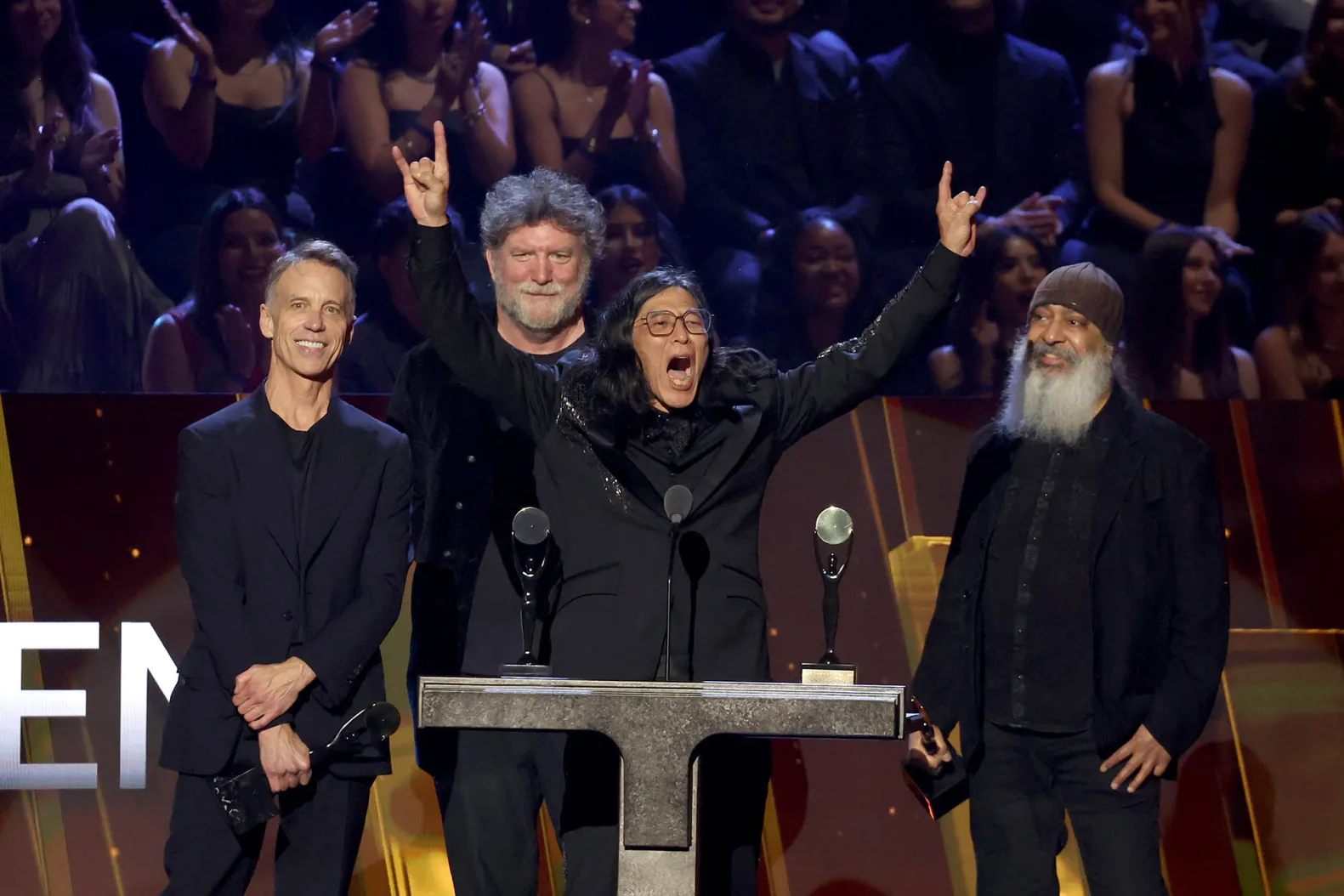

Los Angeles became ground zero for nostalgia, rebellion, and catharsis as Soundgarden — the band that turned angst into art — finally took its rightful place in the Rock and Roll Hall of Fame on November 8 at the Peacock Theater. It wasn’t just another induction night; it was a love letter to Seattle’s gritty soul and to the era that rewrote the rulebook of rock.
For one electric evening, the 1990s were alive again — the flannel, the fuzz, the fury. The surviving members of Soundgarden, Kim Thayil, Matt Cameron, Ben Shepherd, and Hiro Yamamoto, stepped onto the stage not as rock stars, but as keepers of a sound that defined a generation. Their entrance was met with the kind of applause that felt more like a collective exhale — a sigh of gratitude from fans who had waited more than a decade to see justice done for their heroes.
And who better to usher them into immortality than Jim Carrey, a lifelong superfan and an unlikely prophet of grunge? His induction speech was part stand-up, part sermon. Carrey called Soundgarden’s music “an audio baptism,” the kind that could save your soul and melt your speakers at the same time. His words felt less like praise and more like a benediction — the church of distortion in full service.
But it wasn’t all tears and thunder. The music itself was the night’s true high. Taylor Momsen of The Pretty Reckless stormed through “Rusty Cage” with fierce energy that made the crowd rise to their feet. Brandi Carlile’s haunting take on “Black Hole Sun” was pure heartbreak, a tribute that reached the rafters. Then came a moment that stopped time: Chris Cornell’s daughter, Toni, joined Heart’s Nancy Wilson for an acoustic “Fell on Black Days,” a performance so intimate it felt like the universe had gone silent just to listen.
In the audience, familiar faces from the Seattle scene — Pearl Jam’s Mike McCready, Alice in Chains’ Jerry Cantrell — joined the jam, completing what looked and sounded like grunge’s own version of Mount Olympus. It was a reunion of spirits, an echo of smoky basements and rain-soaked stages that gave birth to a sound that the world still hasn’t recovered from.
Soundgarden’s induction wasn’t just a nod to the past; it was a reminder of what real, unapologetic artistry looks like. Before streaming and algorithms, before TikTok hooks and auto-tune choruses, there were songs that made you feel something you couldn’t name. Soundgarden built their legacy on that — raw power, poetry, and pain in perfect chaos.
As Kim Thayil said during his speech, “This is about identity. About where we came from, what we made together, and what still lives on.” His words hung in the air, a quiet acknowledgment that even though Chris Cornell is gone, the sound — their sound — still roars.
And so, Soundgarden finally takes its throne among legends, not as a band that merely defined grunge, but as one that transcended it. They didn’t just make music; they made a movement. On that night in Los Angeles, with guitars wailing and hearts breaking in the best way possible, Soundgarden didn’t just get inducted — they were immortalized.