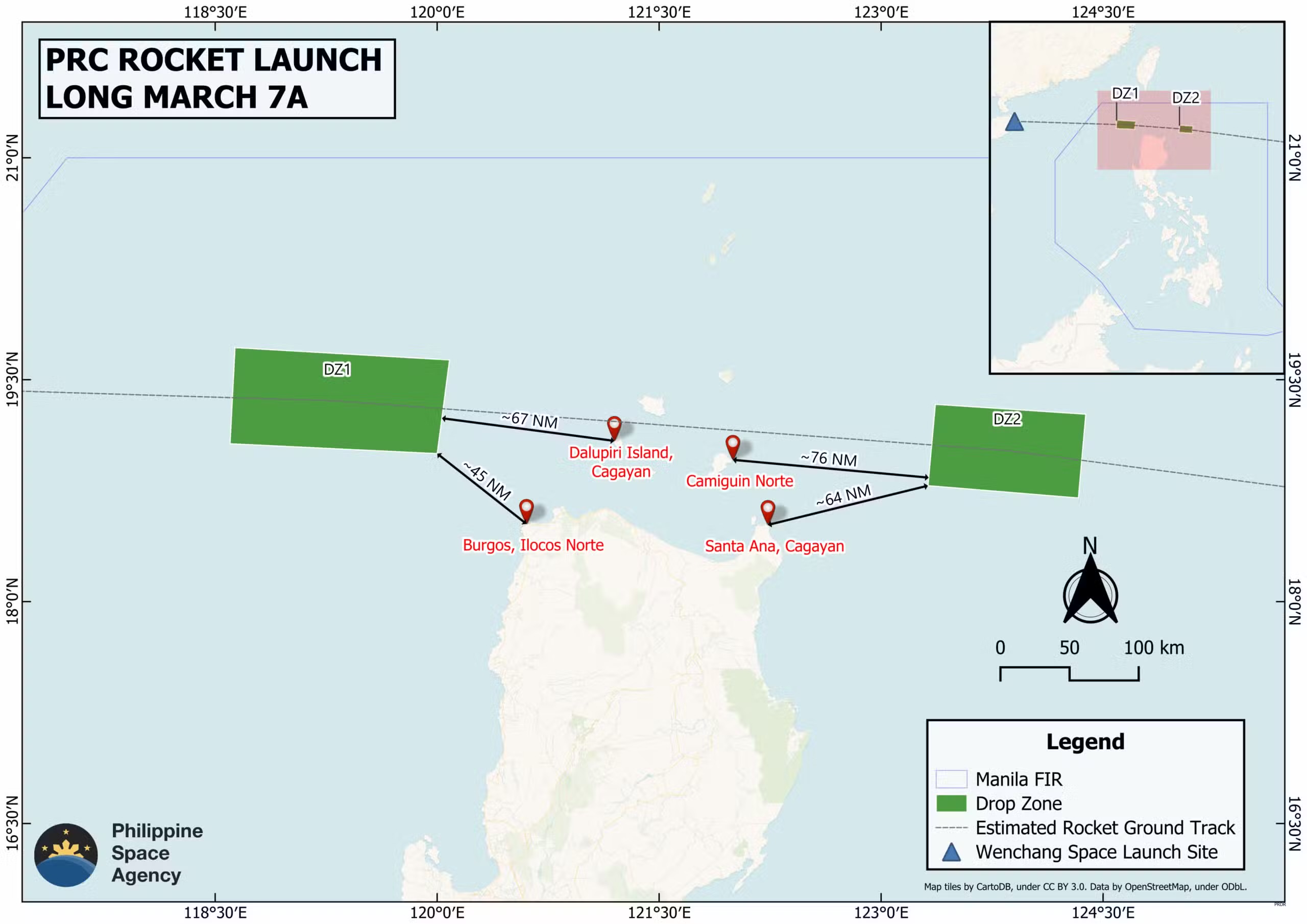
The Philippine Space Agency confirmed on Wednesday that debris from a newly launched Chinese rocket is expected to fall within the Philippine Exclusive Economic Zone, prompting official warnings for maritime and air travel in the northern region.
The Long March 7A rocket lifted off from the Wenchang Space Launch Site in Hainan at approximately 6:40 a.m., with its discarded boosters and fairings projected to splash down in two specific drop zones near the provinces of Ilocos Norte and Cagayan.
According to the latest coordinates provided by the agency, the first primary impact zone is situated roughly 45 nautical miles northwest of Burgos, Ilocos Norte, while the second zone is located about 64 nautical miles northeast of Santa Ana, Cagayan.
While space officials clarified that the debris is not expected to strike land or populated areas, they emphasized that the falling components pose a significant risk to fishing boats, commercial vessels, and aircraft operating within the affected sectors.
Beyond the physical danger of impact, authorities have issued a stern warning to coastal residents and fisherfolk regarding the chemical hazards associated with rocket hardware.
The Philippine Space Agency noted that unburned debris often contains remnants of toxic substances, including volatile rocket fuel, which can cause severe health issues if handled.
The agency also advised the public to avoid any floating materials or objects that may wash ashore and instead report sightings to local government units or the police.
This latest launch adds to a series of aerospace activities from China that have necessitated multiple safety advisories this month.
The agency continues to collaborate with the Civil Aviation Authority of the Philippines and the Philippine Coast Guard to monitor the situation and ensure that local transit routes remain clear of the designated danger zones.