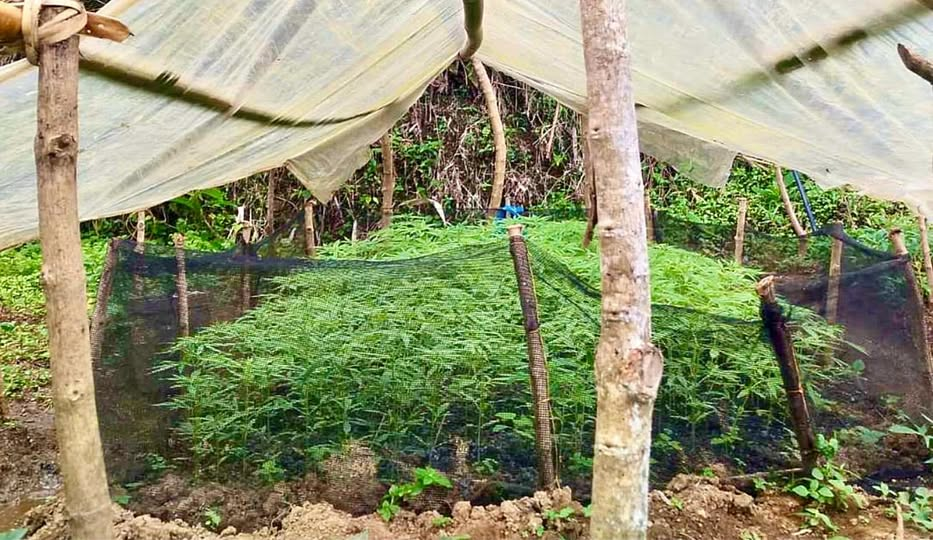

BAGUIO CITY – The revival of the silk industry in the Cordillera Administrative Region could provide farmers in marijuana-growing communities with a legal and potentially profitable alternative livelihood, the Department of Science and Technology (DOST) said.
DOST-Cordillera Regional Director Nancy Bantog said the government is promoting sericulture, or silk production, by presenting farmers with business models that demonstrate its potential income.
“The bottom line when we promote an industry is money, how much can be gained. We are already telling them, giving the business models so that they can be encouraged to plant,” Bantog said.
She cited Kapangan, Benguet, where local officials introduced sericulture and anthurium production in the early 2000s to encourage residents to shift away from marijuana cultivation.
The initiative, supported by the Philippine Drug Enforcement Agency and other government agencies, helped establish sericulture as a lasting livelihood in the municipality.
Kapangan continues to produce silkworm cocoons, with silk becoming its One Town, One Product (OTOP) offering. Kibungan, another Benguet municipality that adopted the industry, has since stopped cocoon production.
Bantog said communities in Kalinga and Quezon, Isabela, have also adopted sericulture as a potential source of livelihood.
She said the Philippine Textile Research Institute (PTRI), a DOST-attached agency, plans to expand silk production by encouraging mulberry farming in areas where marijuana cultivation persists.
“We can introduce sericulture in Kalinga too,” Bantog said.
The proposal comes as authorities continue to destroy marijuana plantations in Kalinga, where cultivation has persisted despite sustained law enforcement operations.
Bantog said the industry’s expansion would require more farmers to grow mulberry, the primary food source of silkworms, to ensure a steady supply of cocoons for processing.
Building a complete silk supply chain
The La Trinidad Silk Innovation Center in Benguet is being converted into the SEDA Pilipinas hub for Northern Luzon, which is envisioned to handle the production process from cocoon farming and silk spinning to fabric and clothing manufacture.
The facility is expected to provide a ready market for farmers while helping maximize the region’s silk-processing capacity.
Julius Leaño, former executive director of the PTRI, said the industry must establish a reliable supply chain, beginning with silkworm eggs and breeding, to sustain production.
“This is the anchor of the industry, no egg, no silk, no breeding activity,” Leaño said.
Speaking on the sidelines of the second day of the seventh Philippine Silk Summit in Baguio on Thursday, Leaño said earlier sericulture initiatives in Benguet, which began in the 1970s, struggled because the market and supply chain were not sufficiently developed.
The government is now working to address those gaps through farmer training, financial assistance and technology support, he said.
Researchers have developed silkworm eggs suited to warmer conditions, allowing production to expand beyond the cool climate of Baguio and Benguet to parts of Regions 1 and 2, Central Luzon and other warmer areas of the Cordillera.
Higher cocoon prices, wider market
Leaño said the government is working to improve the industry’s economic viability by raising the buying price of fresh cocoons from PHP200 per kilogram to between PHP400 and PHP450.
He said a hectare of mulberry plantation supported by one silkworm-rearing house could generate more than PHP30,000 in income, based on at least 10 production cycles annually. The estimate assumes suitable production conditions and access to the market.
Silkworms feed on mulberry leaves and produce cocoons that can be harvested within about 27 days, Leaño said, allowing as many as 12 production cycles a year under favorable conditions.
SEDA Pilipinas in La Trinidad is expected to serve as a direct buyer, helping farmers secure a market for their harvest.
Leaño said the center’s spinning equipment can process about 7 kilograms of cocoons into silk thread in eight hours, with output potentially doubling if operations extend to 16 hours and sufficient raw materials are available.
For the government, the goal is to make silk production a sustainable business rather than simply another livelihood program.
“This is not just a matter of science, but the farmers need to earn,” Leaño said.
By strengthening the supply chain, improving returns and expanding access to processing facilities, officials hope sericulture can create lasting livelihood opportunities in communities where marijuana cultivation has been difficult to eradicate. (Liza Agoot/PNA)