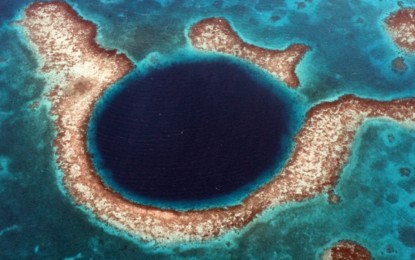
An international team of scientists studying the Great Blue Hole off the coast of Belize has uncovered troubling evidence of a dramatic and accelerating increase in tropical cyclones—raising new concerns about the future impacts of climate change in the Caribbean.
The findings, published in Science Advances and reported by ScienceAlert, are based on a 30-meter (98-foot) sediment core extracted from the floor of the massive underwater sinkhole. The core, a record of environmental conditions dating back 5,700 years, contained 694 distinct storm layers, revealing an unmistakable upward trend in storm frequency over the centuries.
According to the study led by geoscientist Dominik Schmitt of Goethe University Frankfurt, the rise in storm activity follows shifts in the Intertropical Convergence Zone (ITCZ), influenced by long-term orbital patterns. However, the team warns that the pace and scale of recent increases point to a new and disturbing driver: human-induced climate change.
“A 21st-century extrapolation suggests an unprecedented increase in tropical cyclone frequency, attributable to the Industrial Age warming,” Schmitt wrote.
Biosedimentologist Eberhard Gischler, also from Goethe University, highlighted the region’s vulnerability. “Based on these trends, we could be facing an unprecedented spike in tropical cyclone activity,” he said. “There were nine cyclone events in the last 20 years alone; a frequency that is inconsistent with normal, natural climate fluctuations.”
Gischler added that projections suggest up to 45 tropical storms and hurricanes could strike the region this century—far beyond any historical norm observed in the sediment record.
The Great Blue Hole, first made famous by Jacques Cousteau over 50 years ago, is not only a world-renowned diving destination but also a natural archive of climate data. Its sheltered depths preserve detailed sediment layers left by past storms, providing a unique window into the region’s climatic history.
The research underscores growing concerns that the Caribbean and surrounding coastal regions may be entering an era of heightened storm activity, driven not by natural variability alone but by the accelerating effects of global warming.