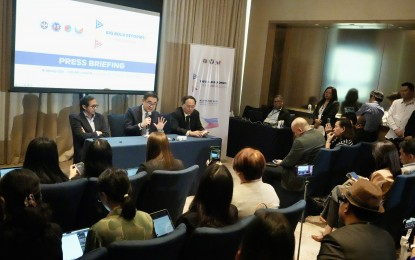

Public Works and Highways Secretary Vince Dizon, Finance Secretary Frederick Go and Transportation Secretary Giovanni Lopez (from left) hold a briefing on the sidelines of the Economic Managers Forum in Taguig City on Friday (Jan. 16, 2026). Go said more reforms are in place to ease doing business, attract investments and sustain domestic economic growth. (PNA photo by Robert Oswald P. Alfiler)
Key reforms across trade facilitation, transportation, and investment policy are firmly in place to sustain economic growth, Department of Finance Secretary Frederick Go said on Friday, signaling a decisive push to make the Philippines more competitive and investor-ready.
Speaking on the sidelines of the Economic Managers Forum in Taguig City, Go highlighted the rollout of the National Single Window (NSW)—a fully integrated trade facilitation platform—and the government’s commitment to fund the Comprehensive Automotive Resurgence Strategy (CARS) program despite vetoed items in the proposed 2026 national budget.
According to Go, the NSW will consolidate trade requirements into a single digital portal, sharply cutting red tape, delays, and compliance costs for businesses. “Global studies consistently show that countries with a national single window significantly enhance trade efficiency and tax collection,” he said, underscoring the platform’s impact on both commerce and revenues.
On the automotive front, Go assured manufacturers that government support remains intact. He said the Department of Budget and Management will soon release details of the newly approved funding for the Comprehensive Automotive Resurgence Strategy, giving enrolled carmakers confidence that state commitments will be honored.
Ferdinand R. Marcos Jr. earlier vetoed several provisions in the proposed 2026 budget, including the P4.32-billion allocation for CARS, as part of a move to curb unprogrammed appropriations. The program offers fixed investment support and production volume incentives to automotive firms. As of 2025, P1.44 billion has been released from its P5.43-billion total budget.
Go also welcomed the government’s decision to allow Chinese business owners and tourists a 14-day visa-free entry through Manila and Cebu airports, saying the move would boost tourism, trade, and investments while strengthening ties with the country’s largest trading partner.
“These reforms—designed to lower the cost of doing business and improve infrastructure—were presented to private sector stakeholders to reinforce investor confidence and encourage greater capital inflows,” Go said.
“This is a clear signal that the Philippines is moving forward decisively and not being distracted,” he added. “Despite the challenges of the past year, our long-term fundamentals remain strong. A stable macroeconomic environment, enabling policies, and a dynamic workforce give us a solid foundation for sustainable growth. With this, we are advancing with big, bold reforms.”