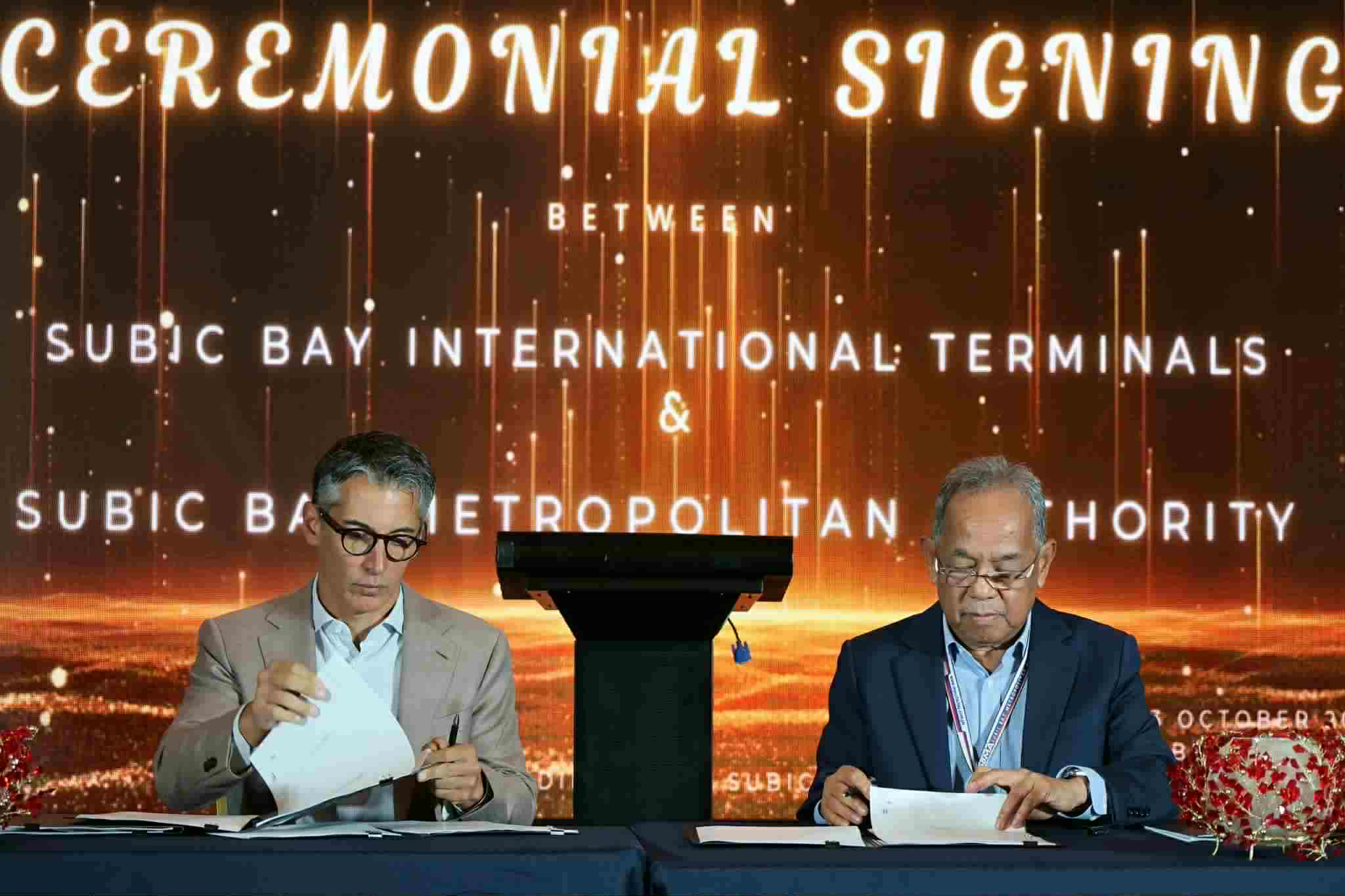

SBMA Chairman and Administrator Eduardo Jose L. Aliño (right) and Subic Bay International Terminal Chairman and President Christian Martin R. Gonzales sign the agreement for the 25-year extension of the management of the New Container Terminal held Friday at the Acea Subic Beach Resort in Subic Bay Freeport.
Subic Bay Freeport — The Subic Bay Metropolitan Authority (SBMA) has approved a 25-year extension for the International Container Terminal Services, Inc. (ICTSI) subsidiaries operating the Subic Bay New Container Terminals (NCTs), securing the port’s role as a key international trade hub for Central and Northern Luzon.
The Memorandum of Agreement (MOA) for the extension was signed on October 3, 2025, at the ACEA Subic Beach Resort by SBMA Chairman and Administrator Eduardo Jose L. Aliño and ICTSI Executive Vice President Christian Gonzalez. Witnessing the signing were SBITC Vice Chairman Juan Miguel Delgado and SBMA Director Honorio Allado III. The renewed contract allows Subic Bay International Terminals Corp. (SBITC) and ICTSI Subic, Inc. (ISI) to operate and manage the NCTs until 2058.
Under the extended concession, SBITC is set to invest over USD 130 million in terminal upgrades, including infrastructure development and the acquisition of new equipment. This includes replacing the port’s four quay cranes and adding a fifth, along with hybrid rubber-tired gantry (RTG) cranes to improve energy efficiency.
These developments are expected to expand the combined annual handling capacity of NCT-1 and NCT-2 from 600,000 to one million twenty-foot equivalent units (TEUs). “We are thankful to SBMA for trusting us and treating us as the right partner to continue until 2058,” said Gonzalez. “Every contract extension we earn across our global network reflects not only our operational reliability but also the trust of our host governments and communities.”
The New Container Terminals serve as a vital maritime link for industrial and logistics operations in Central and Northern Luzon, particularly supporting ecozones in Subic and Clark. To meet growing demand, SBITC plans to double its reefer plug capacity to 1,000 by end-2025 to accommodate more cold-chain logistics, a key driver of the country’s food and agricultural exports.
SBITC has also begun integrating near-zero emission (NZE) equipment such as rubber-tired gantry cranes, tractors, and trailers to reduce its carbon footprint. By early 2026, the company aims to automate gate operations and launch a digital platform for online payments and truck appointments—steps that will modernize port operations and improve logistics flow across Luzon.
SBMA Chair Aliño lauded ICTSI’s continued investment and long-term commitment to Subic, emphasizing that the partnership “strengthens Subic’s position as a globally competitive logistics and shipping hub.”
With the renewed 25-year term and a robust modernization plan, Subic Bay’s container terminals are set to play an even greater role in the Philippines’ economic growth and regional trade connectivity.