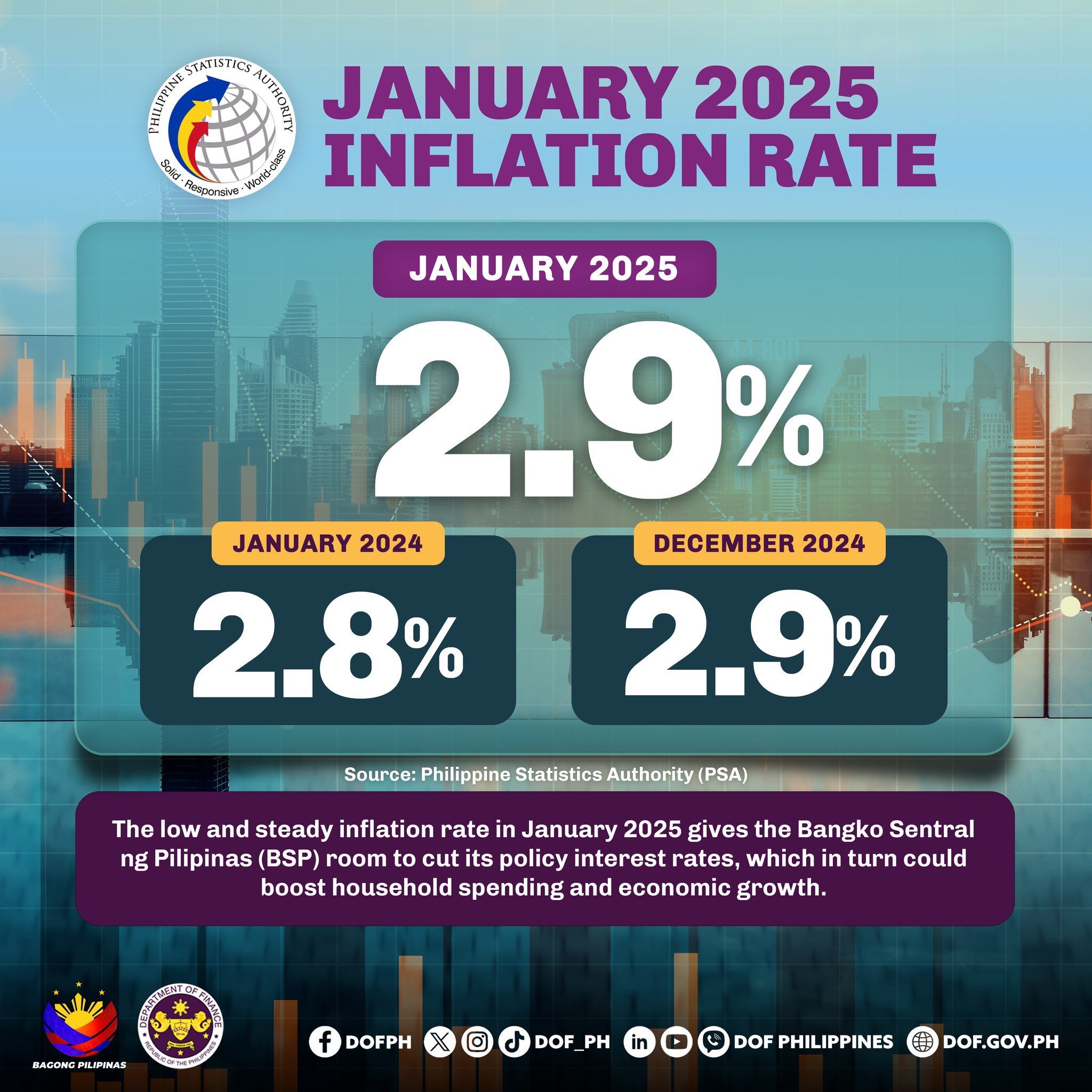

The Philippine inflation rate remained steady at 2.9% in January 2025, marking a significant milestone in the government’s efforts to maintain price stability.
With inflation well within the 2% to 4% target band, Finance Secretary Ralph G. Recto noted that the Bangko Sentral ng Pilipinas (BSP) now has greater flexibility to lower interest rates, potentially boosting household spending and economic growth.
Core inflation, which excludes volatile food and energy prices, also declined to 2.6% from 2.8% in December 2024, reinforcing the positive economic outlook.
“This is great news. A stable inflation rate signals the government’s strong commitment to price stability while giving the BSP more room to ease interest rates. Lower borrowing costs mean more affordable loans for consumers and businesses, which will drive investments and spending,” Recto explained.
However, food inflation rose to 3.8% from 3.4% in December 2024, driven primarily by higher vegetable prices following last year’s typhoons. This increase was offset by declines in housing, utilities, and fuel costs (2.2% from 2.9%) and restaurant and accommodation services (3.2% from 3.8%).
Rice prices show significant improvement
A notable decline in rice prices provided much-needed relief, with rice inflation dropping to -2.4% in January 2025, down from 0.8% in December 2024, and a steep fall from 22.6% a year ago.
The consistent downward trend in rice prices since July 2024, aside from a slight uptick in October, accelerated in January, particularly for imported rice in Metro Manila, which posted a 12.5% price drop.
“This is a welcome development for Filipino consumers, but the government will continue proactive measures to keep rice prices stable and affordable,” Recto assured.
Mitigating food and non-food inflation
The Department of Agriculture (DA) declared a food security emergency on February 3, 2025, allowing the National Food Authority (NFA) to release buffer stocks at lower prices to counter food inflation. The DA also reduced the maximum suggested retail price (MSRP) of imported rice in Metro Manila from P58 to P55 per kilogram, with nationwide implementation set for February 15, 2025.
In preparation for potential typhoon-related disruptions, the DA is intensifying efforts to boost agricultural resilience, including:
✔ Vaccination campaigns against African Swine Fever (ASF)
✔ Modernization of farm-to-market logistics through the newly established Agricultural and Fisheries Logistics Office (AFLO)
Efforts to reduce non-food inflation
To lower electricity costs, the Maharlika Investment Corporation (MIC) has invested in the National Grid Corporation of the Philippines (NGCP), aiming to stabilize power rates and ensure a reliable electricity supply. This complements ongoing government measures, including:
✔ Price caps on electricity rates
✔ Regulatory reforms to improve system efficiency
✔ Phased recovery plans to cushion price fluctuations
Manila Water Co., Inc. launched an enhanced lifeline program in January 2025, offering higher discounts for low-income households to ensure affordable access to essential water services.
With inflation under control and strategic interventions, the Philippines is well-positioned for sustained economic growth. The anticipated BSP interest rate cuts could further stimulate household consumption and business investments, reinforcing economic momentum in the coming months.