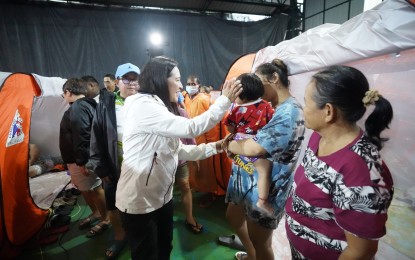

Quezon City Mayor Joy Belmonte visits an evacuation center in District 1 on Wednesday (July 23, 2025) to check on the families affected by the southwest monsoon. In a press briefing on Friday (July 25, 2025), Belmonte said she is looking for long-term solutions to the city’s flooding, as well as improving evacuation centers. (Photo courtesy of QC government)
Quezon City Mayor Joy Belmonte lauded the city’s improved response to recent storms, emphasizing how lessons from past disasters are helping shape a more resilient and prepared community.
Speaking at a press briefing held at the city’s Disaster Risk Reduction and Management Office (DRRMO) on Friday, Belmonte said that while the response to the combined impacts of tropical cyclones Crising, Dante, Emong, and the southwest monsoon was a significant step forward, there’s still more to be done.
“I’m very satisfied with how we responded this time, especially when compared to how we handled Typhoon Carina last year,” said Belmonte, referring to the July 2024 storm that exposed major gaps in the city’s disaster response system.
According to DRRMO chief Bianca Perez, emergency rescue calls dropped dramatically—from 864 during Carina to just 158 in the latest weather event. The city attributes this improvement to proactive evacuations conducted before floodwaters rose, a stark contrast to last year when many residents resisted evacuation calls.
“Last year’s 800-plus rescue calls were a sign that we didn’t do enough to convince people to leave early. That puts not only the residents at risk, but also our rescuers,” Belmonte said. “This time, people left as soon as we asked. That’s progress.”
Still, Belmonte acknowledged that true success remains elusive as long as lives are lost. The city recorded three deaths and two missing persons in the recent floods.
“We want zero casualties in Quezon City. That’s the goal. Anything less is not acceptable,” she stressed.
Mass evacuations and community preparedness
More than 37,000 residents across 142 barangays were safely evacuated to 80 shelters, many of which were in flood-prone areas like San Francisco, Tatalon, and Bagbag. Perez noted that the sheer size and population of Quezon City make disaster management a logistical challenge—but early evacuation efforts have proven effective in minimizing risk.
“Getting people to safety before the worst of the rains hit is the best outcome we can hope for,” Perez said.
Accessing the city’s Quick Response Fund
Following the declaration of a state of calamity, Quezon City was able to tap into its P485.9 million Quick Response Fund—part of the city’s P1.6 billion disaster budget for 2025.
“This fund is strictly for emergencies. Without the state of calamity declaration, it’s locked. But in situations like this, it gives us the flexibility to act quickly,” Belmonte explained.
The city plans to use the fund for flood waste cleanup, emergency infrastructure repairs, and purchasing medical supplies to prevent post-disaster diseases such as leptospirosis.
From short-term fixes to long-term resilience
While addressing urgent needs is a priority, Belmonte said the city is also looking ahead.
A task force led by City Administrator Michael Alimurung is studying flooding patterns district by district to develop more targeted flood control solutions. The mayor also backed the proposal of 1st District Rep. Arjo Atayde to develop a Metro Manila-wide drainage master plan.
Better evacuation centers are also part of the city’s vision. Belmonte wants future evacuation sites to meet international standards—with proper bathrooms, showers, and sleeping areas—to ensure that evacuating is not another hardship for affected residents.
“The goal is to make people feel safe and comfortable, not more distressed,” she said. “We’re planning all future infrastructure projects to double as evacuation centers if needed.”
As Quezon City braces for future storms amid worsening climate conditions, Belmonte emphasized the need to remain people-focused, adaptable, and forward-thinking.
“Our people deserve nothing less than excellent service. We must build a Quezon City that’s resilient, responsive, and always ready for what lies ahead,” she said.