
(Photo courtesy of Anadolu)
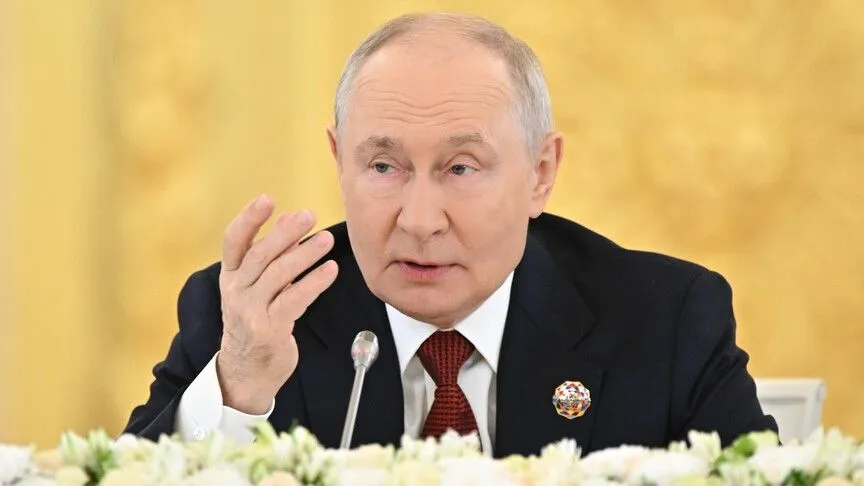
SHENZHEN, China – Russian President Vladimir Putin declared Wednesday, November 18, that traditional instruments of economic dominance and coercion were losing their effectiveness as emerging economies continued to reshape global trade and economic relations.
Speaking at the Asia-Pacific Economic Cooperation (APEC) Business Forum in Shenzhen, Putin said the Asia-Pacific region had emerged as a major center of global economic activity, industrial production, and technological development.
He attributed the transformation largely to the rapid expansion of developing Asian economies, noting that the share of developing countries and emerging markets in the global economy had nearly doubled over the past 35 years.
“It is precisely here, in the Asia-Pacific region, that the fundamental changes originated — changes that are now spreading across the entire globe like waves,” Putin said.
He described the region’s economic development as evidence of what he considered a shift toward a more balanced international economic system.
“The regional model clearly illustrates the emergence of a fairer, more democratic, and more egalitarian global order,” he added.
Putin criticizes economic pressure and sanctions
The Russian leader criticized countries that he said were attempting to restrict the economic progress of emerging nations instead of adapting to changing global conditions.
Putin argued that developing economies were increasingly seeking greater independence in economic policymaking and international relations.
“Experience has shown that the old instruments of economic dominance and de facto coercion have outlived their usefulness and have, to a significant extent, lost their intimidating effect,” he said.
He acknowledged that economic sanctions could still exert pressure but maintained that they were no longer capable of completely preventing economic growth, citing Russia’s experience.
Putin called for stronger international cooperation amid global economic uncertainty, saying countries should prioritize dialogue and mutually beneficial partnerships over confrontation.
He described APEC as an important platform for strengthening economic engagement and addressing shared challenges.
Putin, Xi hold bilateral talks
Following his address, Putin met with Chinese President Xi Jinping for bilateral discussions that lasted more than two hours, according to Russian media reports, including state news agency Tass.
The meeting took place during Putin’s two-day visit to China, where he was scheduled to participate in APEC-related activities and hold talks with other leaders.
Putin arrived in China late Tuesday ahead of the regional gathering.
The Russian president also expressed expectations of “substantial potential benefits” from a planned trilateral meeting with Xi and US President Donald Trump in Shenzhen on Thursday, November 19.
The reported meeting would bring together the leaders of Russia, China, and the United States amid continuing disagreements over trade, economic restrictions, and international security.
However, the trilateral meeting’s schedule and participation have not been independently confirmed.
Russia highlights cooperation with China
Aside from his participation in the APEC Business Forum and bilateral discussions with Xi, Putin visited a joint university established in Shenzhen by Moscow State University and the Beijing Institute of Technology, according to the Kremlin.
The visit highlighted educational and technological cooperation between Russia and China as both countries seek to expand partnerships in research, innovation, and industrial development.
Putin’s remarks at the business forum reflected Moscow’s position that the growing economic influence of emerging markets is changing international economic relations.
He maintained that greater cooperation among Asia-Pacific economies would be essential to addressing global economic challenges and sustaining regional growth.