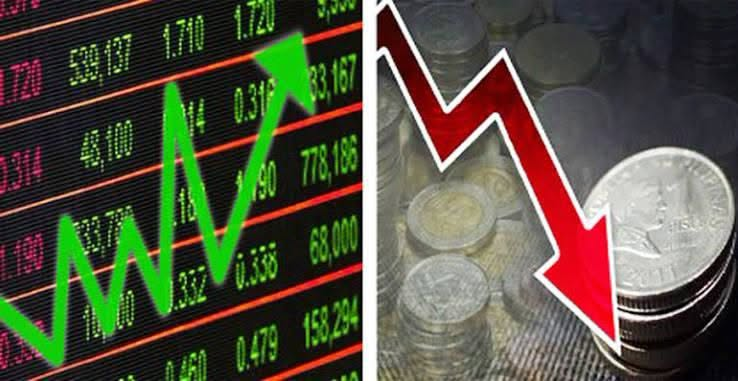

MANILA – After a two-day slide, the local bourse’s main index recovered on Thursday, backed by bargain-hunting, but the peso weakened to a record 63 level against the US dollar.
The Philippine Stock Exchange index (PSEi) rose 0.82 percent to 5,663.17 points, and the broader All Shares by 0.50 percent to 3,174.69 points.
Most sectoral gauges also ended on a positive note – Property, up by 1.89 percent; Financials, 1.28 percent; Services, 0.51 percent; and Holding Firms, 0.40 percent.
On the other hand, Mining and Oil dipped 2.47 percent, and Industrial, 0.30 percent.
Volume reached 664.92 million shares, amounting to PHP6.99 billion.
Advancers led decliners at 91 to 89, while 66 shares were unchanged.
“The local index rebounded following two consecutive trading sessions of declines, supported by bargain hunting across the board. However, prevailing market sentiment remained cautious as the peso touched the PHP63/USD level intraday, reflecting continued currency weakness,” said Luis Limlingan, Regina Capital Development Corp. head of sales.
“Moving forward, the market is expected to remain wary of economic and geopolitical developments, with investors closely monitoring peso movements and broader macroeconomic conditions.”
Meanwhile, the local currency posted its weakest so far against the US dollar after ending the day’s trade at 63.06, from its 62.87 close on Wednesday.
It opened the day on a depreciated level of 62.83 from the previous session’s 62.70.
It touched 63.15 in the morning session, the lowest for the day, but managed to strengthen to 62.75 mid-trade. The day’s average stood at 63.04.
Volume reached USD1.5 billion, higher than the previous day’s USD941 million.
Rizal Commercial Banking Corp. (RCBC) chief economist Michael Ricafort, in a market report, attributed the peso’s weakness to risks brought about by the ongoing geopolitical tensions in Russia and in the Middle East.
These hostilities, he said, “could threaten oil/energy supply flows that only recently recovered to near the levels before the war on Iran/Middle East since Feb. 28, 2026.”
He said the International Energy Agency (IEA) “warned that diesel and other fuels will remain under pressure in 2027 as a result of conflicts, despite a weaker outlook for oil consumption; (and) urged its members to complete pledges to release emergency stockpiles.”
With the supply boost from IEA member countries and anticipated softer demand, Ricafort said global oil prices are expected to ease, which will help stabilize the Philippine peso, among other benefits.
Other positive factors for the peso are the decline of the 10-year US Treasury yield to a three-week low of 5.09 percent, the expected lift from the seasonal increase in importation in the last quarter of the year, and the higher remittance inflows for the Christmas season.
For Friday, the local currency is forecast to trade between 63.00 and 63.20 against the US dollar.
Impact on manufacturing
Federation of Philippine Industries (FPI) Chairperson Elizabeth Lee, in a statement Thursday, said the peso’s weakness “is a reminder of the pressures facing Philippine industry.”
“Whether it ultimately holds above that level will be determined by market conditions, but for manufacturers, the broader trend matters more than any single day’s movement,” she said. “There is also an opportunity in this moment. A more competitive peso can strengthen Philippine exports.”
In 2025, the country posted a record-high exports growth of 15.3 percent, and the strong expansion continued, with the August 2026 level up by 27.8 percent on an annual basis. (PNA)