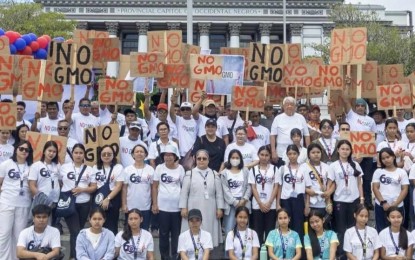
Protests from organic agriculture advocates continue as the Negros Occidental provincial board held a public hearing Tuesday on a proposed ordinance seeking to lift the province’s 18-year-old ban on genetically modified organisms (GMOs).
The hearing was presided over by 3rd District Board Member Andrew Montelibano, chairperson of the committees on agriculture and environment, and joined by Provincial Administrator Rayfrando Diaz, who represented the provincial government in pushing for the ordinance. The proposal, which regulates the entry of GMOs in the province, has already passed its first and second readings last August 26.
“This is not for the organic agriculture community. This is not for the anti-organic community, but this is for the people of Negros Occidental. We cannot force something that is not feasible to everybody,” Montelibano said after the hearing.
He gave opposing groups, including organic advocates, a week to present their suggestions before the board makes a decision.
Negros Occidental’s existing ban, Ordinance No. 07, passed in 2007, prohibits the entry, importation, planting, growing, selling, and trading of GMO plants and animals in the province.
Joshua Villalobos, secretary general of the Negrosanon Initiative for Climate and the Environment, criticized the timing of the public hearing, saying it “came in very late” since the ordinance has already advanced to its second reading. He also raised concerns over the difficulty of enforcing GMO regulations when the existing ban itself is not fully implemented.
In defense of the proposal, the province’s joint legal-scientific team said the amendment aims to align local policies with national regulations.
“There is a compelling need to amend the existing GMO ordinance of the Province of Negros Occidental to ensure consistency with the national policy framework on GMO regulation. The proposed Negros Occidental GMO Regulatory Ordinance seeks to harmonize the province’s local framework with national policy,” the team said.
They emphasized that the measure “does not abandon the values of sustainability and cultural heritage, rather it strengthens our capacity to respond to modern agricultural challenges by aligning local law with national policy and scientific evidence.”
“Through this ordinance, we reaffirm our commitment to safeguarding food security, protecting our farmers and embracing science-based innovation while upholding our province’s organic identity,” they added.
Meanwhile, the GMO-Free Negros Coalition opposed lifting the ban, stressing the need to preserve the province’s agricultural integrity.
“To repeal it would be to concede democratic governance to corporate agribusiness and to sacrifice food sovereignty, ecological justice, and national dignity. Negros Occidental must not abandon its leadership in agroecology, organic farming, and its identity as the ‘Organic Capital of the Philippines’ and ‘Organic Food Bowl of Southeast Asia,’” the group said.