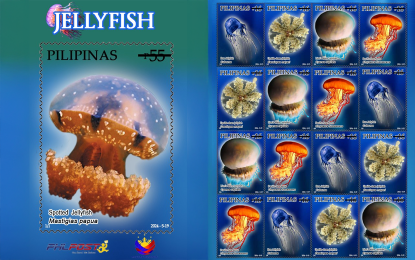
The Philippine Postal Corporation (PHLPost) has unveiled a new set of stamps highlighting various jellyfish species found in the Indo-Pacific region and the Philippines, known as the center of marine biodiversity.
“The Philippines is the home of diverse jellyfish species, which are a part of the country’s natural heritage, with some species potentially being unique in the country,” the PHLPost stated in a news release on Wednesday.
The collection features four jellyfish species — box jellyfish, upside-down jellyfish, lion’s mane jellyfish, and Pacific sea nettle — in a “16 on sheet” layout, which includes 16 individual stamps.
The box jellyfish (Cubozoa), found near northern Australia and the Indo-Pacific, is the most dangerous due to its venom-filled tentacles. The upside-down jellyfish (Cassiopea mayeri) is known for resting upside-down on the seafloor with its tentacles facing upward.
The lion’s mane jellyfish (Cyanea capilata), one of the world’s largest jellyfish, typically grows to 1.5 feet (40 cm) but can reach up to 6.5 feet (200 cm). Meanwhile, the Pacific sea nettle (Chrysaora fuscescens) displays vibrant colors with a bell up to 3 feet (1 meter) in diameter and tentacles extending 15 feet (4.6 meters).
PHLPost also released a special souvenir stamp featuring the spotted jellyfish (Mastigias papua), a member of the lagoon jelly genus sometimes referred to as the Papua jelly.
The official first-day cover showcases Cassiopea culionensis, a newly discovered jellyfish species found in Culion Bay, Palawan. It was identified by an international team of scientists, including Filipino marine experts.
PHLPost printed 10,000 copies of the stamp sheet and 2,000 souvenir sheets for collectors and marine life enthusiasts.