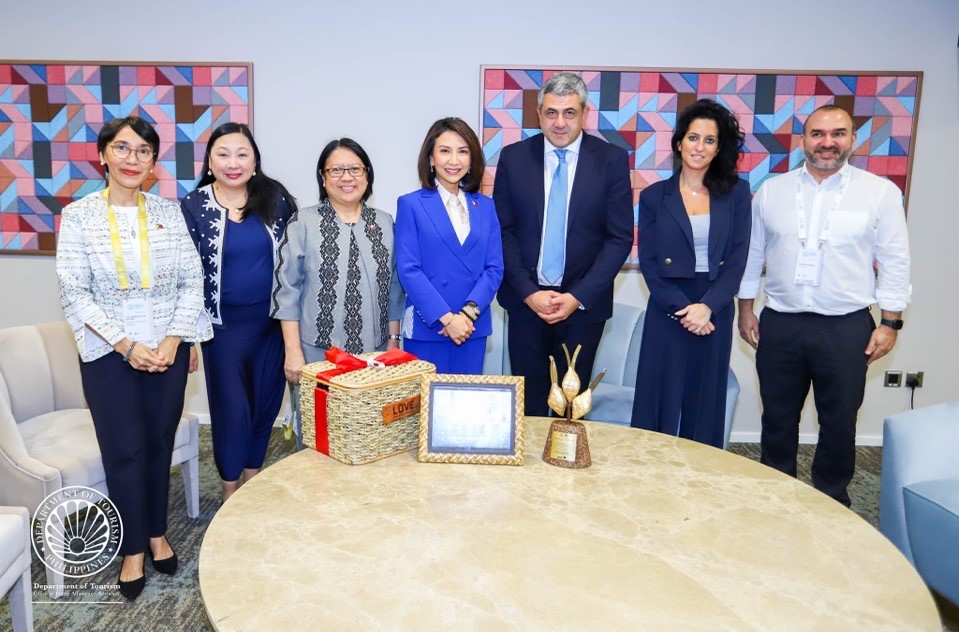

MANAMA, BAHRAIN – Department of Tourism (DOT) Secretary Christina Garcia Frasco led the Philippine delegation to the 9th UN Tourism World Forum on Gastronomy Tourism, held on November 18-19, 2024, at Exhibition World Bahrain.
Organized by UN Tourism, and its Affiliate Member, the Basque Culinary Center (BCC), in collaboration with the Government of Bahrain, the Forum carried the theme, “Gastronomy Tourism: A Driver of Economic Diversification and Inclusion.
Held for the first time in the Middle East, the two-day event brought together global leaders, policymakers, industry experts, and renowned chefs to explore how gastronomy tourism enhances destination branding and fosters innovative practices worldwide.
At the Forum, Secretary Frasco highlighted the Philippines’ robust policy framework and innovative initiatives that harness gastronomy’s potential to drive tourism development.
“In the Philippines, gastronomy is embedded in our national strategy, by way of our National Tourism Development Plan (NTDP), which our President approved at the beginning of his administration. By way of this plan, we have made deliberate and focused approaches towards developing gastronomy,” Secretary Frasco shared.
In the high-level session titled “Shaping Policies for Advancing Gastronomy Tourism,” Secretary Frasco joined Bahrain’s Minister of Tourism Fatima bint Jaffar Al Sairafi, and Saudi Arabia’s Deputy Minister of International Affairs Sultan AlMusallam, with the discussion moderated by UN Tourism Director of Market Intelligence, Policies, and Competitiveness Sandra Carvao.
The DOT chief spotlighted the Philippines’ successful hosting of the inaugural UN Tourism Regional Forum on Gastronomy Tourism for Asia and the Pacific in Cebu, a milestone highlighting the country’s role in regional gastronomy tourism.
The event, said Frasco, provided the Philippines with the platform that resulted in the Cebu Call to Action on Gastronomy Tourism—“a framework for the development of gastronomy tourism in Asia and the Pacific, which prioritizes, first and foremost, coming up with policies and strategies to ensure that gastronomy tourism is developed in a manner that is not singular only in one country, but is regional.”
The 12-point Cebu Call to Action supports inclusive growth by addressing the entire tourism value chain, with a focus on uplifting small and medium enterprises, farmers, fisherfolk, cooks, and chefs.
“This Call to Action provides an impetus for supporting gastronomy tourism in a manner that increases the value proposition of destinations. We attached gastronomy tourism to every experience that is had in the destination, knowing fully well that over 54% actually use gastronomy as one of the reasons for travel. Domestically, in the Philippines, it ranks as the number two reason for travel across our nation,” Frasco added.
Under its Love the Philippines campaign, gastronomy has become a vital pillar in positioning the country as a top global destination. Flagship initiatives, such as the Philippine Experience: Heritage, Culture, and Arts Caravan, integrate gastronomy into tourism offerings through its key component, ‘Salu-salo,’ where tourists and tourism stakeholders are introduced to the local foods of each destination.
According to Frasco, the future for Gastronomy tourism in the Philippines is bright, with the vast diversity of regional cuisines in the country.
“And so, the effort on the part of the Department of Tourism has been to bring attention to our dishes across the country that vary from one island to another while, at the same time, continuing to support the Filipino dishes that have come to be loved, known worldwide, such as our sinigang, our adobo, our lechon, and to continue to encourage more cities in the Philippines, our municipalities, to consider Gastronomy Tourism as a value proposition for their destination,” Secretary Frasco said.