
By Ma. Cristina Arayata
MANILA – The Department of Science and Technology – Philippine Institute of Volcanology and Seismology (DOST-Phivolcs) and its partners from the government and private sectors have been working to increase public awareness of tsunamis.
“It is vital for them to know the threats so they could prepare and take the right preventive measures such as structural retrofitting, evacuation, drills and preparing go bags,” DOST-Phivolcs Director Teresito Bacolcol told the Philippine News Agency in an interview on Tuesday.
Knowing the signs of a tsunami will guide the local government units in their actions, such as the need for an evacuation, he said.
Lead time for people to move away prior to a tsunami varies from five to 20 minutes, he noted.
“Tsunamis can occur without warning. The aftermath can be huge like collapsed buildings, high casualties, especially in highly urbanized cities,” he pointed out.
Bacolcol said a tsunami occurs depending on the source or epicenter — if it is under the sea or near the shore.
Phivolcs issues a tsunami information if an earthquake has a magnitude of 6.5 and above, regardless of depth of focus.
With the need to inform the public more about this geological hazard, Phivolcs along with SM Supermalls, ARISE Philippines, Pasay City government, Metro Manila Development Authority and the Department of Science and Technology, among others, will lead the advocacy run called “Tsunami! Run for Safety” at 5 a.m. on Oct. 24 at the Mall of Asia complex.
“Public registration is temporarily closed due to full slots, but additional slots will be opened on Oct. 18,” Bacolcol said.
This is the third time that the advocacy run will be held. The first two were in Mati City in 2024 and Vigan City in 2025.
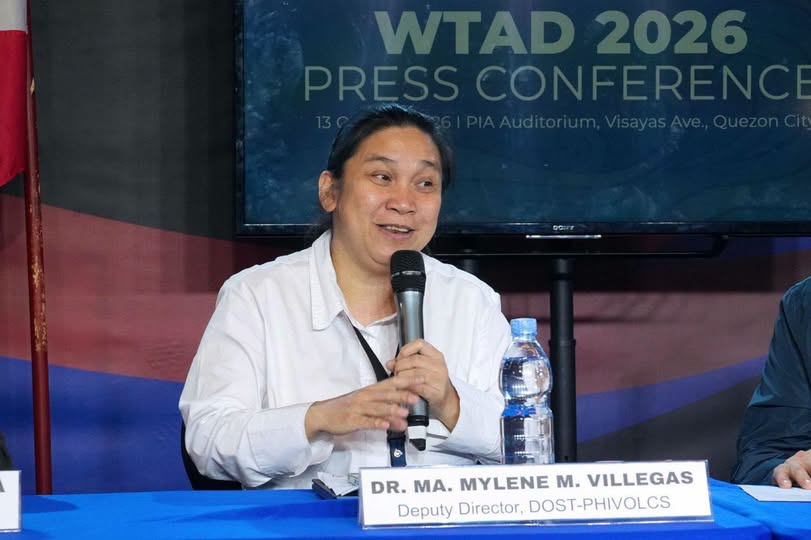
In a press conference at the Philippine Information Agency in Quezon City, Department of Science and Technology (DOST)-Phivolcs deputy director Ma. Mylene Villegas emphasized cooperation to ensure people are well prepared and informed, noting that Metro Manila and 66 of the country’s 82 provinces have coastal areas exposed to tsunamis.
These province include Albay, Aurora, Bataan, Batangas, Batanes, Bulacan, Cagayan, Camarines Norte, Camarines Sur, Catanduanes, Cavite, Ilocos Norte, Ilocos Sur, Isabela, La Union, Marinduque, Masbate, Occidental Mindoro, Oriental Mindoro, Palawan, Pampanga, Pangasinan, Quezon, Sorsogon, Zambales, Aklan, Antique, Biliran, Bohol, Capiz, Cebu, Eastern Samar, Guimaras, Iloilo, Leyte, Negros Occidental, Negros Oriental, Northern Samar, Romblon, Samar, Siquijor and Southern Leyte.
Agusan del Norte, Basilan, Camiguin, Davao de Oro (formerly Compostela Valley), Davao del Norte, Davao del Sur, Davao Occidental, Davao Oriental, Dinagat Islands, Lanao del Norte, Lanao del Sur, Maguindanao del Norte, Misamis Occidental, Misamis Oriental, Sarangani, South Cotabato, Sultan Kudarat, Sulu, Surigao del Norte, Surigao del Sur, Tawi-Tawi, Zamboanga del Norte, Zamboanga del Sur and Zamboanga Sibugay also have coastal communities.
She said 94 coastal barangays across six provinces have undergone training under the Tsunami-Ready Communities since 2023.
“Marami po sa ating coastal communities ang naghahanda para sa posibleng pagkakaroon ng tsunami. Marami na po sa kanila ang naglagay ng signages (Many of our coastal communities are preparing for a possible tsunami. Many of them have already put up signage),” she said.
She said a tsunami exercise is conducted every fourth quarter as part of the nationwide simultaneous earthquake drill to test local tsunami contingency plans.
Villegas said the DOST also continues to build the capacity of local government units and communities to build resilience against the threat of tsunamis.
She also announced the establishment of the National Tsunami Ready Board (NTRB), headed by the Office of Civil Defense (OCD), with DOST and the Departments of the Interior and Local Government, Environment and Natural Resources and Economic Development as members.
The National Tsunami Action Plan for NTRB, a national-level governing body responsible for overseeing, evaluating and approving community applications for the UNESCO-Intergovernmental Oceanographic Commission Tsunami Ready Recognition Programme, will be rolled out by next year, she added.
The United Nations General Assembly designated Nov. 5 as World Tsunami Awareness Day to promote a global culture of tsunami awareness.
“Since 2015, nagpa-participate po tayo dito kasama ng iba pang mga bansa sa buong mundo (We have been participating in this alongside other countries around the world since 2015),” she said.
For his part, OCD-National Capital Director George Keyser emphasized tsunami awareness in Metro Manila, noting that the capital region has eight cities exposed to tsunami threats.
“We have to consider the triggering hazards. A major offshore earthquake can generate a tsunami, which means that the earthquake and tsunami may occur within the same event,” Keyser said. (with reports from Ericka Mae Espiritu/Uel Aurelio/PNA)

