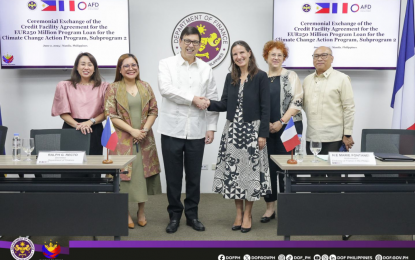

Finance Undersecretary Maria Luwalhati Dorotan Tiuseco (from left), Assistant Secretary Donalyn Minimo, Secretary Ralph Recto, French Ambassador to the Philippines Marie Fontanel, AFD Country Director Benedicte Gazon, and DOF Undersecretary Joven Balbosa pose for a photo at the ceremonial exchange for the Climate Change Action Plan, Subprogram 2 (CCAP2) on Monday (June 2, 2025). France will provide P15 billion to fund CCAP2 which aims to assist the vulnerable sectors in the Philippines to transition to a resilient, low-carbon economy. (Photo courtesy of DOF)
The Philippines just received a major boost in its fight against climate change, securing €250 million (₱15.79 billion) in concessional funding from the French government through the Agence Française de Développement (AFD).
Finance Secretary Ralph Recto and French Ambassador to Manila Marie Fontanel formalized the agreement during a ceremonial exchange on Monday. The funding supports the second phase of the Philippines’ Climate Change Action Plan (CCAP2), aimed at accelerating the country’s transition to a greener, low-carbon future.
“This partnership is a strong vote of confidence in the Filipino people and in our shared vision of a more resilient and sustainable future,” said Recto, highlighting the strategic importance of the funding.
The new phase, CCAP2, builds on the momentum of the initial program (CCAP1), which ran from 2020 to 2022 with support from the Asian Development Bank (ADB) and AFD. CCAP2 will continue to align with the Philippines’ Nationally Determined Contribution (NDC) targets, ensuring that the country remains committed to reducing emissions and helping vulnerable communities adapt to climate impacts.
President Ferdinand R. Marcos Jr. has consistently emphasized the need for innovative, bold strategies to address climate change—something this program directly supports.
The broader CCAP initiative is made up of three subprograms, each focused on key climate priorities: policy reforms, sustainable financing, and institutional capacity building. These aim to enhance climate resilience, promote clean energy, and create systemic change.
Beyond the French funding, the program is backed by significant global support. The ADB is contributing ₱28.36 billion, while the Japan International Cooperation Agency (JICA) is adding another ₱13.3 billion.
“With this agreement, we’re not just exchanging documents—we’re reinforcing a strategic alliance for climate resilience,” said Recto. “This is the kind of partnership our times demand: ambitious, focused, and designed for impact.”
He also expressed gratitude to France for its ongoing commitment to the Philippines, noting a decade of cooperation and shared determination to fight climate change.
“We’ll ensure that every euro is put to work to create real, lasting improvements in the lives of ordinary Filipinos,” Recto added.
Ambassador Fontanel echoed that sentiment, praising the Philippines for its leadership on global environmental issues.
“France and the Philippines once again stand united in the face of the climate crisis. We commend the Philippine government for its resolve in addressing climate change, environmental degradation, and marine protection,” she said.
AFD Country Director Benedicte Gazon emphasized the importance of systemic solutions in tackling today’s environmental challenges.
“As a development partner, we are proud to support policy-level initiatives that aim for long-term impact,” Gazon said. “Systemic change is the only way forward if we want to meet the urgency and scale of today’s climate threats.”
With fresh funding and strengthened international alliances, the Philippines is poised to scale up its climate ambitions—and bring meaningful change where it’s needed most.