
(Photo courteys of PIA)
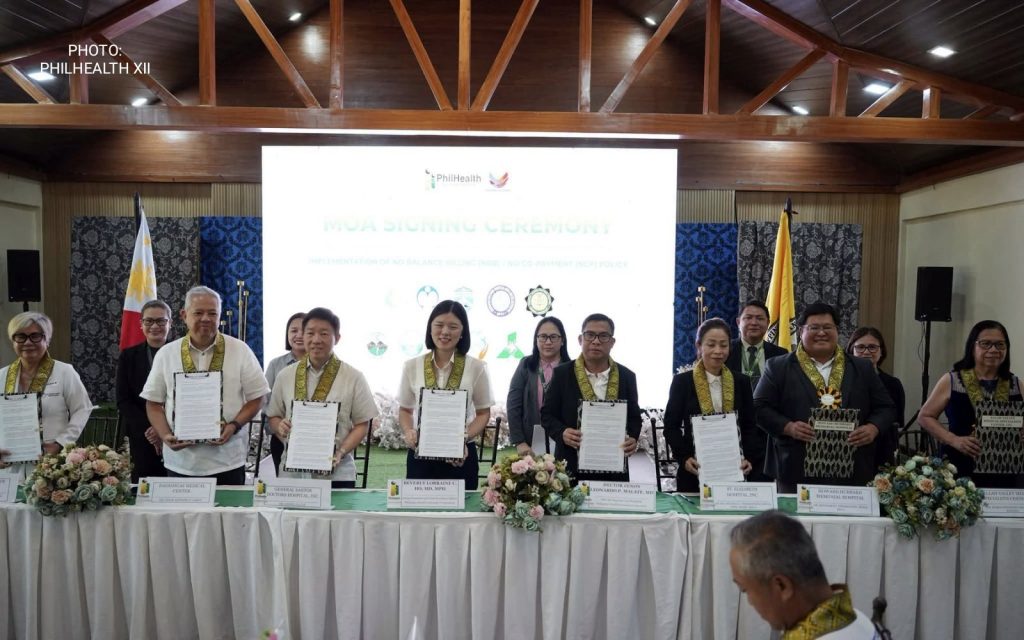
KORONADAL CITY, South Cotabato — The Philippine Health Insurance Corporation (PhilHealth) has partnered with 11 accredited hospitals in SOCCSKSARGEN to allocate 137 beds under its No Balance Billing (NBB) policy, expanding access to hospital services without additional out-of-pocket charges for qualified patients.
The agreement was formalized through a memorandum of agreement (MOA) signed by PhilHealth Region 12 and participating healthcare facilities as part of efforts to strengthen the implementation of Republic Act No. 11223, or the Universal Health Care (UHC) Act.
PhilHealth Acting President and Chief Executive Officer Dr. Beverly Lorraine Ho welcomed the commitment, saying the partnership would provide more patients with access to medical treatment without additional hospital charges for covered services.
“We’re very grateful to the 11 hospitals who have jointly committed 137 beds para po yun ay maging No Balance Billing for certain services,” Ho said.
She said PhilHealth would continue working with healthcare providers to increase the number of participating beds and expand the medical conditions and services covered by the policy.
Under the UHC Act, hospitals are required to allocate a portion of their beds for NBB patients, including a 10-percent allocation for private hospitals.
Ho acknowledged that implementation had previously faced challenges because of concerns over PhilHealth’s benefit payment rates.
However, she said increased benefit payments in 2025 had strengthened the agency’s capacity to expand the program and encourage more private hospitals to participate.
“Nung 2025, lumaki na po yung binabayaran ng PhilHealth at mas confident tayo ngayon na kaya na po natin siya gawin,” Ho said.
PhilHealth aims to cover approximately 60,000 of the country’s estimated 120,000 hospital beds under the NBB policy, including 2,400 beds in private hospitals.
The 137 beds committed by the participating SOCCSKSARGEN hospitals will contribute to the nationwide target.
Ho emphasized that expanding NBB coverage to private hospitals would give patients more healthcare options, particularly when government hospitals reach full capacity.
The 11 participating hospitals are Allah Valley Medical Specialists Center, Dr. Arturo P. Pingoy Medical Center, Howard Hubbard Memorial Hospital, Dadiangas Medical Center, General Santos Doctors Hospital, St. Elizabeth Hospital, Tomboc-Salayog Hospital, Kidapawan Doctors Hospital, Kidapawan Medical Specialists Center, Anecito T. Pesante Sr. Memorial Hospital, and Mindanao Doctors Hospital and Cancer Center.
Meanwhile, Ho outlined PhilHealth’s joint healthcare agenda with the Department of Health (DOH), known as UNA, which focuses on five priorities: healthy schools, workplaces and communities; primary care; quality hospitals; digitization; and institutional strengthening.
She stressed the importance of making preventive healthcare and primary medical services more accessible through programs such as the Yaman ng Kalusugan Program (YAKAP).
“We really want to strengthen prevention, and we don’t want people to be sick already, malalang-malala na, before they actually go and see their physician,” Ho said.
The initiative also includes improvements in digital healthcare services through the eGov app, allowing members to access information on YAKAP provider transfers and PhilHealth’s GAMOT benefits.
PhilHealth is also pursuing organizational reforms, including opportunities for long-serving job order and casual employees to obtain permanent positions.
The agency said its continuing partnerships with public and private healthcare providers aim to strengthen financial protection for members and their dependents while improving access to preventive care, primary healthcare and hospital treatment.