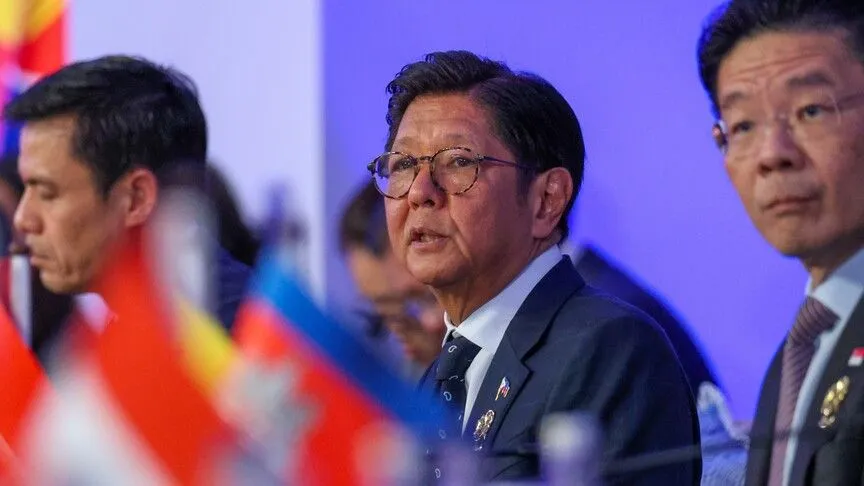

(Photo courtesy of PCO)
MANILA, Philippines — President Ferdinand Marcos Jr. on Monday urged ASEAN and China to strengthen cooperation and pursue common interests despite growing geopolitical tensions and economic uncertainties affecting the region.
Speaking at the opening of the 29th ASEAN-China Summit in Manila, Marcos emphasized the importance of practical cooperation, mutual respect and peaceful dispute resolution in sustaining regional stability and economic growth.
“Even amid regional and global uncertainties, ASEAN and China continue to find common ground and pursue tangible cooperation,” Marcos said.
The summit, attended by Chinese Premier Li Qiang, coincided with the 35th anniversary of ASEAN-China dialogue relations and the fifth anniversary of their Comprehensive Strategic Partnership.
Marcos said the milestones provided an opportunity to build on existing partnerships, particularly in trade, investment, environmental protection and sustainable development.
He also emphasized that commitments to international law and peaceful dispute settlement must be demonstrated through concrete actions.
The President called for self-restraint, mutual respect and practical cooperation as essential principles in addressing regional challenges.
His remarks came amid continuing tensions in the South China Sea, where the Philippines and China have overlapping maritime claims.
Despite these differences, Marcos stressed the importance of maintaining constructive engagement and expanding economic opportunities between ASEAN and China.
He urged both sides to build on their partnership’s achievements to promote peace, stability and prosperity across Southeast Asia.
Meanwhile, Chinese Premier Li Qiang warned of increasing unilateralism, protectionism and recurring geopolitical conflicts that continue to challenge the global economy.
“Despite the challenging global environment, China-ASEAN cooperation has maintained strong momentum and achieved encouraging results,” Li said.
The Chinese premier reported that bilateral trade between China and ASEAN exceeded USD 1 trillion last year, representing a 20.1 percent increase from 2021.
He also highlighted progress in economic integration and regional connectivity, including the China-ASEAN Free Trade Area 3.0 Upgrade Protocol and major infrastructure projects such as the Jakarta-Bandung High-Speed Railway and China-Laos Railway.
Li cited the Pinglu Canal project and the implementation of the ASEAN Visa program as additional initiatives supporting connectivity and people-to-people exchanges.
“The past five years have been truly extraordinary, and the achievements we scored have not come easily,” he said.
Li outlined three priorities for strengthening ASEAN-China relations: preserving friendship and mutual assistance, promoting openness and mutual benefit, and advancing innovation-driven development.
He emphasized that the longstanding relationship between China and ASEAN had become more resilient despite international challenges.
According to Li, growing trade restrictions and protectionist policies worldwide have made regional economic cooperation increasingly important.
“We remain firmly committed to safeguarding multilateralism and promoting free trade and endeavor to make the pie of cooperation bigger,” he said.
Both leaders underscored the importance of sustaining dialogue and economic cooperation to address shared challenges while maintaining regional peace and stability.
The Philippines is chairing ASEAN in 2026, with regional economic integration, security cooperation and sustainable development among its priorities.