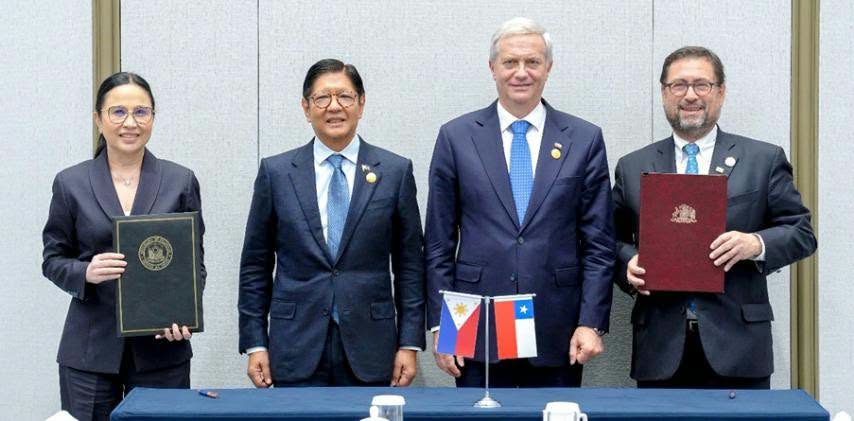

(Photo from DTI)
MANILA – The newly signed Philippines-Chile Comprehensive Economic Partnership Agreement (PH-CL CEPA) is expected to expand export opportunities, strengthen local industries and create more jobs for Filipino workers, the Department of Trade and Industry (DTI) said Friday.
Trade Secretary Cristina Roque said the agreement would provide Philippine businesses with greater access to the South American market while supporting the country’s efforts to diversify its international trade partnerships.
“The world is our market, and Filipino businesses are ready to compete. The PH-Chile CEPA opens new doors for our exporters, strengthens our manufacturing sector, and advances our goal of creating better jobs and greater opportunities for every Filipino,” Roque said in a statement.
Signed on November 19 during the 33rd Asia-Pacific Economic Cooperation (APEC) Economic Leaders’ Meeting in China, the agreement marks the Philippines’ first free trade deal with a South American country.
The DTI said the partnership aims to deepen economic cooperation between Manila and Santiago while expanding the Philippines’ presence in international markets.
Under the agreement, virtually all existing Philippine exports to Chile will qualify for duty-free treatment, improving the competitiveness of Filipino products.
Among the products expected to benefit are electronics, machinery, desiccated coconut, carrageenan, processed tuna and other value-added agricultural and manufactured goods.
The agreement also introduces provisions covering digital trade, cross-border data flows, electronic transactions, consumer protection and cybersecurity cooperation.
According to the DTI, these measures are designed to encourage innovation, improve confidence in online transactions and support the expansion of the digital economy.
Beyond export opportunities, the trade deal is expected to strengthen supply chains by providing Philippine industries with access to additional sources of raw materials and manufacturing inputs.
The department identified copper and other critical industrial materials as among the products that could support the country’s manufacturing sector, energy transition initiatives and expanding digital infrastructure.
The agreement is also expected to help reduce dependence on limited sources of supply and improve the resilience of domestic industries against disruptions in global trade.
The DTI said the PH-Chile CEPA forms part of President Ferdinand Marcos Jr.’s broader strategy to expand market access for Philippine exporters, strengthen economic partnerships and create more opportunities for local enterprises and workers.
The department maintained that closer trade cooperation with Chile would support the country’s long-term industrial development and international competitiveness.