
(Bongbong Marcos Facebook page photo)
SHENZHEN, China – President Ferdinand Marcos Jr. expressed optimism Friday over improving relations between the Philippines and China following a warm reception at the 33rd Asia-Pacific Economic Cooperation (APEC) Economic Leaders’ Meeting and discussions with Chinese Foreign Minister Wang Yi.
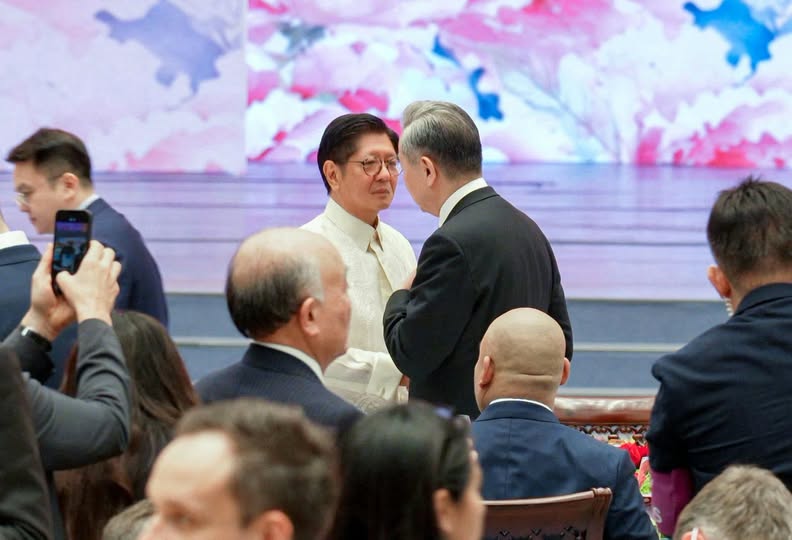
Speaking at a press conference, Marcos said he held an extensive conversation with Wang during the APEC gala dinner, focusing on easing tensions in the West Philippine Sea (WPS) and strengthening bilateral trade and investment cooperation.
“I have to say that the way that we were received here in China is very encouraging and very gratifying. And despite our differences with China, we still find ways to communicate and to make things better,” Marcos told reporters.
The President said their discussions also explored ways to address existing disagreements and move bilateral relations forward.
“And I think I really do believe we made some progress,” he added.
The meeting took place amid persistent maritime tensions between Manila and Beijing over competing claims in the South China Sea, particularly in areas within the Philippines’ exclusive economic zone (EEZ).
The two countries have repeatedly exchanged protests over incidents involving Chinese vessels and Philippine maritime operations, including resupply missions.
Manila maintains that its maritime entitlements are protected under the United Nations Convention on the Law of the Sea (UNCLOS) and the 2016 arbitral ruling, which rejected China’s expansive historic-rights claims under its nine-dash line.
Beijing continues to reject the arbitral decision.
Tensions also surfaced ahead of the recent Association of Southeast Asian Nations (ASEAN) Summit, when China criticized the Philippines over matters concerning Beijing’s participation in ASEAN ministerial meetings. Philippine officials rejected the accusations.
Despite these differences, Marcos emphasized that both countries remained open to diplomatic engagement.
The President also expressed hope for the completion of negotiations on a Code of Conduct (COC) in the South China Sea, citing progress achieved during the Philippines’ ASEAN chairship in 2026.
“The ball, of course, is now in Singapore’s court,” Marcos said, referring to Singapore’s assumption of the ASEAN chairship in 2027.
He noted that ASEAN member states and China had expressed support for finalizing the COC, which seeks to establish guidelines for managing maritime disputes and preventing confrontations in the contested waters.
“I feel it very strongly that China would also like to have a COC. And they say so,” Marcos said.
“Let’s really hope that Singapore will be able to host the actual finalization of the COC,” he added.
Marcos maintained that continued dialogue and cooperation could help improve relations between Manila and Beijing while both sides work to manage their differences in the South China Sea.