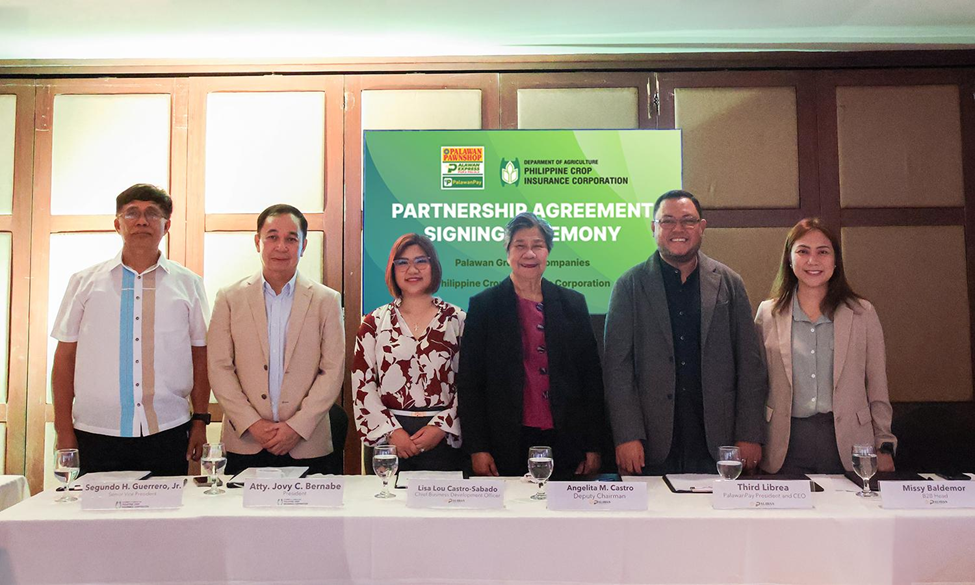

Palawan Group of Companies and the Philippine Crop Insurance Corporation officially signed a Memorandum of Agreement to promote accessible and inclusive crop insurance disbursement for Filipino farmers.
For generations, Filipino farmers have stood at the frontline of the nation’s food security, enduring storms, droughts, pests, and diseases just to keep dinner tables filled. Yet, when calamities strike, many of them face a new battle: the long, costly wait to access much-needed crop insurance payouts.
That struggle may soon be eased. The Palawan Group of Companies and the Philippine Crop Insurance Corporation (PCIC) have sealed a new partnership aimed at giving farmers faster, safer, and more convenient access to their insurance claims. The agreement was formalized through a Memorandum of Agreement, marking a significant step toward strengthening financial inclusion in rural communities.
Last year alone, PCIC insured more than 4.2 million farmers—a 7.76% increase from 2023—covering over ₱141 billion worth of crops. Despite these efforts, many farmers in remote areas remain cut off from banking infrastructure, often forced to travel far or resort to rediscounting checks just to access their benefits.
Through the partnership, Palawan Group will open its extensive nationwide network of over 3,500 Palawan Pawnshop–Palawan Express Pera Padala branches, many of which operate even on weekends and holidays, as payout centers for crop insurance. Farmers can also turn to PalawanPay, the company’s digital wallet, to receive funds directly on their phones, pay bills, and manage transactions without needing a traditional bank account.
“This will reduce delays, burdens, and ensure that our farmers receive their benefits in a faster, cheaper, and more convenient way,” PCIC President Atty. Jovy C. Bernabe said. “They save on transportation costs, and more importantly, they will no longer be forced to rediscount their checks at unreasonable rates.”

Segundo H. Guerrero Jr., PCIC senior vice president; Atty. Jovy C. Bernabe, PCIC president; Angelita M. Castro, co-founder and deputy chairman of Palawan Group; Third Librea, CEO of PalawanPay, and Missy Baldemor; B2B department head of Palawan Group
The partnership highlights Palawan Group’s “BrickTech” approach, which combines the reach of physical branches with the ease of digital solutions. The goal: to modernize the way government services are delivered, especially in hard-to-reach communities.
Lisa Lou Castro-Sabado, Palawan Group’s Chief Business Development Officer, underscored the deeper purpose behind the collaboration. “We believe farmers are the backbone of our nation. Because of their hard work, we enjoy nutritious meals every day. Yet many remain vulnerable. This is not just a business agreement—it is a shared commitment to uplift and empower our agricultural sector.”
PalawanPay CEO Third Librea echoed this, calling the initiative a bridge between farmers and reliable financial support. “Our farmers work tirelessly to feed the nation, yet their livelihoods remain fragile. With PalawanPay, we’re making sure help gets to them faster—serbisyong matatag, maaasahan, mapagkakatiwalaan nasaan man sila sa Pilipinas.”
For Palawan Group, this partnership is only the beginning. Co-founder and deputy chairman Angelita M. Castro expressed the company’s long-term vision: “We’re proud to partner with PCIC and serve underserved communities. This marks the start of rolling out more inclusive solutions that truly benefit farmers everywhere.”

Lisa Lou Castro-Sabado, chief business development officer of the Palawan Group, highlights the deeper purpose behind the partnership with PCIC, describing it as a shared mission to uplift and protect the nation’s farmers.
As climate risks intensify and financial inequality continues to weigh down rural livelihoods, the tie-up between Palawan Group and PCIC arrives at a critical time. By bringing insurance payouts closer to farmers, both organizations are working to replace delays and red tape with speed, transparency, and trust—helping farmers focus less on paperwork and more on producing the food that sustains the nation.