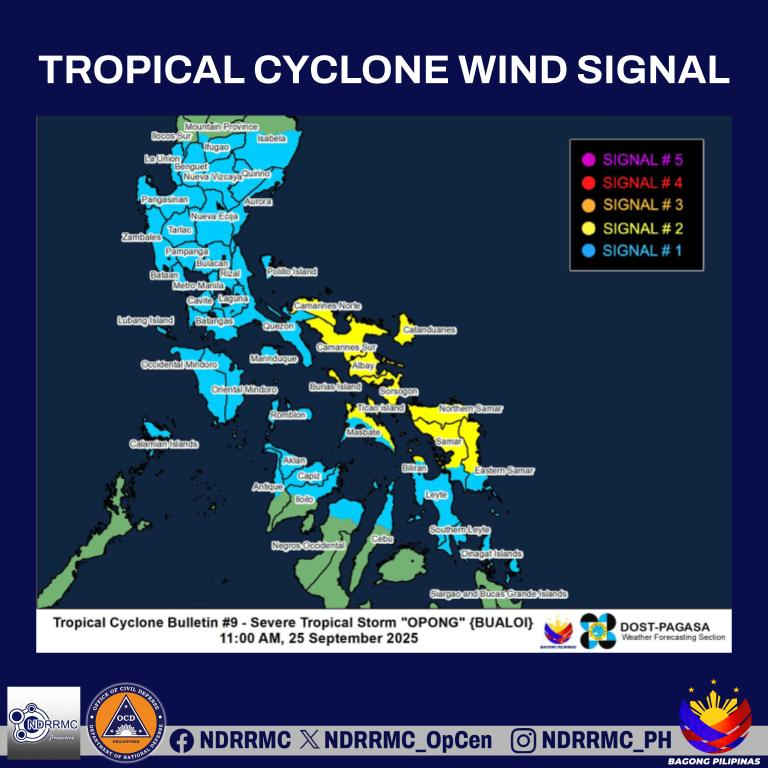

Malacañang has placed the country’s disaster response mechanisms on high alert, ordering all government agencies to fully activate the 2024 National Disaster Response Plan (NDRP) as Severe Tropical Storm Opong moves closer to the Philippines.
Through Memorandum Circular No. 100 signed on September 23, Executive Secretary Lucas Bersamin directed the National Disaster Risk Reduction and Management Council (NDRRMC), under the Office of Civil Defense (OCD), to lead implementation of the NDRP. The directive underscores what the Palace called a “whole-of-government approach” to protect lives, deliver swift relief, and mitigate the economic toll of natural calamities.
“It is imperative for all national agencies, state corporations, and local government units to coordinate and carry out the NDRP’s provisions,” the memo read. “Every sector must be prepared to do its part.”
Marcos calls for maximum readiness
The order comes as President Ferdinand Marcos Jr. presided over a situation briefing at the NDRRMC headquarters on Wednesday. Marcos emphasized that the government cannot afford delays in deploying resources and urged agencies to maximize assets ahead of Opong’s projected landfall.
“Let’s not wait for the damage to happen before acting. All available resources must already be mobilized,” the President said, noting that lessons from recent typhoons highlight the cost of under-preparation.
A country tested by consecutive storms
The renewed emphasis on disaster preparedness follows the devastation left by Super Typhoon Nando (international name: Ragasa), which struck Northern Luzon last week. Nando’s onslaught killed at least eight people in Cagayan province, submerged farmlands, and disrupted power for thousands of households before exiting the Philippine area of responsibility on Tuesday.
With Opong now gaining strength, the Philippine Atmospheric, Geophysical and Astronomical Services Administration (PAGASA) reported as of 10 a.m. Thursday that the storm was 335 kilometers east of Guiuan, Eastern Samar, packing maximum sustained winds of 110 km/h and gusts of up to 135 km/h. It is moving west-northwest at 25 km/h, with forecasts warning that it may intensify further.
From paper plan to real-world test
The NDRP, updated in 2024, sets detailed protocols for search and rescue, relief operations, health response, infrastructure recovery, and post-disaster rehabilitation. While the plan has long existed on paper, the coming days may serve as a critical test of its effectiveness when fully implemented across agencies and local governments.
Analysts note that the Philippines’ frequent exposure to extreme weather events makes strict adherence to disaster protocols not just a bureaucratic formality but a matter of survival. With the country still reeling from Nando’s aftermath, Opong’s approach will determine whether the system can withstand back-to-back calamities.