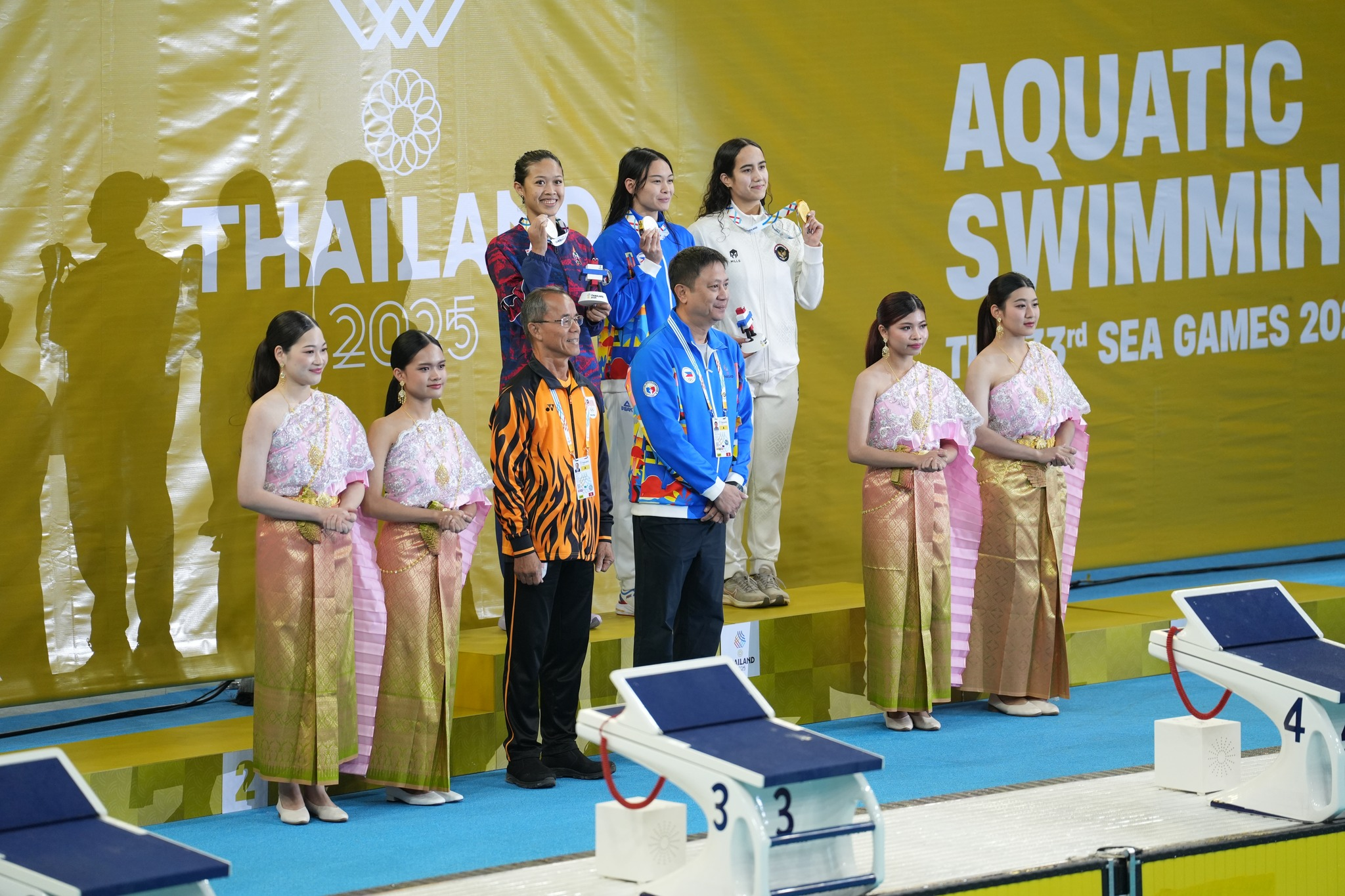

The Philippine contingent left Bangkok without the medal haul it originally set out to win at the 33rd Southeast Asian Games, but it returned home with performances that carried weight far beyond the final tally. In a campaign defined by narrow losses, hostile venues, and roster gaps, a handful of moments stood out as affirmations of resilience, pride, and competitive identity.
That spirit was distilled in the closing hours of the Games through Eumir Marcial, who delivered the country’s lone boxing gold in the men’s 80-kilogram division. Fighting through fatigue and pressure, Marcial edged Indonesia’s Maikhel Muskita via a 4–1 decision, landing a decisive right hand in the final round to break a deadlock after two. It was a victory that spared the Philippine boxing team from a rare gold-less finish and capped a tournament that had tested the program’s depth.

Marcial did not frame the moment as a personal triumph. Speaking moments after his win, he dedicated the medal to the entire delegation, underscoring a sense of shared struggle within the team. For a boxer who admitted he did not even expect to make the roster, carrying the Philippine flag during the closing ceremonies became a symbolic full circle, from uncertainty to national standard-bearer.
Overall, the Philippines closed the Games with 50 gold medals, a total that fell short of expectations and placed the country sixth in the standings, one rung lower than its finish in Cambodia two years ago. Yet numbers alone failed to capture the emotional and competitive peaks that defined the campaign.
Few moments resonated more with Filipino fans than Gilas Pilipinas Men silencing a partisan Bangkok crowd to reclaim basketball gold. In a sport that borders on national obsession, winning on Thai soil against the host nation carried a significance that went well beyond the medal count. It was a reminder of the Philippines’ enduring basketball pedigree, delivered under pressure and without the comfort of a friendly environment.

Hours earlier, the women’s national team delivered a similarly defiant performance. Gilas Pilipinas Women outlasted Thailand, 73–70, to secure their third gold in the last four Southeast Asian Games, reclaiming the title they surrendered in 2023. The path to the top was anything but smooth. Coaching staff navigated restrictive FIBA eligibility rules, while overseas club commitments sidelined key players, including established star Jack Animam.
In that vacuum, Kacey dela Rosa emerged as the tournament’s breakout figure. Thrust into a leadership role, the former Ateneo standout responded with composure and consistency, piling up double-doubles and anchoring a retooled lineup that leaned heavily on grit and chemistry. Supported by veterans Afril Bernardino, Janine Pontejos, and Khate Castillo, along with fellow newcomer Sophia Dignadice, the team overcame its thin rotation to grind out close wins.

For dela Rosa, the experience was as much personal as it was collective. She acknowledged the pressure of filling major gaps but framed the challenge as an opportunity rather than a burden. Her performance not only stabilized the team during the Games but also hinted at a larger role in the national program moving forward.
Taken as a whole, the Philippines’ Bangkok campaign may be remembered less for its final rank and more for its defining statements. Marcial’s solitary gold in boxing, the men’s and women’s basketball triumphs on enemy ground, and the emergence of new leaders offered glimpses of continuity amid transition. In a Games where expectations were not fully met, those moments ensured that the Philippine flag was still raised with purpose when it mattered most.