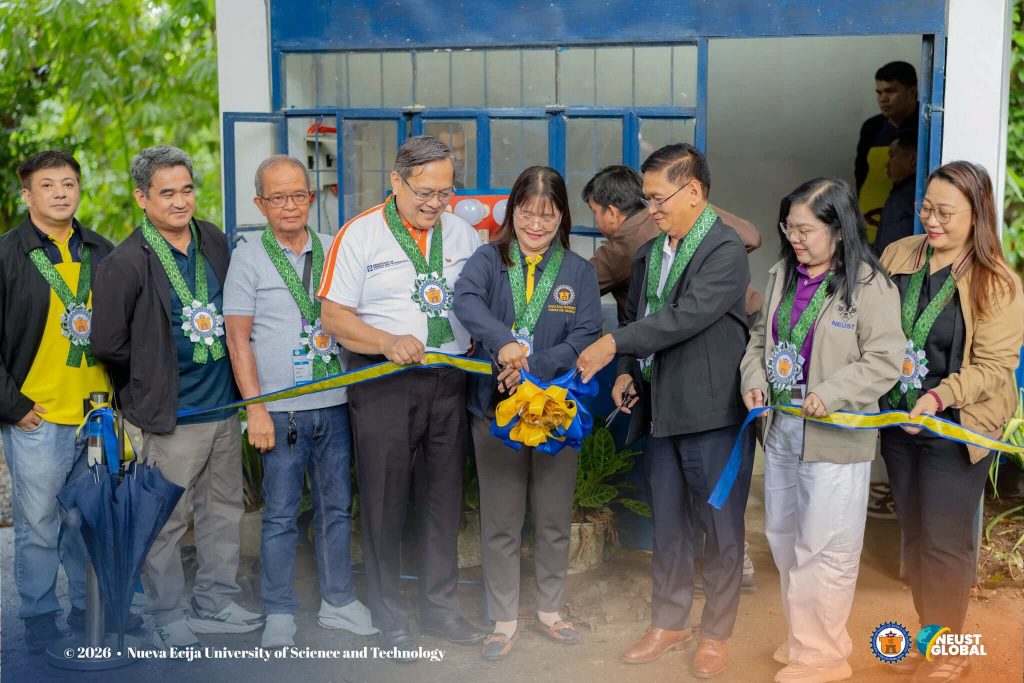

GABALDON, Nueva Ecija – The Nueva Ecija University of Science and Technology (NEUST) has restored its micro-hydropower plant at the Gabaldon Campus, reviving a renewable energy facility that will support electricity generation, engineering education, and research initiatives.
The rehabilitated plant, which had been inactive for nearly a decade, has an estimated generating capacity of 11 kilowatts and will serve as a functional laboratory for students and researchers exploring sustainable energy technologies.
NEUST President Rhodora Jugo welcomed the facility’s reopening, emphasizing its potential to promote innovation and environmental sustainability.
“I find it inspiring that something as natural as flowing water can be turned into a source of energy and learning,” Jugo said during the inauguration.
Project leader Nathaniel Oliveros explained that the facility operates using a cross-flow turbine connected to a 16-kilovolt-ampere generator, with an estimated efficiency of 70 to 75 percent.
Originally established in 2011 through a partnership with the Department of Science and Technology (DOST) Central Luzon, the plant stopped operating in 2016 after typhoons and other natural disasters caused technical and operational problems.
Rehabilitation work began in August 2026 and included equipment repairs, reinforcement of the mini-dam, and improvements to the electrical system to restore the facility’s operations.
Jugo reaffirmed the university’s commitment to working with DOST on research and development projects that address community needs and provide students with practical learning opportunities.
“This is your laboratory,” she told students, encouraging them to use the facility to develop solutions to energy and water-related challenges.
DOST Undersecretary for Special Concerns Teodoro Gatchalian said the restored facility could serve as a model for other educational institutions interested in developing renewable energy projects.
He encouraged researchers to explore integrating digital technologies and artificial intelligence into future system upgrades.
Gatchalian also emphasized the importance of protecting forests and watersheds, which are essential to maintaining the water resources needed for hydropower generation.
Meanwhile, NEUST Vice President for Research, Extension, and Training Jean Guillasper highlighted the university’s continuing environmental and renewable energy initiatives.
These include the GUNITA Program, which documents biodiversity within the Gabaldon Campus to support conservation efforts, and the REVIVE renewable energy program.
Guillasper said the university had prepared a proposal for additional improvements to the micro-hydropower facility.
Oliveros disclosed that possible upgrades include battery storage systems, automated controls, and real-time remote monitoring capabilities, depending on the availability of funding.
Gabaldon Municipal Administrator Ricardo Subido recalled that the plant previously served as an alternative electricity source during power interruptions, allowing residents to charge mobile phones and maintain communication.
With the facility operational again, NEUST expects the micro-hydropower plant to help supply part of the campus’s daily electricity requirements while providing engineering students and faculty members with hands-on experience in renewable energy systems.
The project also supports broader government efforts to promote clean energy, strengthen scientific research, and advance sustainable development through technology-driven solutions.