
(Photo courtesy of PIA)
PROSPERIDAD, Agusan del Sur – The provincial government of Agusan del Sur has strengthened its commitment to children’s rights and youth participation in governance through the 2026 Provincial Children’s Congress and Day of Governance, providing young residents with opportunities to voice their concerns and experience public service.
The initiative, held as part of National Children’s Month, brought together young Agsurnons from different communities to discuss issues affecting their welfare, propose policy recommendations, and develop leadership skills.
During the flag-raising ceremony at the Datu Lipus Makapandong Cultural Center in Patin-ay on November 16, Child Governor Princess Alyeka Japay urged government officials, parents, and teachers to take an active role in protecting children.
“It takes a village to raise a child. To our leaders, parents, and teachers, you don’t have to do everything, but please do something,” Japay said.
In her 2026 Local State of the Children Address, Japay emphasized every child’s right to safety, education, healthcare, and protection from violence, abuse, and neglect.
She also called for greater recognition of children’s voices in decisions affecting their future.
“Let this be a place where our voices matter, our talents grow, and our safety and dignity are always protected. We are small today, but we will not stay small forever. Please take care of us now, and we promise to take good care of Agusan del Sur when it is our turn,” she said.
The Provincial Children’s Congress, held at the Provincial Learning Center in the D.O. Plaza Government Center, served as a platform for participants to identify community concerns and recommend programs and policies addressing children’s needs.
Provincial Social Welfare and Development Office head Razel Montemor said the annual gathering allows children to develop proposals for submission to the Sangguniang Panlalawigan.
“We always conduct the Children’s Congress because this is where children discuss various issues affecting them in their communities. From these discussions, they develop proposed policies to submit to the Sangguniang Panlalawigan for appropriate action,” Montemor explained.
The congress also facilitated the election of child officials who would temporarily assume leadership roles in various provincial government offices.
Participants attended learning sessions on parliamentary procedures, public administration, governance, and resolution-making to prepare them for their assignments.
Montemor said the activity aims to ensure that children’s concerns are reflected in government policies and interventions.
“We firmly believe that even as children, they have voices and are the very people who can speak about the issues and concerns affecting them,” she said.
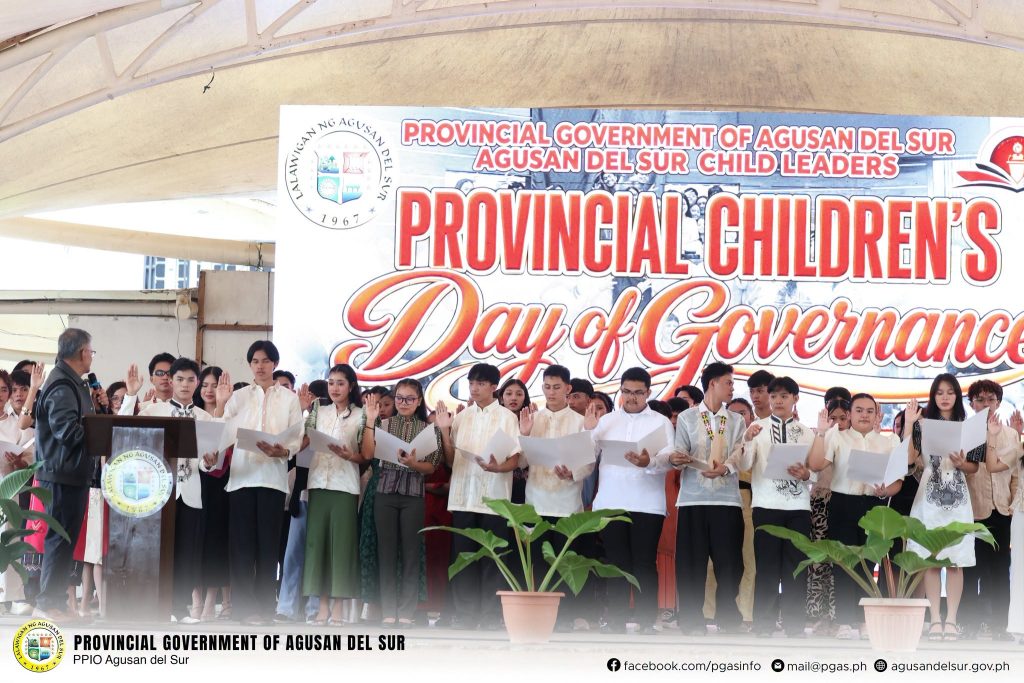
A highlight of the four-day program was the inauguration of elected and appointed child officials, who were given opportunities to observe and participate in provincial government operations.
The young officials also attended a session of the Sangguniang Panlalawigan, where they learned about legislative proceedings and the preparation of resolutions and ordinances.
Governor Santiago Cane Jr. directed provincial department heads to orient the participating children on the functions and responsibilities of their assigned offices.
He encouraged government personnel to provide the young officials with meaningful exposure to public service, including opportunities to participate in official administrative activities.
The provincial government said the initiative seeks to develop responsible young leaders while ensuring that children’s perspectives are considered in local policymaking.
Through the Children’s Congress and Day of Governance, Agusan del Sur aims to promote stronger child participation, leadership development, and cooperation between young residents and government officials in building safer and more inclusive communities.
The program also reinforces the province’s recognition of children as active partners in governance and community development rather than merely recipients of government assistance.