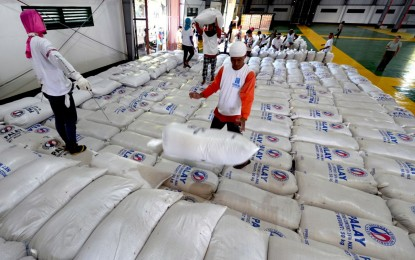

Warehouse personnel fix rice stocks at a warehouse in Malolos, Bulacan on May 26, 2025. The National Food Authority (NFA) on Thursday (June 26) imposed stricter rules on its palay (unhusked rice) procurement to ensure transparency and benefit more local farmers. (PNA photo by Ben Briones)
The National Food Authority (NFA) has rolled out stricter guidelines for its palay (unhusked rice) procurement program, aiming to bolster transparency and ensure that the benefits go directly to legitimate farmers—not traders.
The reforms were announced Thursday following reports that middlemen have been exploiting the system, crowding out genuine farmer-sellers. NFA Administrator Larry Lacson said the new policies are designed to prevent such abuses and bring more fairness to the agency’s rice-buying operations.
“Increased transparency is the core of these changes,” Lacson said in a Zoom interview. “There have been growing concerns that traders are taking advantage of the system, and we want to assure the public that we’re addressing that.”
Under the revised rules, only farmers officially registered under the Registry System for the Basic Sectors in Agriculture (RSBSA), or those with certification from their local government, will be allowed to sell to the NFA. Each qualified farmer can only sell up to 100 bags of palay per harvest season—or a total of 200 bags annually—regardless of the size of their landholding.
Lacson emphasized that the limit was intended to distribute support more equitably:
“Let’s help one another. Some farmers used to sell more than the new limit, but many others are struggling to access the program. This way, more small farmers can benefit.”
He added that selling 100 bags at the current NFA buying price of P24 per kilo, even if the rest is sold at a lower market price of PHP16, would still average to P20 per kilo—well above the production cost of P14.
To promote transparency, the NFA will now publicly disclose the names of participating farmers and the volume of palay they sold. These records will be posted on bulletin boards at NFA warehouses and offices, and on the agency’s Facebook page—provided farmers give their consent.
“We want the public and farmer groups to verify the legitimacy of these sellers. If their names are posted, others can confirm whether they’re real farmers or not,” said Lacson.
In addition, the NFA will set up special observation tables in its warehouses to allow accredited farmer organizations to witness the procurement process firsthand. Deliveries will also be closely monitored, with daily logs noting the farmer’s name, vehicle plate number, and time of arrival.
To further guard against abuse, NFA staff will verify that deliveries came directly from farms and were not repackaged by traders posing as farmers.
Lacson issued a stern warning: any farmer found to be acting as a trader—or any farmer cooperative doing the same—will be blacklisted and barred from future transactions with the NFA. Likewise, NFA personnel found violating procurement protocols may face suspension or dismissal.
“These reforms are not just about control—they’re about justice,” Lacson said. “We owe it to our real farmers to protect this system.”