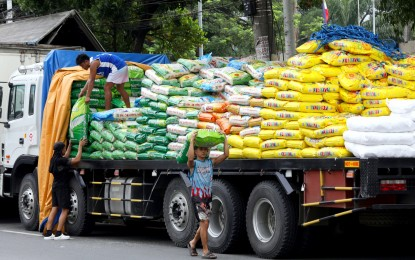

The House Quinta Comm, also known as the Murang Pagkain Super Committee, on Wednesday ordered the National Bureau of Investigation (NBI) to investigate the role of “middlemen” in alleged manipulation that has kept rice prices high, burdening Filipino consumers and farmers.
The motion, forwarded by House Deputy Majority Leader and Iloilo 1st District Rep. Janette Garin, sought to identify individuals and organizations responsible for significant markups in the rice supply chain.
“With this, Mr. Chair, will this august body allow me to put forward a motion to direct the [NBI] to investigate [both ways]—from the retailers to the middleman to the wholesalers, or wholesalers papunta rito sa mga middleman papunta sa mga retailers—so we can specifically identify the responsible people in terms of price manipulation. I so move, Mr. Chair,” said Garin.
Cavite 2nd District Rep. Lani Mercado-Revilla seconded the motion, which Albay 2nd District Rep. Joey Salceda, lead chair of the joint panel, approved.
“Are there any objections? The same is approved,” Salceda said, instructing the NBI to investigate both supply chain directions to uncover illicit practices.
Garin’s motion followed a presentation by the Philippine Competition Commission (PCC) outlining vulnerabilities in the rice supply chain, particularly among vertically integrated entities and middlemen.
In her interpellation, Garin pressed Agriculture Secretary Francisco “Kiko” Tiu Laurel Jr. to clarify which agency monitors middlemen in the rice market.
“Sa pananaw niyo po, Mr. Chair, doon sa ipinakitang flow ng [PCC] kanina, there was a chart presented by PCC and they mentioned the vertical aspect itong dito sa wholesaler papunta sa retailer, tila meron doon mga middlemen. ‘Yun po ba, kaninong ahensya ang pag-police ng mga middlemen na iyon?” Garin asked.
Laurel acknowledged that no agency is tasked explicitly with monitoring middlemen.
“In my opinion, Mr. Chair, wala,” Laurel admitted, highlighting the regulatory gaps that allow manipulative practices to persist unchecked.
Garin emphasized the impact of these gaps, noting that enacting the Rice Tariffication Law in 2019 stripped the National Food Authority (NFA) of its power to intervene and stabilize prices by selling rice.
“Natanggalan ng power ang NFA na magbenta ng bigas. Bakit ito importante? Dahil kapag nagkakaroon ng sabwatan sa baba, pumapasok ang gobyerno para magbenta at ibaba ang presyo,” she said.
During the hearing, lawmakers focused on rice importers, traders, and middlemen suspected of collusion. Despite tariff reductions—from 35% to 15%—intended to make rice more affordable, retail prices remain high, ranging from P55 to P60 per kilo.
Garin pointed out that some middlemen exploit their control over access to legitimate wholesalers, inflating prices further.
“At ‘yung retailer ay tila hindi nabibigyan ng direct na linya papunta sa totoong wholesaler kasi kontrolado nito ang mga middleman na ito,” she said.
Government data show that the tariff reductions have resulted in P13.3 billion in foregone revenues, which lawmakers suspect may have benefited rice importers and traders instead of lowering retail prices.
Garin cited the NBI’s earlier investigation into onion price manipulation as a blueprint for the rice probe.
She recalled how investigators traced transactions step by step, from wholesalers to retailers, exposing those profiting unjustly.
“Noong inisa-isa ko na, nakita natin ang mga nagtatago dahil iba ang sinasabi ng importer, wholesaler, iba naman ang sinasabi ng farmers’ association. Only to realize na ‘yung nasa gitna na siyang malaki ang kinikita, there was actually a jump of I believe P250 to P300 per kilo profit only net for that specific person and organization na ngayon nga kinakasuhan na ng NBI,” Garin said.
She urged the NBI to replicate the same approach for rice. “To clarify, Mr. Chair, my motion was for the NBI to do both ways—either retailer, backward hanggang sa source sa Customs, or from the importer papunta sa retailer—indicating the price so that we can identify whether there is price manipulation or there is unacceptable profiteering and economic sabotage at the level of the middleman.”
The upcoming NBI investigation is expected to uncover whether manipulative middlemen’s practices constitute economic sabotage or profiteering, potentially leading to criminal charges and regulatory reforms.
The Quinta Committee was established under House Resolution No. 254, introduced by Speaker Ferdinand Martin G. Romualdez. Its purpose is to conduct a comprehensive inquiry into smuggling, price manipulation, and rising hunger while advocating for systemic reforms to enhance food security and affordability.
The Quinta Committee, created by virtue of House Resolution 2036 introduced by Speaker Martin G. Romualdez and Senior Deputy Speaker Aurelio Gonzales, is composed of the House Committees on Ways and Means, Trade and Industry, Agriculture and Food, Social Services, and the Special Committee on Food Security. Ways and Means panel chair Rep. Joey Salceda leads the inquiry.
The panels are tasked to address weaknesses in government programs and ensure accountability for market abuses.
