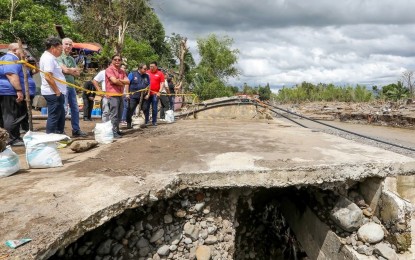

DAMAGED. President Ferdinand R. Marcos Jr. leads the inspection of the damaged Bungahin Steel Bridge during his visit to La Castellana, Negros Occidental, after the devastation of Typhoon Tino on Nov. 15, 2025. Tino is one of the natural disasters that tested the resilience and strength of Negrenses in 2025. (Photo courtesy of La Castellana DRRMO)
BACOLOD CITY – The year 2025 was full of challenges for Negros Occidental, including the highly urbanized Bacolod City, which faced natural disasters and sugar industry woes that tested the resilience and strength of Negrenses.
Despite the difficulties, the past year had put a spotlight on what its people can offer on the global stage.
Kanlaon’s unrest
About eight months after its explosive eruption in December last year, the Philippine Institute of Volcanology and Seismology (Phivolcs) lowered the status of Kanlaon Volcano to Alert Level 2 (moderate level of volcanic unrest) on July 29, from Alert Level 3 (magmatic unrest/high level of volcanic unrest).
It was a development that marked the decampment of thousands of internally displaced persons whose houses are located outside the 4-km. permanent danger zone.
Residents of the cities of Bago and La Carlota and La Castellana town within the 6-km. extended danger zone were evacuated after Alert Level 3 was raised.
The downgrading came after the volcano exhibited “less frequent volcanic earthquake activity, decreased volcanic gas emitted by subsurface magma and ground deformation cycles.”
Typhoons, floods
On Nov. 4, Typhoon Tino (Kalmaegi) brought devastation across Negros Occidental, affecting 806,665 persons from 233,437 families in at least 17 local government units (LGUs).
This is based on the report presented by Governor Eugenio Jose Lacson to President Ferdinand R. Marcos Jr., who visited the worst-hit areas in the province on Nov. 15.
Some 13,036 houses were totally damaged or destroyed, while 105,936 others were partially damaged.
Total losses in agriculture, fishery, livestock, infrastructures and schools was estimated at PHP1.85 billion.
The worst-hit LGUs included Moises Padilla, Hinigaran, Binalbagan, Isabela, and La Carlota City.
In Bacolod City, Tropical Depression Verbena brought massive floods that affected more than 50 percent of the 61 barangays due to heavy rains on Nov. 25.
Data from the city’s Department of Social Services and Development showed 5,318 families, or 15,896 persons, sought shelter in more than 60 evacuation centers across the city.
Continued assistance from the national government, particularly from the Office of the President, Department of Social Welfare and Development, and Office of Civil Defense, eased the burden for Bacolod City and Negros Occidental in responding to the effects of the series of typhoons in the past year.
‘Handa Pilipinas’ goes to Negros Island Region
On the last week of October, Bacolod City and Negros Occidental hosted the Handa Pilipinas-Visayas Leg, themed “Padayon Visayas: Science, Technology and Innovation for Resilient, United, and Sustainable Visayas.”
The three-day exposition is part of the national campaign of the Department of Science and Technology to strengthen public awareness, promote collaboration, and build resilient and sustainable communities across the country.
The event highlighted the continuing vulnerability of Visayas to natural hazards, especially earthquakes, flooding, and the ongoing activity of Kanlaon Volcano, underscoring the urgency of developing science-based, technology-driven, and community-centered solutions.
Challenges in the sugar industry
Negros Occidental, the Philippines’ top sugar-producing province, was also challenged by the infestation of red-striped soft-scale insect (RSSI) that affected more than 7,400 hectares of sugarcane fields as of the last week of October, data from the Sugar Regulatory Administration (SRA) showed.
As part of its response, the SRA has been conducting validation of reported pest incidence and collecting samples for laboratory observations of both pests and natural enemies for biocontrol.
Typhoon Tino, which brought more than PHP1.2 billion in losses to the sugar industry, was among the strongest storms with the heaviest flooding experienced by the industry in the past two decades.
“It is a major challenge to our industry that is already facing problems with the red-striped soft-scale insect infestation,” SRA Administrator Pablo Luis Azcona said.
Earlier this month, the Department of Agriculture (DA) and the SRA sustained the moratorium on sugar imports until the end of harvest or further as it cited a stronger domestic raw sugar production and the need to prioritize locally produced sugar.
Both agencies also extended the moratorium on molasses importation until March 2026 after SRA’s assessment showed that current local stocks are enough to meet domestic requirements.
Japan-Philippines collaboration for sugar industry
On the first week of December, the SRA established a demonstration site for the deep planting technology transfer from Japan at the La Granja Agricultural Research and Extension Center in La Carlota City, Negros Occidental.
Japanese Ambassador to the Philippines Endo Kazuya led a team of officials and researchers on a visit to the research center with Azcona.
Before the demonstration site was established in Negros Occidental, the deep planting technology was tested in three sites in Pampanga.
According to a study implemented by the SRA, in collaboration with Japan International Research Center for Agricultural Sciences, deep planting resulted in an increased yield of 20.8 percent to 77.23 tons per hectare, from an average yield of 63.92 tons per hectare for manual planting.
Campaign to keep Negros GMO-free
Among the top stories in Negros Occidental this year is the campaign led by the GMO-Free Negros Coalition opposing the proposed ordinance allowing the entry of living genetically modified organisms (GMOs) in the province.
The proposed “Negros Occidental GMO Regulatory Ordinance,” which was initially passed by the Provincial Board on second reading on Aug. 26, seeks to reverse the province’s 18-year-old GMO ban under Provincial Ordinance No. 07, Series of 2007 or “The Safeguard Against Living Genetically Modified Organisms.”
The local campaign has gained broad global backing, with 51 organizations from nearly 20 countries expressing support at the 8th Organic Asia Congress in Ninh Binh, Vietnam in September, and at the inaugural Terra Madre Asia and Pacific, jointly hosted by Bacolod City and Negros Occidental in November.
In defending the proposed ordinance, the Negros Occidental provincial government’s joint legal-scientific team said “there is a compelling need to amend the existing GMO ordinance to ensure consistency with the national policy framework on GMO regulation.”
Hosting of inaugural Terra Madre Asia and Pacific
On Nov. 19 to 23, Bacolod City and Negros Occidental jointly hosted the inaugural Terra Madre Asia and Pacific (TMAP), which was a celebration of good, clean and fair food, gathering farmers, fishers, chefs, indigenous leaders and advocates from more than 25 countries.
According to TMAP, the event gathered about 75,000 visitors and generated PHP46.59 million in total sales.
Attended by about 2,500 delegates, the TMAP was an “overwhelming success,” receiving notable support from the national government, particularly from the Department of Tourism, Department of Agriculture, Department of Trade and Industry, and the Technical Education and Skills Development Authority.
New leadership in Bacolod City
On June 30, this highly urbanized city ushered in a new administration, with Greg Gasataya taking over the mayor’s seat for the first time.
Gasataya, a three-term lawmaker, succeeded Alfredo Abelardo Benitez, a first-time local chief executive who was elected congressman.
Councilor Claudio Jesus Puentevella was elected vice mayor for the first time as well.
The three belong to the Team Asenso coalition that dominated the May 12 elections. (PNA)