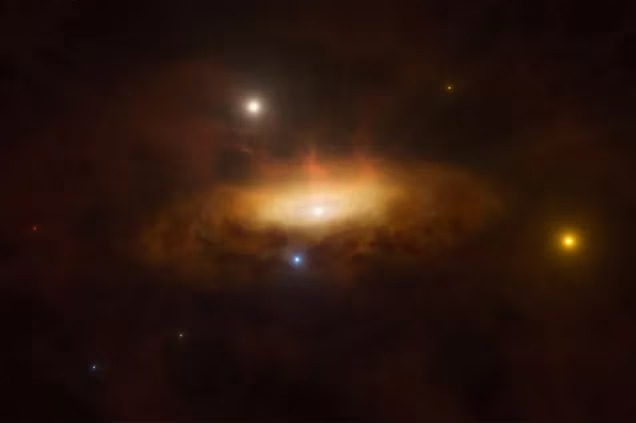
A previously quiet black hole at the center of the galaxy SDSS1335+0728 in the Virgo constellation has suddenly awakened, emitting intense X-ray flares that have caught the attention of astronomers worldwide. The galaxy, located 300 million light-years away from Earth, began shining unusually bright in 2019. But it was in February 2023 when astronomers from Chile started observing regular X-ray bursts coming from its core.
These signals are believed to be signs that the galaxy’s central supermassive black hole, now nicknamed “Ansky,” is becoming active again. The study, published in Nature Astronomy, explains that the black hole is now classified as an “active galactic nucleus.”
“This is the first time we have observed such an event in a black hole that seems to be waking up,” said Lorena Hernandez-Garcia, an astronomer at Valparaiso University in Chile. “We don’t yet understand what causes them.”
These short-lived X-ray flares, known as quasiperiodic eruptions (QPEs), are happening every 4.5 days—the longest interval ever recorded for this type of event. The energy and length of Ansky’s flares are also far greater than previously observed QPEs.
“Each of these eruptions is releasing a hundred times more energy than we have seen elsewhere,” said Joheen Chakraborty, a PhD student at MIT and a member of the research team.
Interestingly, there’s no sign that the black hole recently swallowed a star, which is the usual cause for such events. One theory suggests that a small celestial object might be orbiting the black hole and crossing its disc regularly, producing the bursts.
“Simply imagine a black hole and disc around it,” explained Norbert Schartel, chief scientist of the European Space Agency’s XMM-Newton telescope. “Now imagine the star crossing the disc twice every time it orbits — shooting out flares — but at a particular angle which means ‘there is no real strong force to drag it in.’”
Despite the growing number of models and theories, astronomers admit more data is needed.
“For QPEs, we’re still at the point where we have more models than data,” said X-ray astronomer Erwan Quintin. “We need more observations to understand what’s happening.”