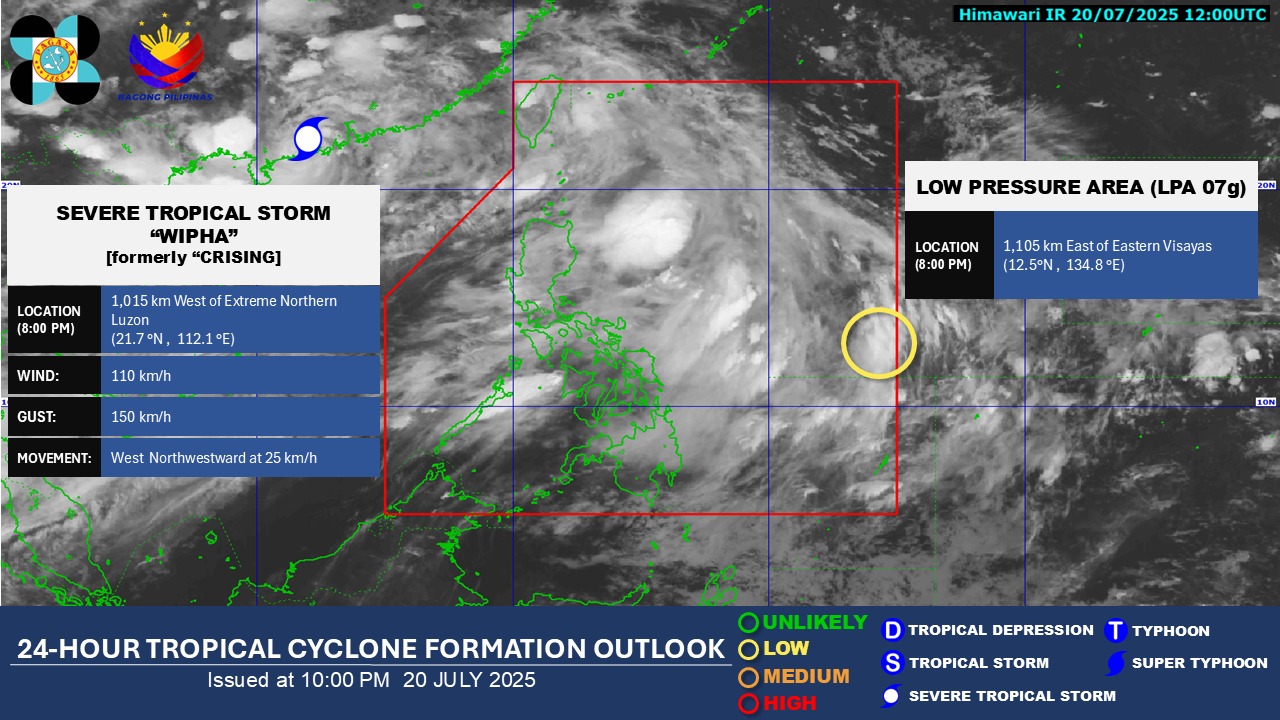

As the country continues to reel from last week’s downpour, the southwest monsoon, or habagat, refuses to loosen its grip, with the Philippine Atmospheric, Geophysical and Astronomical Services Administration (PAGASA) warning of more rains across wide areas of Luzon and the Visayas.
While most eyes are drawn to a developing low-pressure area (LPA) spotted 1,140 kilometers east of Southeastern Luzon early Monday morning, forecasters say it poses no immediate threat. However, it adds a layer of concern to an already weather-battered landscape.
“This LPA is unlikely to become a cyclone within the next 24 hours,” PAGASA meteorologist Ana Clauren Jordan explained. “But the more pressing issue remains the habagat, which will continue to bring persistent rain in several parts of the country.”
Hardest hit will be provinces along the western seaboard including Zambales, Bataan, and Occidental Mindoro. Meanwhile, occasional rains are forecast in Metro Manila and nearby provinces including Ilocos, Benguet, Tarlac, Pampanga, Bulacan, Cavite, Laguna, Batangas, Rizal, and Oriental Mindoro.
“These rains, especially in mountainous areas, bring real risk of flooding and landslides,” Jordan warned in a radio interview. “We urge residents in vulnerable areas to remain alert.”
Elsewhere in the country, the rest of Luzon, along with the Visayas, Zamboanga Peninsula, and Northern Mindanao, can expect overcast skies peppered with scattered rainshowers and thunderstorms. Conditions are improving across other parts of Mindanao, though localized afternoon and evening rain is still likely.
This prolonged wet spell comes on the heels of devastation brought by the recent tropical cyclone Crising, which intensified the southwest monsoon and left a trail of destruction. According to the National Disaster Risk Reduction and Management Council (NDRRMC), the storm’s impact claimed at least five lives and disrupted the lives of over 800,000 individuals. Nearly 6,000 families were forced to flee their homes and seek refuge in evacuation centers.
As weather patterns grow increasingly unpredictable, authorities are doubling down on their calls for vigilance. The Department of the Interior and Local Government (DILG) has instructed local governments to be on high alert, especially in flood- and landslide-prone communities.
Though the looming LPA may not develop into a major threat, PAGASA continues to track its path. In the meantime, the persistent influence of the habagat remains the country’s primary weather driver—one that could linger in the days to come.
“Preparedness should not depend on cyclone classification,” an NDRRMC official stated. “It’s the rain and its aftermath we should always be ready for.”