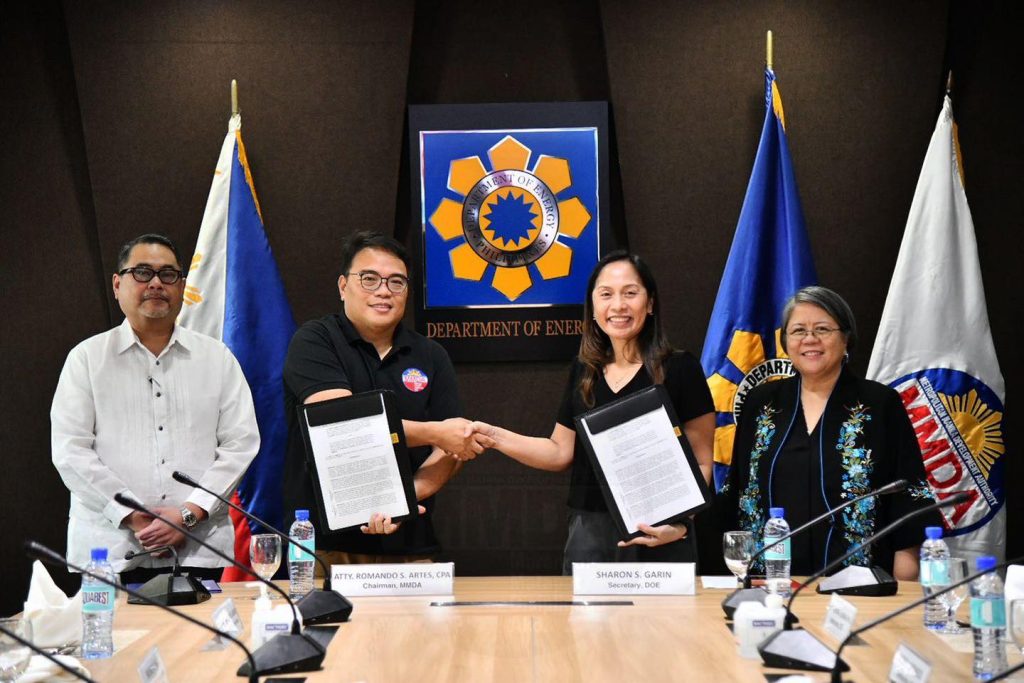

(Photo courtesy : PIA)
The Metropolitan Manila Development Authority and the Department of Energy have formalized a partnership aimed at tackling Metro Manila’s growing landfill crisis through a waste-to-energy program that will convert residual waste into usable power.
The memorandum of agreement was signed on Tuesday by MMDA Chairman Don Artes and Energy Secretary Sharon Garin, establishing a framework that links solid waste management with energy generation. Under the agreement, non-recyclable and residual waste collected by local government units will be directed to specialized facilities where it can be processed into electricity, heat, or fuel instead of being dumped in already strained landfills.
Officials said the initiative is anchored on a three-pronged objective of reducing waste volume, mitigating flooding, and expanding energy supply. By diverting residual waste that often ends up clogging drainage systems and waterways, the agencies expect improvements in flood control while generating additional power for communities in the metropolis.
Artes said the partnership reflects a shift toward a more integrated approach to urban waste management. “Through this partnership, we aim to advance a more effective, resilient, and sustainable approach to solid waste management in Metro Manila,” he said.
The agreement follows months of inter-agency coordination and consultations with local chief executives. In November 2025, mayors across Metro Manila met at the MMDA Main Office in Pasig City to authorize the deal, amid growing concern that existing sanitary landfills, including sites in Rizal and San Mateo, are nearing full capacity. The discussions were intensified by the permanent closure of the Navotas Sanitary Landfill earlier in 2025, which forced cities to reroute hundreds of tons of daily waste to alternative disposal sites.
Garin said the collaboration allows national energy goals to be aligned with the operational challenges faced by Metro Manila. “Together, we share this responsibility to envision a cleaner, greener Metro Manila,” she said, adding that the agreement enables both agencies to support pilot waste-to-energy projects.
The initiative also builds on the MMDA’s “Road to Zero Waste” program launched in early 2025. While recycling rates across the region have shown improvement, technical working group meetings held later in the year underscored that residual waste remains a major environmental concern. The waste-to-energy system is intended to address this gap by processing materials that cannot be recycled and converting them into additional electricity that can benefit barangays and cities.
For the first phase of implementation, the MMDA and DOE are coordinating closely with LGUs to secure feedstock service agreements. These arrangements are expected to ensure a steady supply of residual waste for the facilities while supporting the broader goal of keeping Metro Manila’s waterways clear and its waste management system sustainable.