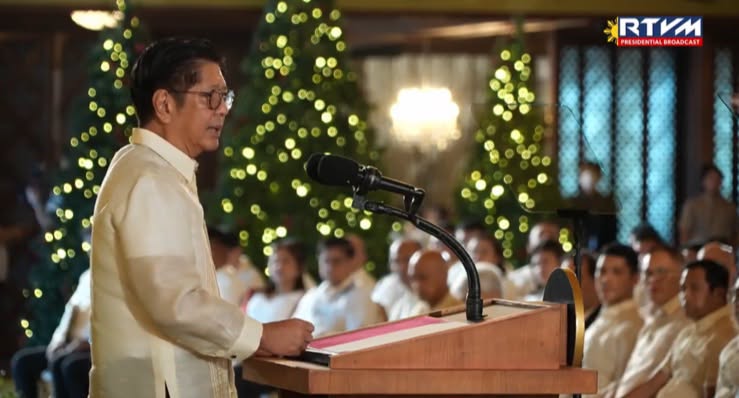

(Screengrab from RTVM)
President Ferdinand Marcos Jr. on Thursday warned local government units (LGUs) against corruption and misuse of disaster rehabilitation funds as the national government allocated Php 8.645 billion to help 306 disaster-affected localities rebuild damaged infrastructure and restore livelihoods.
Speaking during the ceremonial turnover of funds under the Disaster Rehabilitation and Reconstruction Assistance Program (DRRAP) at Malacañan Palace, Marcos emphasized that the assistance must be used exclusively for recovery and reconstruction efforts.
“Pera po ito ng taumbayan at para ito sa mga kababayan nating nasalanta. Hindi ito pondo para pagkakitaan at hindi rin ito pondo para sinumang gustong magpayaman sa gitna ng ating mga nararamdaman na trahedya,” Marcos said.
He stressed that public funds intended for disaster victims must not be diverted to fraudulent projects, kickbacks or substandard construction.
“There must be no room for corruption in this program. Bawal ang ghost projects. Bawal ang mga komisyon. Bawal mga substandard na rehabilitation projects,” he added.
The President warned that officials or individuals found exploiting disaster rehabilitation programs for personal gain would face legal consequences.
“Anyone who tries to profit from the suffering of our fellow Filipinos will face the full force of the law. So, to our LGUs, I enjoin you, use these funds wisely and serve our people with the honesty, the diligence that they deserve,” Marcos said.
Php 8.645 billion allocated for disaster recovery
Marcos said the government approved Php 8.645 billion in rehabilitation assistance for 306 LGUs affected by typhoons, earthquakes and volcanic activity between 2024 and 2026.
Of the total allocation, Php 6 billion has already been released, while a second tranche amounting to more than Php 2.5 billion has been approved and is being transferred to recipient LGUs.
The funds will support the repair and reconstruction of damaged roads, bridges, public buildings and evacuation centers.
Assistance will also cover the rehabilitation of agriculture, housing, educational facilities, health services and livelihood programs in affected communities.
Marcos said the government streamlined the release of rehabilitation assistance to address delays that previously prevented local governments from immediately implementing recovery projects.
He noted that the processing period for rehabilitation assistance has been reduced from eight to 11 months to approximately four to six months, depending on the type of intervention.
The President said the shorter processing period would allow LGUs to respond more quickly to the needs of disaster-affected residents.
Assistance based on need, not politics
Marcos also assured local officials that the distribution of rehabilitation funds would be determined by the needs of affected communities rather than political affiliation.
“It is with trust that we hand it to you based on need—no political color considered,” he said.
Under the DRRAP, local governments receive direct financial assistance and are responsible for identifying priority rehabilitation projects based on conditions in their respective communities.
Marcos emphasized that LGUs are best positioned to determine which facilities, services and livelihood programs require immediate restoration.
“We trust our LGUs know what is best for their communities. In turn, we will provide the resources that you need to carry out these interventions,” he said.
The President also directed local officials to improve the documentation and reporting of disaster damage to the Office of Civil Defense and the National Disaster Risk Reduction and Management Council.
He said accurate and timely reports would help the national government assess the extent of damage, identify urgent requirements and provide appropriate assistance.
The Php 8.645-billion rehabilitation allocation covers communities affected by major disasters from 2024 to 2026, including the eruption of Kanlaon Volcano.
Marcos reaffirmed the national government’s commitment to supporting local recovery efforts while ensuring accountability and transparency in the use of public funds.
He said cooperation between national agencies and LGUs would remain essential to restoring damaged communities and strengthening their resilience against future disasters.