
(RTVM screengrab)
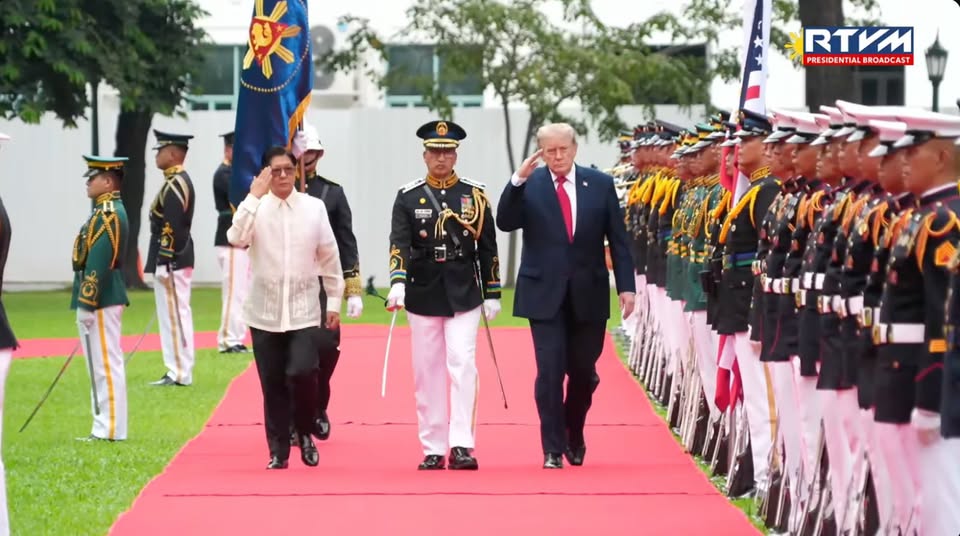
MANILA – President Ferdinand Marcos Jr. and United States President Donald Trump reaffirmed the longstanding alliance between the Philippines and the United States on Wednesday, November 18, with both leaders emphasizing their shared history, defense commitments, and plans to expand cooperation in security, energy, trade, and technology.
During their bilateral meeting at Malacañang, Trump described the Philippine-US partnership as a relationship built on generations of shared sacrifices, particularly during periods when American and Filipino forces fought alongside each other.
“Generations of Americans and Filipino patriots have served side by side and formed a bond, and it’s a bond formed in blood, defending the sovereignty and liberty of both of our nations,” Trump said.
The American leader described the Philippines as one of Washington’s oldest and most important allies in the Pacific, reaffirming his administration’s commitment to maintaining close relations with Manila.
“America stands with the Filipino people, just as we have for generations,” Trump said.
“Our alliance has never been better,” he added, citing his close working relationship with Marcos.
Marcos, meanwhile, highlighted the historical significance of the visit as the Philippines and the United States commemorate the 80th anniversary of diplomatic relations and the 75th anniversary of their Mutual Defense Treaty (MDT).
The President said the bilateral partnership has continued to evolve beyond traditional security cooperation, with both countries exploring opportunities in emerging technologies and other strategic industries.
“The United States is our only treaty ally, and our relationship has continued to grow and evolve over the many years,” Marcos said.
Expanded defense cooperation
Defense cooperation remained a central focus of the bilateral discussions, with Trump announcing continued efforts to strengthen military ties and enhance the Philippines’ defense capabilities.
Trump cited increased US foreign military financing for the Philippines and approved arms sales worth more than USD5 billion since he assumed office.
“Working with President Marcos, we’re also expanding our defense cooperation, which has always been a key pillar of security for this part of the world,” Trump said.
The two countries maintain a defense alliance under the 1951 Mutual Defense Treaty, which commits both nations to act against common dangers arising from armed attacks in the Pacific, in accordance with their respective constitutional processes.
The renewed commitment comes amid continuing maritime security concerns in the Indo-Pacific, particularly tensions in the South China Sea.
Energy and nuclear technology
Beyond defense, Trump identified energy cooperation as another potential area for expanding economic relations between Manila and Washington.
He highlighted American oil and natural gas production and discussed plans for a major pipeline project in Alaska that could support energy exports to US allies and partners across the Pacific.
Trump described the Philippines as a “natural partner” in the proposed initiative, indicating that discussions between the two governments were underway.
The US president also raised the possibility of cooperation in civilian nuclear energy, saying the two countries were exploring opportunities involving American nuclear technology.
According to Trump, the Philippines’ potential adoption of US technology for its first modern nuclear energy project could further strengthen bilateral ties.
However, specific project agreements, investment commitments, and implementation timelines were not detailed during the remarks.
Trade and investment
Trump also emphasized the importance of the Luzon Economic Corridor, a trilateral initiative involving the Philippines, the United States, and Japan.
The initiative seeks to attract USD100 billion in investments from partner countries to support infrastructure development, strategic industries, and economic security.
Trump said the economic corridor could help strengthen the Philippines’ industrial capacity and support the development of critical sectors.
He assured Marcos that Washington would remain engaged in the initiative as both countries pursue greater investment and economic cooperation.
The project forms part of broader efforts to strengthen supply chains, improve connectivity, and encourage investments in industries considered essential to long-term economic growth.
ASEAN cooperation
The bilateral meeting also covered regional cooperation following the ASEAN-US Special Summit hosted by Marcos on Tuesday, November 17.
Trump thanked the Philippine president for hosting the gathering and the 49th ASEAN Summit and Related Summits, which brought together Southeast Asian leaders and international partners in Manila.
The American leader praised Marcos’ leadership during the regional meetings, saying ASEAN leaders held the Philippine president in high regard.
The discussions reflected the importance Washington places on its partnership with Manila and its broader engagement with Southeast Asia.
The two leaders’ reaffirmation of their alliance comes as the Philippines and the United States mark major diplomatic and defense milestones, with both governments seeking to deepen cooperation in traditional security matters and emerging economic sectors.
Their meeting underscored the continuing role of the Philippine-US partnership in regional security while opening discussions on potential cooperation in energy, technology, and investment.