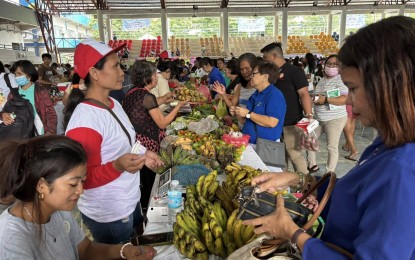

Consumers purchase fruits and vegetables directly from farmers at Kadiwa sa Pangulo in Dumaguete City, Negros Oriental on Sept. 13, 2025. President Ferdinand R. Marcos Jr. on Saturday (Oct. 25) issued Executive Order No. 101, directing the full implementation of the Sagip Saka Act, which establishes a program for farmers and fisherfolk aimed at improving their production and productivity. (PNA file photo by Judy Partlow)
President Ferdinand R. Marcos Jr. has signed Executive Order (EO) No. 101, mandating the nationwide enforcement of Republic Act No. 11321, or the Sagip Saka Act, to strengthen government support for farmers and fisherfolk and improve agricultural productivity across the Philippines.
Under EO 101, all national government agencies (NGAs), government-owned and -controlled corporations (GOCCs), and state universities and colleges (SUCs) must align their programs and projects with the objectives of the Sagip Saka program, which seeks to uplift the livelihoods of local agricultural producers through direct government support, market access, and enterprise development.
Local government units (LGUs) are likewise urged to participate in the program’s implementation, helping farmers and fisherfolk achieve higher productivity and income.
EO 101 directs all government entities to directly purchase agricultural and fishery products from accredited farmers and fisherfolk cooperatives and enterprises (FFCEs), exempting such procurement from public bidding in accordance with negotiated procurement rules under Republic Act No. 12009 or the New Government Procurement Act.
The order also requires all government institutions to ensure that rice and other food products served in official functions, canteens, and events are sourced directly from local producers. This measure aims to promote the consumption of locally grown food while sustaining the incomes of small agricultural stakeholders.
Promoting convergence for inclusive growth
To ensure effective coordination, the order calls for stronger collaboration among government agencies, LGUs, private sector partners, civil society organizations, academic institutions, and development partners. The goal is to foster inclusive, sustainable agricultural growth and guarantee consistent access to markets and government assistance for small-scale producers.
The Department of Agriculture (DA) has been tasked to establish Sagip Saka desks in all regional and field offices to serve as one-stop centers for information, assistance, and coordination.
The Farmers and Fisherfolk Enterprise Development Council—created under the Sagip Saka Act—will oversee the implementation of EO 101, monitor its progress, and submit biannual reports to the Office of the President.
Enacted in 2019, the Sagip Saka Act aims to empower Filipino farmers and fisherfolk by integrating them into the value chain, improving their productivity, and promoting local procurement to ensure a stable source of income.
EO 101 takes effect immediately upon its publication in the Official Gazette or in a newspaper of general circulation.