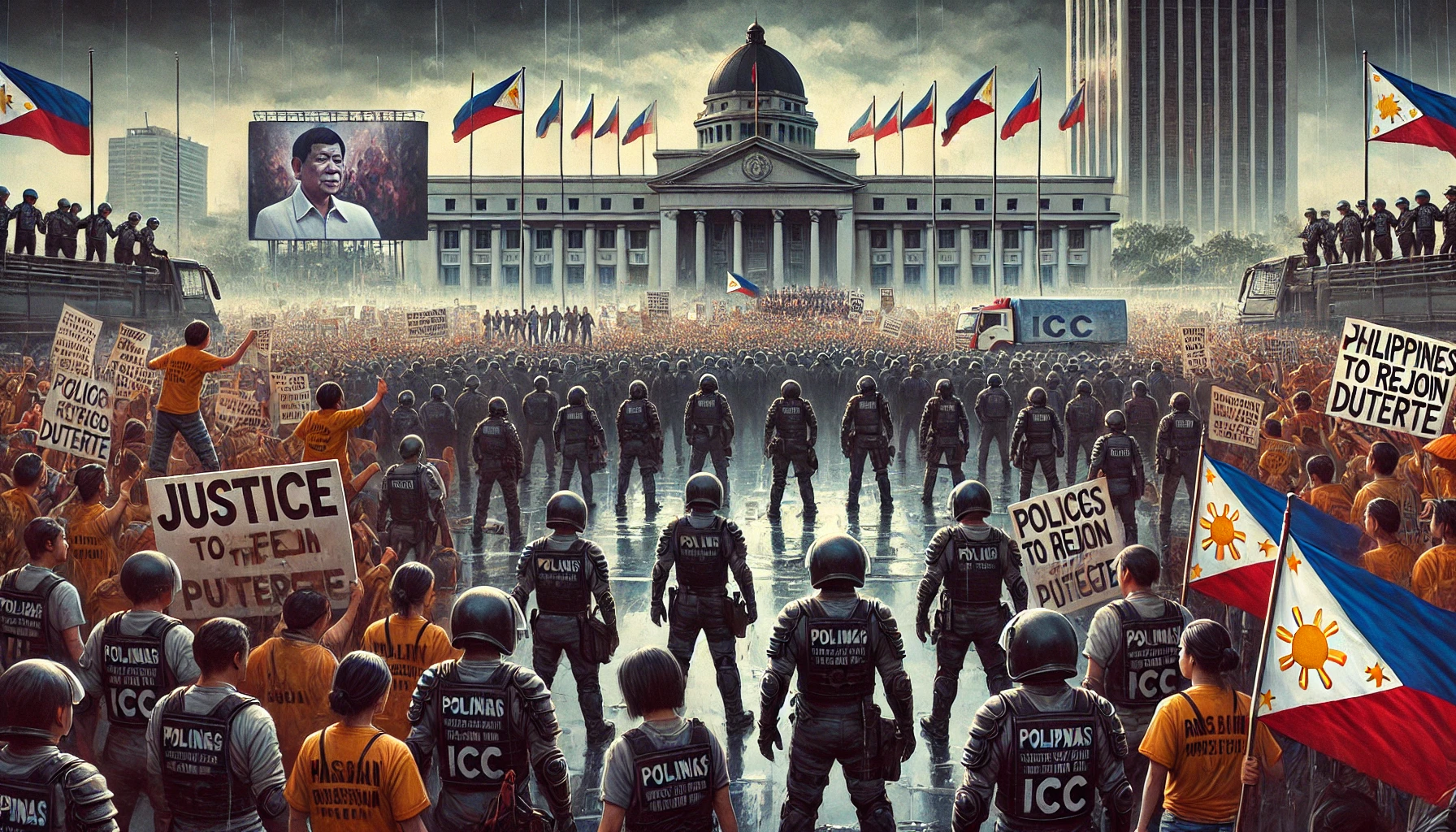

The administration of President Ferdinand Marcos Jr. is facing calls to reconsider rejoining the International Criminal Court (ICC) following the arrest of former President Rodrigo Duterte.
Human Rights Watch (HRW) has urged the government to take this step and initiate investigations into other officials implicated in the controversial war on drugs, in an effort to dispel allegations that Duterte’s arrest is being used as a political weapon.
Duterte was detained last Tuesday and swiftly transported to the Netherlands, where he made his first appearance before the ICC in The Hague. He faces charges of crimes against humanity, specifically murder, related to his administration’s brutal anti-drug campaign.
A logical move for the Marcos administration
In light of the situation, several lawmakers have proposed reinstating the Philippines as a member of the ICC. Carlos Conde, a senior researcher at HRW, emphasized in an interview with Teleradyo Serbisyo that rejoining the ICC is the “only logical move” for the Marcos administration.
“If the Marcos administration is consistent in recognizing the ICC’s value and truly intends to improve the country’s human rights situation, then it has no choice but to bring the Philippines back into the ICC,” Conde stated.
Failure to do so, he warned, could fuel resentment among Duterte supporters, as it might be perceived that the current government is merely leveraging the issue for political gains. Although Marcos Jr. has previously asserted that the Philippines does not recognize the ICC’s jurisdiction, his administration has shown some flexibility. Recently, the government acknowledged that it would not obstruct an International Criminal Police Organization (Interpol) request for assistance in executing an ICC warrant, which ultimately led to Duterte’s arrest.
Beyond rejoining the ICC
Conde stressed that simply rejoining the ICC would not suffice. He called on Marcos Jr. to ensure a comprehensive investigation into law enforcement officials and other key figures who were instrumental in implementing Duterte’s anti-drug operations.
“The government must not stop at rejoining the ICC. It also needs to investigate members of the police force and other officials who carried out the killings under Duterte’s watch,” Conde insisted.
One notable figure he identified is Senator Ronald “Bato” Dela Rosa, the former Philippine National Police chief and primary enforcer of Duterte’s drug war. Dela Rosa has indicated his willingness to join Duterte in The Hague should legal avenues to avoid prosecution be exhausted. He has also expressed a desire to seek protection within the Senate if the ICC issues a warrant for his arrest.
Duterte supporters’ reactions and disinformation
Following Duterte’s arrest, his allies—including Vice President Sara Duterte and his legal team—have framed the event as “state kidnapping.” Some have even criticized the manner of his arrest, alleging that authorities failed to read his Miranda rights, despite video evidence and statements from the Criminal Investigation and Detection Group (CIDG) disproving these claims.
Conde dismissed these arguments as attempts to divert attention from the real issue—the loss of thousands of lives due to Duterte’s violent drug war. “The focus should remain on the estimated 30,000 extrajudicial killings that took place under Duterte. He is receiving proper treatment in The Hague; the concern should be for his victims,” he said.
He also urged Duterte’s supporters to stop “gaslighting” the public and instead acknowledge the gravity of the human rights violations committed. “The drug war was the worst human rights catastrophe in Philippine history—far worse than even the Marcos dictatorship. If people continue fixating on the circumstances of Duterte’s arrest instead of the atrocities committed, they need to reassess their moral compass.”
Establishing a pattern to prove crimes against humanity
The ICC’s case against Duterte currently references 43 killings, a fraction of the 30,000 extrajudicial executions reported by human rights organizations and the 6,000 officially acknowledged by the Philippine National Police. However, Conde explained that proving a “pattern” in these cases is key to establishing the crime of humanity.
Since the ICC opened its preliminary investigation in 2018, gathering evidence has been challenging, as many victims’ families have been reluctant to come forward. “It has been difficult to find witnesses willing to testify or file complaints in The Hague because they have already been denied justice in the Philippines,” Conde noted.
“To establish that crimes against humanity were committed, the ICC needs to demonstrate a clear pattern of killings. Even a small number of well-documented cases can be sufficient to prove this before the court.”
Moving forward
The Marcos administration now faces a crucial decision. Will it align itself with the international community and take meaningful steps to address past human rights abuses, or will it risk further alienating a divided nation? Rejoining the ICC and launching independent investigations into all those involved in the drug war could demonstrate a genuine commitment to justice—one that goes beyond political maneuvering.