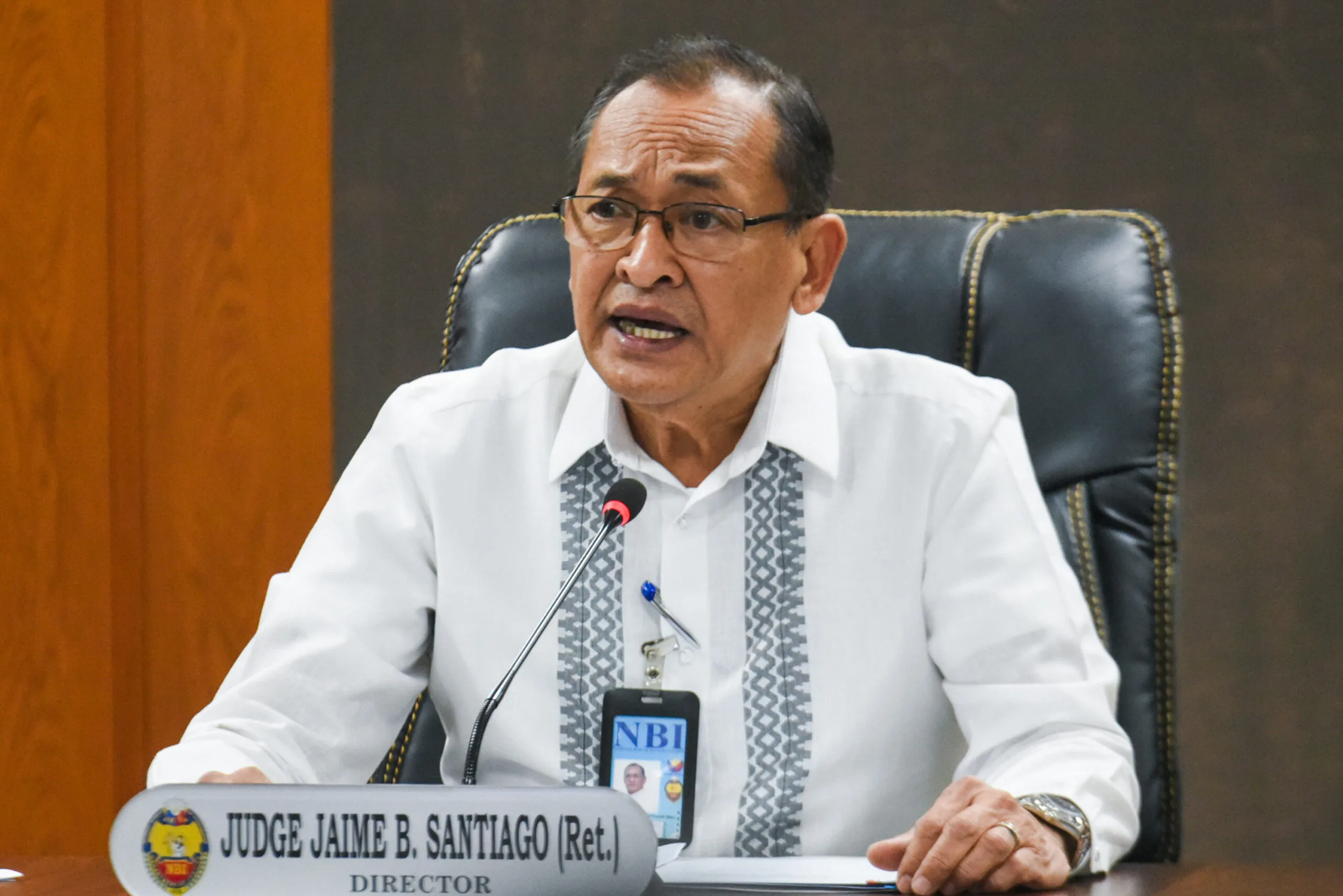

The country’s top investigative agency faces a sudden change in leadership following the resignation of National Bureau of Investigation (NBI) Director Jaime Santiago, who stepped down after barely a year in office.
Justice Secretary Jesus Crispin Remulla confirmed the resignation on Saturday, August 16, noting that the move opens another chapter in the NBI’s history of abrupt leadership shifts.
Santiago, in a letter to President Ferdinand Marcos Jr., described his decision as necessary to protect his integrity against what he called a “coordinated effort” to discredit him. The longtime public servant said he refused to allow “lies repeated over time” to overshadow his decades of work in law enforcement, prosecution, and the judiciary.
His exit comes at a time when the NBI has been in the spotlight for handling high-profile operations, including the arrest and deportation of controversial figures linked to Philippine offshore gaming operators (POGOs), as well as the complex repatriation of former Negros Oriental lawmaker Arnolfo Teves from Timor-Leste.
Santiago’s background in law enforcement was often highlighted as a strength. Before becoming NBI chief, he wore many hats: a sharpshooter in the Manila Police District’s SWAT unit, an assistant city prosecutor under the DOJ, and later a presiding judge in Manila and Tagaytay. Supporters said these roles allowed him to steer the Bureau with credibility, but detractors increasingly questioned his leadership.
His resignation underscores a recurring challenge in Philippine institutions: the tug-of-war between reformist leaders and political undercurrents. Leadership changes at the NBI have historically been shaped not only by performance but also by shifting alliances and behind-the-scenes maneuvering.
For Santiago, the tipping point was what he saw as relentless attempts to undermine his name. In his letter, he stressed that while he was prepared to continue serving, he chose to step aside to avoid further disruption to the Bureau’s operations.
Santiago took over the helm in June 2024 after the retirement of career officer Medardo de Lemos. His departure leaves the Marcos administration with another critical appointment to fill—one that will determine the direction of the NBI at a time when the agency is expected to take on more politically sensitive cases.
The resignation raises key questions: Can the next NBI chief withstand the same pressures that Santiago claims forced his hand? And more importantly, will the institution be allowed to focus on its mandate of justice without becoming entangled in political crossfire?
For now, the Bureau awaits the appointment of Santiago’s successor—a decision that will signal how the administration intends to balance stability, integrity, and the demands of political reality.