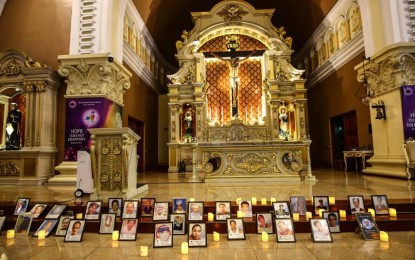

Photos of supposed extrajudicial killing (EJK) victims under the Duterte administration’s drug war are displayed at the Sacred Heart Parish in Kamuning, Quezon City during a Mass held on March 11, 2025. Several lawmakers on Wednesday (July 9, 2025) filed a measure seeking to classify EJK as a heinous crime and seek justice for the victims of the previous administration’s drug war. (PNA photo by Joan Bondoc)
A group of influential lawmakers in the House of Representatives has reignited the push to deliver justice for victims of extrajudicial killings (EJKs), particularly those linked to former president Rodrigo Duterte’s bloody war on drugs.
Refiling House Bill No. 1629, leaders of the House Quad Committee (Quadcom) want EJKs officially classified as heinous crimes, with tougher penalties and broader accountability mechanisms. The bill is jointly authored by Reps. David “Jay-jay” Suarez, Bienvenido Abante Jr., Romeo Acop, Zia Alonto Adiong, Paolo Ortega V, Ernesto Dionisio Jr., Rodge Gutierrez, Lordan Suan, Jay Khonghun, Gerville “Jinky Bitrics” Luistro, and Jonathan Keith Flores.
Several of the authors, including Ortega, Abante, Luistro, Khonghun, Adiong, Dionisio, and Suan, personally led the filing of the bill in Congress on Wednesday.
Originally filed during the early days of the 19th Congress, the measure stemmed from Quadcom’s in-depth investigation into unlawful killings committed outside legal processes.
At the heart of the proposal is a clear legal definition of extrajudicial killing: “the taking of life without the sanction of lawful judicial process.” If passed, the bill would impose life imprisonment on public officials, state agents, or anyone acting under government authority who commits or orders such killings.
The proposal directly addresses the widespread violence tied to Duterte’s anti-drug campaign. According to the Commission on Human Rights, between 2016 and 2022, at least 846 cases of EJKs were investigated. Of these, 577 were allegedly perpetrated by law enforcement officers, while the remaining 269 were attributed to unidentified assailants.
The bill takes aim not just at individual perpetrators but also at systemic failure. Senior police or military officers who order their subordinates to carry out killings would be held equally accountable. Public officials may be presumed negligent if EJK cases rise under their watch, especially if they receive intelligence or peace and order funds.
To support victims’ families, the bill proposes the creation of the Extrajudicial Killings Claims Board under the Commission on Human Rights. This body would be tasked with granting both monetary and non-monetary reparations, with compensation ranging from P250,000 to P500,000. The Department of Health and the Department of Social Welfare and Development would also be required to provide psychosocial support and educational assistance to affected families.
The authors emphasized the urgency of the legislation in their explanatory note, warning that EJKs “pose a serious challenge to democratic institutions and erode public confidence in the justice system.” They added, “When perpetrators are not held accountable, impunity thrives and the most basic human rights are rendered hollow.”
Beyond domestic concerns, the bill also reinforces the Philippines’ obligations under the International Covenant on Civil and Political Rights, which requires signatory states to uphold the right to life and prevent arbitrary killings.
“This legislation is about more than just punishment,” the lawmakers said. “It is about restoring accountability, strengthening democratic values, and making it clear that the State will never turn a blind eye to violence committed outside the law.”