
(Photo courtesy of PIA)
DAVAO CITY – Southeast Asian leaders discussed measures to address transboundary haze pollution caused by forest fires in Indonesia during the 49th ASEAN Summit in Manila, emphasizing stronger law enforcement, regional cooperation, and the protection of public health.
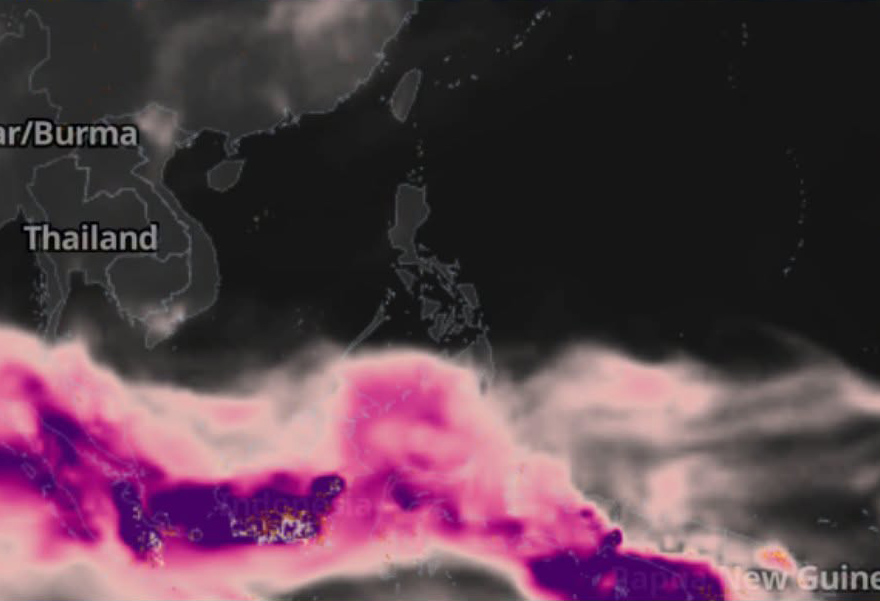
The issue was among the environmental concerns raised during the regional gathering, particularly as smoke from forest fires in Indonesia’s Kalimantan, Sumatra, and Papua regions affected neighboring countries, including the Philippines.
Foreign Affairs Secretary Maria Theresa Lazaro said Indonesia acknowledged the seriousness of the problem and outlined its efforts to contain forest fires responsible for the recurring haze.
“Indonesia was very frank and candid in expressing the efforts that they have been exerting in addressing the forest fires,” Lazaro said during a press conference.
She said ASEAN leaders also discussed strengthening enforcement measures against companies and individuals whose activities contribute to forest destruction and haze pollution.
“There were also discussions about strengthening law enforcement against companies and people with disruptive practices that have caused the haze and forest fires in Indonesia,” she added.
The leaders also encouraged ASEAN member states to prioritize the ratification of the agreement establishing the ASEAN Coordinating Centre for Transboundary Haze Pollution, which is intended to strengthen regional coordination in preventing and responding to haze incidents.
Indonesian president apologizes to neighboring countries
During the ASEAN leaders’ plenary session on November 15, Indonesian President Prabowo Subianto apologized to Malaysia and Singapore for the smoke pollution caused by extensive forest fires in his country.
“I would like to apologize to my neighboring countries, Malaysia and Singapore, when we had a very big forest fire which nearly took us four months to control. The haze traveled to Malaysia and to Singapore. It is not our fault, but once again we apologize, and we have done our best,” Prabowo said.
The Indonesian leader’s remarks highlighted the cross-border impact of forest fires, which can spread smoke and airborne pollutants across Southeast Asia depending on prevailing weather conditions.
Davao air quality improves after months of haze
In the Philippines, the Davao Region was among the areas affected by haze originating from Indonesia.
Air quality monitoring conducted from August to early October recorded unhealthy and, at times, very unhealthy conditions in parts of the region.
Environmental Management Bureau-Davao Regional Director Alnulfo Alvarez said air quality had since improved, with monitoring results from late October to November 16 showing generally good conditions.
Alvarez attributed the improvement partly to rainfall in Indonesia, particularly in Kalimantan and Papua, which helped suppress fires in areas previously identified as major sources of haze.
“Because of the series of rainfall experienced by Indonesia, especially in Kalimantan and Papua, yung hotspot areas, source of transboundary haze na-burn down na siya they are in alert level zero, meaning good na yung situation in Indonesia,” Alvarez said.
He explained that the reduction in fire activity helped improve atmospheric conditions in affected areas of Mindanao.
However, he stressed that continued monitoring remains necessary because haze can return when weather conditions favor the movement of smoke across national boundaries.
Haze poses risks to public health
During the height of the haze episode, an air quality monitoring station in Calinan, Davao City, recorded unhealthy pollution levels.
Alvarez said one monitoring period even registered very unhealthy air quality, prompting concerns about exposure among vulnerable residents.
“There was one time monitoring showed a result of very unhealthy, which means our going outside is limited, especially for those na asthmatic or meron sila respiratory diseases – they are not advised to go outside,” he said.
People with asthma and other respiratory illnesses face greater risks during severe haze episodes because airborne pollutants can aggravate existing health conditions.
Alvarez explained that the movement and concentration of haze depend heavily on atmospheric conditions, including wind direction, humidity, temperature, and rainfall.
“The regional transboundary haze depends on the meteorological parameters, meaning the wind direction, the humidity, the temperature of the air and the rainfall; these are the major factors that influence the haze,” he said.
These conditions can determine whether smoke from forest fires remains concentrated near its source or travels hundreds of kilometers to neighboring countries.
El Niño raises concerns over renewed forest fires
The EMB regional director also warned that El Niño could increase the risk of renewed forest fires and transboundary haze, particularly in areas where land clearing through burning continues.
Alvarez cited concerns over the conversion of forestlands into agricultural areas, including palm oil plantations, and the burning of peatlands.
Peat fires are particularly difficult to extinguish because combustion can continue beneath the ground even after surface flames have disappeared.
“If they continue with the burning, since this is a conversion of forest land into agricultural land purposely for palm oil, and they are worrying about the burning of peatlands, murag marshes because nasa ilalim ang burning nya (the burning is underneath), it is still burning; with a strong El Niño it will trigger another fire,” Alvarez said.
Prolonged dry conditions associated with El Niño could further increase the vulnerability of forests and peatlands to fires, potentially worsening haze pollution across the region.
The discussions at the ASEAN Summit underscored the need for stronger regional coordination, effective enforcement against destructive land-clearing practices, and sustained air quality monitoring.
For the Philippines, particularly Mindanao, continued cooperation with neighboring countries remains important in reducing the health and environmental risks associated with transboundary haze.