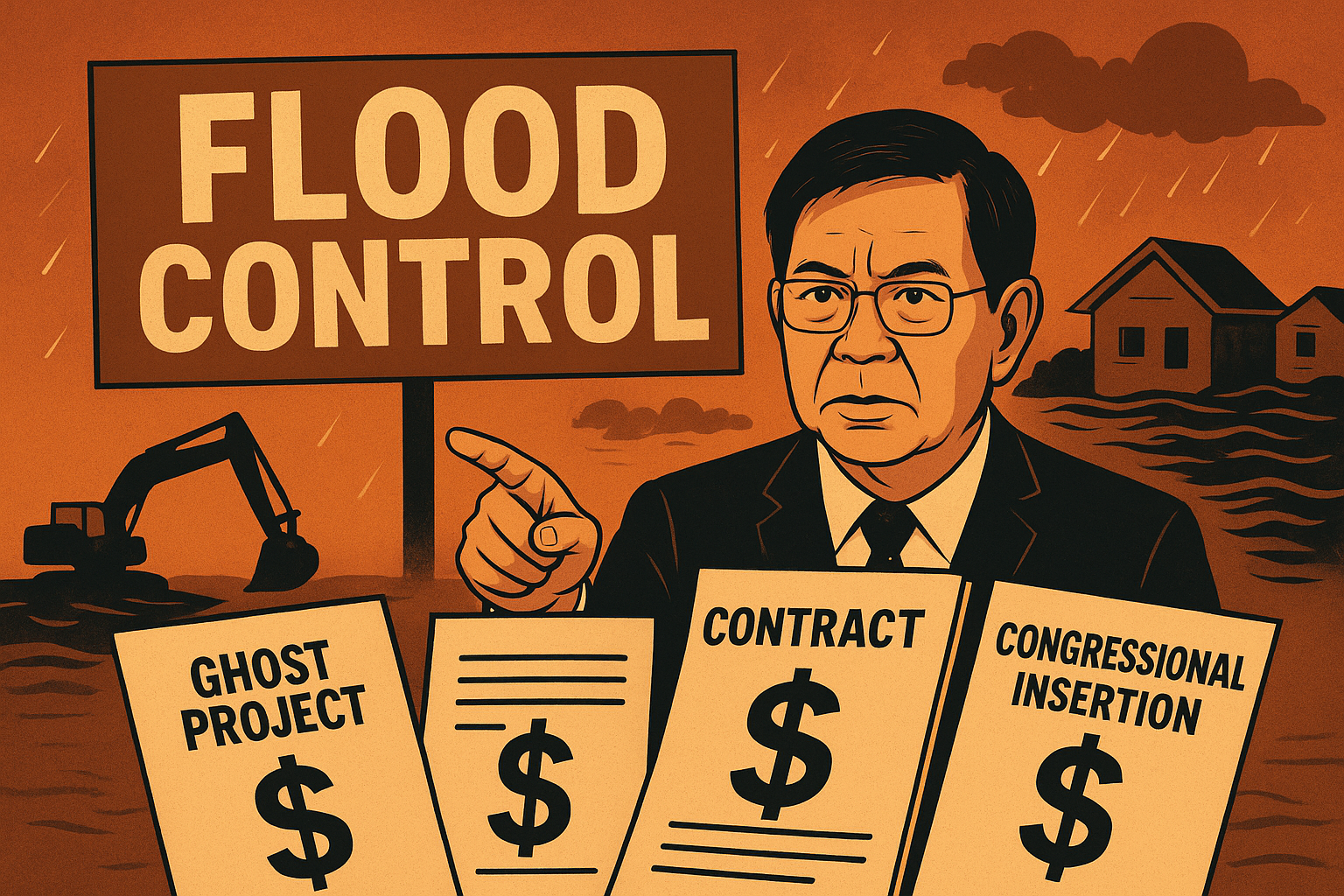

As floodwaters continue to swallow communities year after year, a different kind of deluge has come to light: the steady flow of public funds into ghost projects, political insertions, and questionable contracts.
Senator Panfilo Lacson, in a privilege speech at the Senate on Wednesday, warned that flood control has become one of the country’s most lucrative but most abused budget items — a system he described as “flooded not with solutions, but with greed.”
According to Lacson, insiders at the Department of Public Works and Highways (DPWH), contractors, and even legislators have allegedly built a network of collusion where every project is pre-divided, leaving little for actual construction.
“For the past 15 years, close to P2 trillion has been poured into flood control. Yet every rainy season, the same neighborhoods drown,” Lacson said. “What we have is not water control but wealth control.”
The money trail
Lacson detailed how a P100-million project could be carved up:
- 18% goes to taxes, bonds, and insurance
- 8–10% for contractors’ profit
- 6% or more for DPWH district engineers
- An additional 2–3% for engineering offices
The result, Lacson explained, is a pre-determined “prescription” where the contractor’s role is simply to execute what has already been agreed behind closed doors — often using substandard materials.
The cost of corruption
The senator presented examples of collapsed or redundant projects, including a slope protection wall along the Pampanga River that was funded repeatedly but failed within years, requiring repairs that cost nearly ten times the original budget.
In Oriental Mindoro, one district cornered over half of the province’s 2025 flood control funds, only for its towns to remain underwater during heavy rains.
“This is the cruel irony: billions spent, communities still devastated,” Lacson said.
Beyond infrastructure: A governance crisis
While President Ferdinand Marcos Jr. recently flagged “ghost projects” in his State of the Nation Address, Lacson’s revelations underscore a deeper crisis — that public works have been converted into political currency. Congressional insertions, he said, inflate budgets for projects that either underperform or do not exist at all.
Lacson urged both whistleblowers and honest officials within DPWH to come forward, promising protection.
“The Filipino people deserve more than flood control — they deserve greed control,” he stressed.
What comes next
Calls are now mounting for a full-scale audit of the DPWH’s flood control spending. Civil society groups and local residents alike are demanding not just transparency but accountability, as lives and livelihoods remain at risk every monsoon season.
For many Filipinos, the question has shifted from where the money went to whether trust in government infrastructure can still be rebuilt.