
By Liza Agoot
BAGUIO CITY – The Kalinga provincial government is stepping up preparations for worsening dry conditions, directing local agriculture offices to intensify information campaigns and help farmers adjust to the expected impacts of El Niño.
“It is important for our farmers to know what El Niño is so they can be properly guided on what to do and what to plant, preventing possible losses,” Gov. James Edduba said in a message Wednesday.
Edduba directed the Office of the Provincial Agriculturist to meet with city and municipal agriculture officers and concerned national government agencies to assess conditions on the ground and coordinate timely assistance for affected and at-risk farmers.
Provincial Agriculturist Nancy Aowat said at least 2,840 farmers had been affected as of June, with 4,142.13 hectares of agricultural land damaged and estimated production losses of 5,842.74 metric tons.
Corn and high-value crops at both vegetative and reproductive stages were among those affected, she said.
The Department of Agriculture in the Cordillera Administrative Region (DA-CAR) is advising farmers to shift to short-maturing or drought-resistant varieties, adjust planting schedules and practice rotational irrigation. Early sowing in October and November is also encouraged to take advantage of residual soil moisture before the peak of the dry months.
The provincial government and partner agencies are providing interventions including solar-powered irrigation systems, pump engine sets, seeds, small water impounding projects, cisterns and small farm reservoirs.
Other measures include rainwater harvesting, crop diversification, crop insurance and the prepositioning of seeds and fertilizer.
Aowat urged farmers to monitor government advisories and adopt water-saving and climate-resilient farming practices. Rain-fed upland farms and tail-end irrigated areas are expected to be particularly vulnerable as dry conditions persist.
The provincial agriculture office said the latest outlook from the Philippine Atmospheric, Geophysical and Astronomical Services Administration points to worsening conditions in the coming months, with below-normal rainfall expected to reduce soil moisture.
The agency expects the strongest effects of the dry spell from November to December, followed by potentially severe drought conditions from January to March.
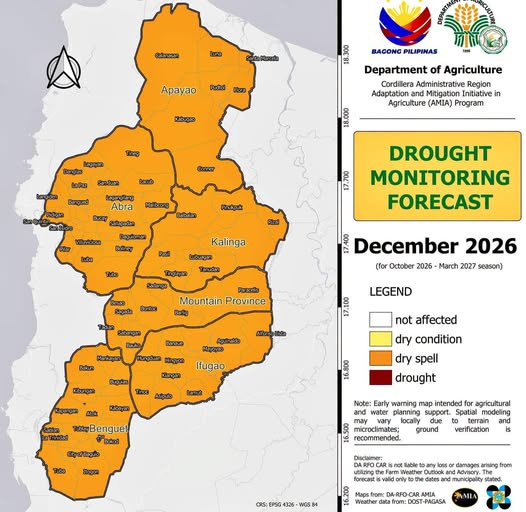
The DA said the Cordillera remains under dry conditions in October but is expected to progress to dry spell in November, except for Baguio City and Benguet province, which are expected to remain under dry conditions.
By January, all areas in the region except Baguio and Benguet are expected to be under dry conditions, while the entire region could experience drought in February and March, according to DA.
The provincial agriculture office will continue monitoring conditions and providing information to help farmers make decisions on planting and other farm activities. (PNA)
DROUGHT. The Department of Agriculture-Cordillera Administrative Region reminds farmers to prepare for declining rainfall and worsening dry conditions. Most areas in the region, except Benguet and Baguio City, are expected to experience dry conditions by November.