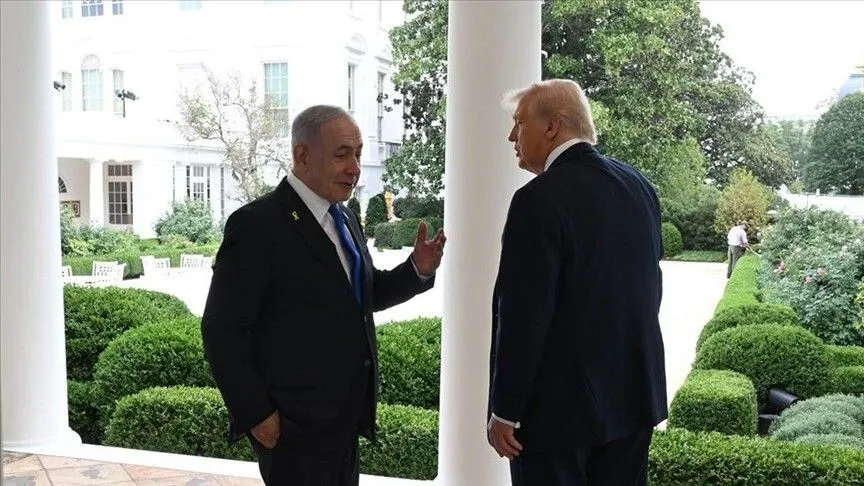

(Photo courtesy of Anadolu)
ISTANBUL – Israeli defense and finance officials are scrambling to assess how the country will finance existing weapons purchases and replenish military supplies after US President Donald Trump announced plans to terminate American aid to Israel by the end of 2026.
The announcement has raised concerns over Israel’s ability to fund fighter jets already on order and replace ammunition and military equipment depleted during three years of conflict, Israeli media reported Tuesday.
In an interview with Fox News, Trump said Washington provides approximately $4 billion in annual assistance to Israel and claimed he had reached an agreement with Israeli Prime Minister Benjamin Netanyahu months earlier to discontinue the funding.
“We won’t be paying any more to Israel,” Trump said, while clarifying that the United States would continue selling weapons to Israel and provide assistance if necessary.
Defense budget faces potential shortfall
According to Israel’s Channel 12, the Finance Ministry was unaware of the decision until Trump’s public announcement.
The government had reportedly expected $3.8 billion in annual US military assistance to help finance defense spending in 2027 and 2028.
A senior Israeli defense official told public broadcaster KAN that the announcement came as a surprise despite ongoing discussions between Israeli and American authorities.
The official said defense agencies had not yet received formal details of the decision and would need to evaluate its potential consequences.
The development came just two weeks after an Israeli Defense Ministry delegation visited Alabama on October 20 to discuss future military purchases with officials from the US Army Security Assistance Command.
KAN economic commentator Shaul Amsterdamski warned that an immediate suspension of assistance beginning in January could create an annual defense funding gap of approximately 12 billion shekels, equivalent to $3.8 billion.
He said Israel could address the shortfall through tax increases, reductions in government spending or stronger economic growth that would generate additional revenue.
However, Amsterdamski considered higher taxes the most likely option.
Fighter jet purchases face uncertainty
Israeli officials involved in security discussions with Washington are also seeking clarification on how existing contracts for fighter jets and other military equipment would be financed.
Channel 12 reported that authorities are examining whether the funding cutoff would take effect immediately at the end of the year or be implemented gradually under a revised defense cooperation arrangement.
Questions have also emerged over the currency Israel would use to settle payments for weapons already ordered.
Under a 10-year memorandum of understanding signed in 2016, the United States committed $38 billion in military assistance to Israel through 2028.
Both countries began formal negotiations in May on a successor agreement, but the implications of Trump’s announcement for existing commitments and future defense cooperation remain uncertain.
Military equipment strained by years of conflict
Meanwhile, Israeli newspaper Maariv reported that three years of sustained military operations have placed significant pressure on Israel’s defense equipment and ammunition reserves.
According to the report, the Israeli Air Force accumulated flight hours equivalent to approximately nine years of normal peacetime operations, accelerating aircraft wear and increasing maintenance requirements.
The country’s armored forces also reportedly used thousands of engines for tanks and armored personnel carriers during the same period.
Maariv further reported that Israel’s military consumed ammunition over the past three years at levels comparable to its total usage during the preceding three decades.
The newspaper warned that losing US military assistance could complicate efforts to rebuild ammunition stockpiles, maintain aging equipment and meet financial obligations for weapons already purchased.
Israeli authorities are now awaiting further clarification from Washington as they assess the potential impact on defense spending, military procurement and long-term security cooperation between the two countries.