
(Photo courtesy of Romy Gonzales)
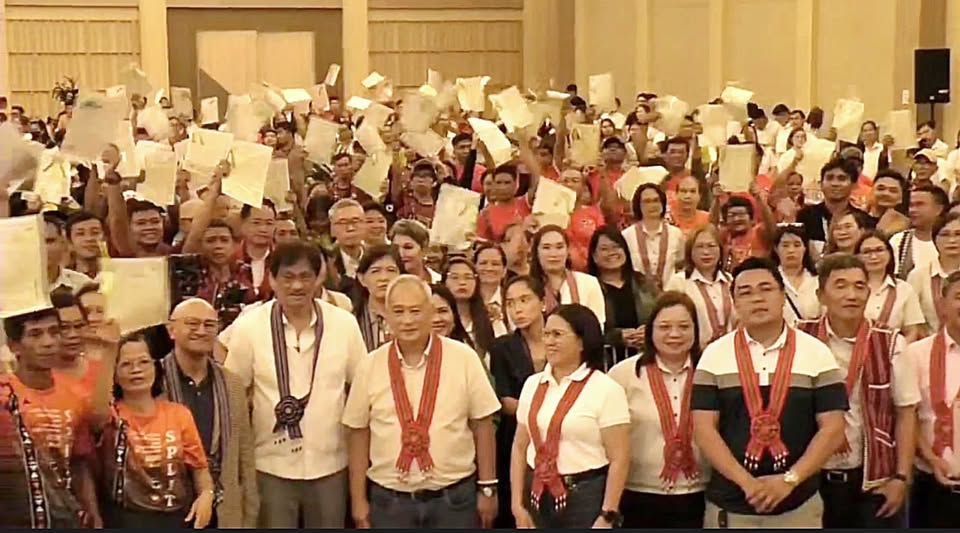
BAGUIO CITY – The Department of Agrarian Reform (DAR) has distributed land titles covering 7,050.14 hectares to 7,206 agrarian reform beneficiaries across the Cordillera Administrative Region (CAR), ending years of waiting for thousands of farmers and landowners.
During a distribution ceremony in Baguio City on Tuesday, DAR Secretary Conrado Estrella said some beneficiaries had waited more than 20 years to secure legal ownership of the land they cultivate or occupy.
“The time has come when your waiting ends. The title you have been waiting for will be distributed today,” Estrella said in Ilocano.
The distribution forms part of the government’s continuing agrarian reform program, which President Ferdinand Marcos Jr. highlighted during his 2026 State of the Nation Address.
Marcos earlier directed the DAR to accelerate the issuance of land titles to qualified beneficiaries, particularly farmers.
Estrella said the beneficiaries would also be relieved of unpaid land amortizations, fees, charges and surcharges under Republic Act 11953, or the New Agrarian Emancipation Act, which took effect in July 2023.
“The payables have been removed. You are getting your titles for free. You will no longer pay anything,” he said.
According to the DAR, approximately 7,400 individual land titles are ready for distribution through its provincial offices in the six Cordillera provinces.
Of the reported 7,206 beneficiaries, 3,699 are from Abra, 200 from Apayao, 1,295 from Benguet, 1,237 from Ifugao, 405 from Kalinga and 564 from Mountain Province.
Apart from the land titles, the agency also issued certificates authorizing the release of funds and the start of construction of a farm-to-market road in Kiangan, Ifugao, to improve agricultural accessibility and support local farmers.
“We hope that with these, the farmers’ condition will further improve,” Estrella said.
DAR encourages youth to pursue agriculture through filmmaking
Meanwhile, Estrella emphasized the importance of attracting younger generations to agriculture through the DAR’s Pelikula Agraryo program, which encourages college students to tell stories about farming and rural communities through filmmaking.
He expressed concern over the aging population of Filipino farmers, noting that their average age has increased over the past decade.
“Ten years ago, our farmers were in their 50s. Now, they are in their 60s. We want the youth to appreciate farming and livestock raising so they will engage in these activities,” Estrella said.
Now in its second year, the regional filmmaking competition featured renowned Baguio-based filmmaker Kidlat Tahimik among its judges.
Estrella said encouraging young Filipinos to pursue farming and livestock production is essential to strengthening food security and reducing the country’s reliance on imported agricultural products.
“If the youth see their importance in food production, they might be enticed to engage in agriculture, which will help ensure food sustainability,” he added.
Recognizing the financial and logistical challenges of filmmaking, Estrella announced plans to double the competition’s prize money next year and provide additional subsidies to participating students.
The 2026 competition attracted at least nine entries in the Agrarian Reform Beneficiary (ARB) category and four entries in the ARB Stories of Cooperation, Enterprise and Community Aspirations category.
Winners were also recognized during Tuesday’s event.