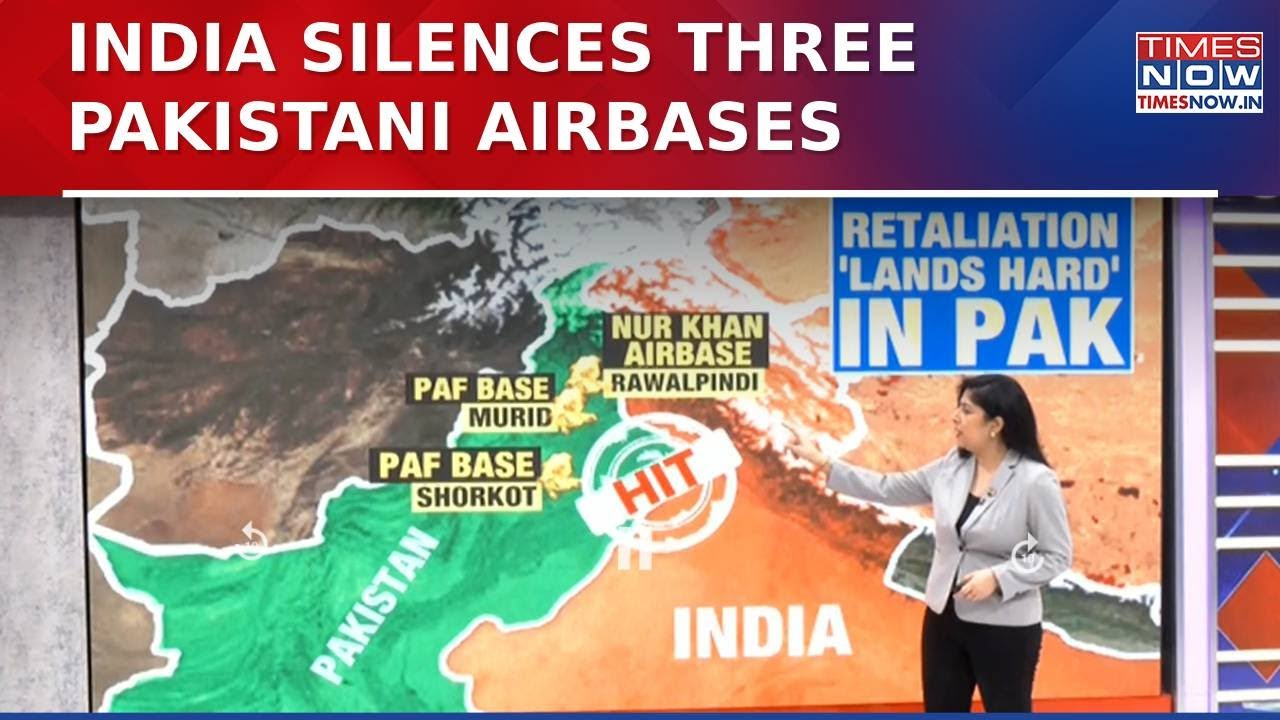

ISLAMABAD/NEW DELHI — A dangerous new phase in the long-standing hostilities between India and Pakistan unfolded Saturday, as both countries exchanged missile fire in what analysts are calling the most serious escalation in years between the nuclear-armed neighbors.
Pakistan accused India of launching a wave of missile strikes on three of its air bases early Saturday, triggering immediate retaliatory action. Pakistani military officials said their response targeted key Indian defense installations, including an ammunition depot and two airbases.
“This is not just a flare-up—this is a calculated provocation,” said Pakistani military spokesperson Lt. Gen. Ahmad Sharif, claiming that Pakistan intercepted most of the incoming missiles. He added that remnants of Indian missiles landed inside India’s eastern Punjab state, implying technical failures in the attack.
India has not yet publicly responded to Pakistan’s claims, and no independent confirmation of the missile strikes has been made.
The hostilities come just weeks after a deadly terrorist attack at a popular site in Indian-administered Kashmir that killed 26 civilians, most of them Indian tourists. India has blamed Pakistan-based militants for the assault—an allegation Islamabad has denied.
The Pakistani military reported launching Fateh medium-range missiles at Indian targets in Pathankot and Udhampur. Indian-controlled Kashmir residents described hearing loud blasts overnight, stoking panic in several cities.
“The sounds we heard were different from the previous drone strikes,” said Shesh Paul Vaid, former police chief in the region. “It feels like we’re in the middle of a full-scale war.”
Local residents in Srinagar and Jammu, cities in the disputed Kashmir region, said they were awakened by the sounds of jets and explosions. “My children were terrified. We heard at least two big blasts near the airport,” said Mohammed Yasin, a Srinagar local.
While India has not issued a formal statement on the incident, its army confirmed earlier that multiple armed drones originating from Pakistan were neutralized over military zones in northern Punjab. “This is a gross violation of our airspace and a threat to civilian lives,” a statement from India’s Ministry of Defence said.
Meanwhile, Pakistani media reported that Prime Minister Shehbaz Sharif convened an emergency meeting of the National Command Authority, which oversees the country’s strategic weapons program. Civilian airports across Pakistan were shut down, and crowds gathered in cities like Lahore to express support for the military.
Global powers are closely watching the unfolding crisis. U.S. Secretary of State Marco Rubio held a phone call with Pakistan’s Army Chief, urging restraint. The U.S. State Department reiterated calls for de-escalation, warning that “continued exchanges could lead to an uncontrollable spiral.”
“This is a crisis with no clear endgame,” said Praveen Donthi, a senior South Asia analyst with the International Crisis Group. “Neither side appears interested in backing down, and civilian populations are increasingly caught in the middle.”
Experts warn that even if a formal war hasn’t been declared, the situation may already qualify as an undeclared conflict—one driven by political pressure, rising nationalism, and an absence of diplomatic engagement.
In a sign of how volatile the situation has become, Indian authorities reported drone sightings in more than two dozen locations in the past 24 hours. Security forces remain on high alert.
As both countries continue to flex their military capabilities, the international community remains deeply concerned. The potential for a wider regional conflict is now higher than it has been in years.