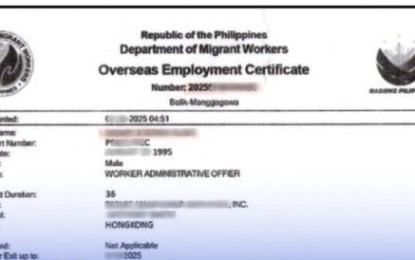

The Overseas Employment Certificate (OEC) is a requirement set by the Department of Migrant Workers (DMW) for overseas Filipino workers (OFWs) departing the country for employment abroad. The Bureau of Immigration (BI) said Saturday (Sept. 6, 2025) it is implementing the OEC requirement in accordance with the policies of the DMW, to ensure proper documentation and the protection of OFWs. (Image from BI)
The Bureau of Immigration (BI) on Saturday clarified that the Overseas Employment Certificate (OEC) is not an added airport hurdle but a requirement set by the Department of Migrant Workers (DMW) to safeguard overseas Filipino workers (OFWs) leaving for jobs abroad.
The statement came after a viral video showed a child at the airport whose mother was unable to board her flight for allegedly failing to present a working visa and an OEC.
According to BI Commissioner Joel Anthony Viado, immigration officers simply enforce the OEC policy under the DMW, which ensures that all departing OFWs are properly documented.
“Filipinos traveling abroad on employment visas are required to present a valid OEC, while those on dependent visas are not required to secure the said document,” Viado explained. “This process ensures the protection and welfare of our migrant workers.”
Republic Act 11641, or the Department of Migrant Workers Act, mandates the issuance of an exit clearance to confirm that OFWs are legally documented. The OEC also provides exemptions from travel tax and terminal fees, easing costs for workers.
The BI reminded travelers that OEC requirements vary depending on visa type and advised OFWs to secure the document ahead of time to avoid travel disruptions.
To further assist migrant workers, the government recently opened a dedicated OFW wing at Ninoy Aquino International Airport (NAIA) Terminal 3, designed to streamline departure processes and improve convenience for OFWs.